.svg&w=384&q=75 "logo")
Vande Mataram Debuts at T20I Match in New Delhi
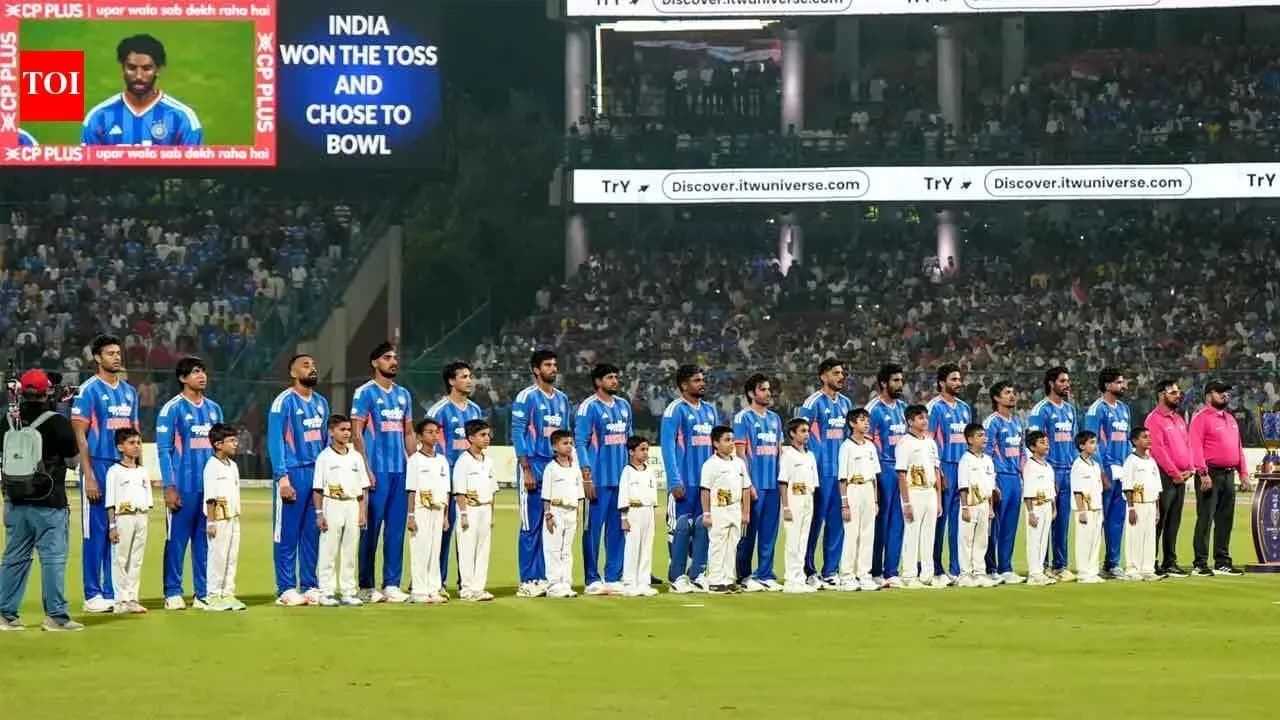
The floodlights were on, the stands were filling, but before a ball was bowled in New Delhi on Sunday, the Arun Jaitley Stadium witnessed something it had never seen on an international cricket night.
For the first time, India’s National Song, Vande Mataram, was sung before an international match, ahead of the opening T20I between Afghanistan and India. Both teams lined up, shoulder to shoulder, as the familiar notes rolled across the ground. Only after the final stanza faded did Jana Gana Mana begin.
On a circuit that has seen World Cups, IPL finals and countless high-pressure evenings, this was a different kind of occasion. A ceremonial shift. A moment where cricket paused and the tricolour took centre stage.
Vande Mataram takes the field
The move followed a Ministry of Home Affairs notification issued earlier this year, which set out formal protocols for the National Song. The directive, dated January 28, specified that all six stanzas of Vande Mataram should be sung at official functions — a rendition that runs for about 3 minutes and 10 seconds.
The ministry also identified the types of events where Vande Mataram must be sung alongside the National Anthem. Sporting events were not on that list. Yet in Delhi, ahead of this three-match T20I series, the two pieces were given equal space, back to back, on an international cricket stage.
The pairing of Vande Mataram and Jana Gana Mana in full had previously marked a major national moment on August 15, 2026, when they were sung together after Prime Minister Narendra Modi’s Independence Day address. On Sunday, that symbolism travelled from the Red Fort to a cricket outfield.
Once the last note ended, the noise returned. The players broke formation, the warm-ups resumed, and the evening swung back towards cricket.
India choose the chase, Bumrah returns
At the toss, India captain Shreyas Iyer wasted no time. He chose to bowl.
“We are going to bowl first. Whenever you come to Delhi, you know what the pitch has got to offer; it usually is a bowl-first wicket,” he said, explaining a decision that felt in tune with the venue’s reputation for skiddy evenings and chasing sides.
The more eye-catching news, though, stood at the top of his bowling plans. Jasprit Bumrah, India’s premier quick, returned to the T20I XI for the first time since IPL 2026. For a format that can turn on one over, his presence instantly altered the tone of the contest. As Iyer put it, “We know Bumrah is a match-winner.”
India arrived with confidence from the Zimbabwe T20I series, a tour that had allowed them to test depth and blood new faces. Iyer referenced those “positives” and made it clear the template from that trip would be carried into this higher-profile assignment.
Vaibhav misses out as India tweak the mix
One of the standout performers from Zimbabwe, Vaibhav Sooryavanshi, did not find a place in the XI. The youngster’s omission will raise eyebrows, given his recent form, but India opted for a different balance in Delhi.
Sanju Samson came in, taking the gloves and a batting slot, with Iyer confirming at the toss: “Vaibhav is not playing, Washington is not playing, and two more.” The message was blunt — this is a rotation phase, and even impressive recent returns do not guarantee continuity.
India, interestingly, are the designated away side for this series, with Afghanistan listed as the official home team despite all matches being staged in Delhi. On paper, it is Afghanistan’s home campaign. In the stands, it felt very much like an Indian night.
XIs locked in for a high-intensity opener
India’s final combination underlined their intent: batting depth, variety in spin, and Bumrah to spearhead the pace attack.
India XI: Sanju Samson (w), Abhishek Sharma, Ishan Kishan, Shreyas Iyer (c), Tilak Varma, Nitish Kumar Reddy, Shivam Dube, Axar Patel, Arshdeep Singh, Jasprit Bumrah, Varun Chakaravarthy.
Afghanistan answered with a side built around their familiar core of power-hitters and world-class spin.
Afghanistan XI: Ibrahim Zadran (c), Rahmanullah Gurbaz (w), Sediqullah Atal, Darwish Rasooli, Azmatullah Omarzai, Gulbadin Naib, Mohammad Nabi, Rashid Khan, Mujeeb Ur Rahman, Noor Ahmad, Fazalhaq Farooqi.
On one side, a returning pace ace and a captain talking up continuity. On the other, a team that has turned “home” into a flexible concept, carrying their identity across borders and venues.
The anthem and the National Song had set a charged, almost ceremonial tone. Now the question shifts to the pitch: in a series that already feels symbolically loaded, who seizes the first real cricketing moment?