.svg&w=384&q=75 "logo")
The Tragic Death of Arjun Menon: A Family's Fight for Justice
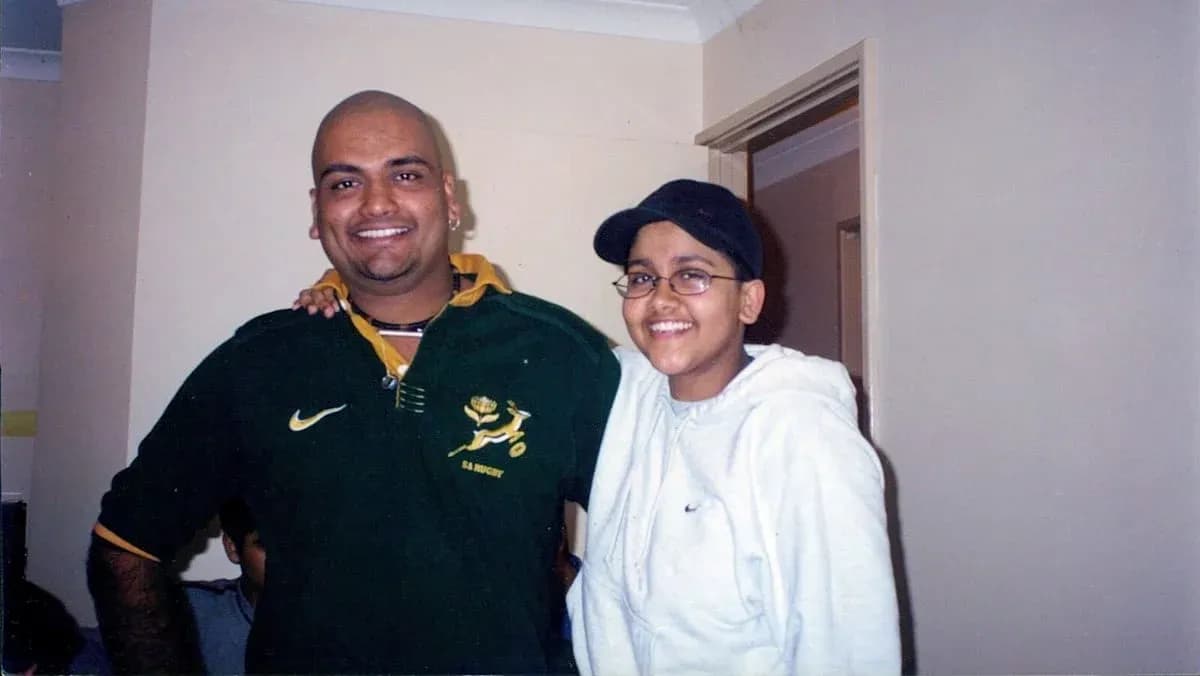
The Sunday morning that shattered everything began like any other.
Prema Menon, back in Singapore on a visit, was in the car with her family, heading to a house viewing. The phone rang with an unfamiliar country code. They let it ring out. It rang again. And again.
Her younger sister finally picked up.
On the other end, from Blantyre in Malawi, came a scream that would redraw the rest of their lives: Arjun is dead.
The world knew Arjun Menon as a coach, a former Singapore international who helped guide his country to SEA Games gold in 2017 and later took on the task of lifting cricket in Malawi. To his older sister, he was still the “cool kid” from Neptune Court, the eldest of three, the boy who played with her in the corridors and lived by a simple rule: never punch down.
He was 48 when unknown assailants killed him at his home in Blantyre, the country’s second-largest city. His car and wallet were taken. His family has been trying to make sense of the rest ever since.
A family scattered, a call that pulled them back
The Menon siblings had grown into adulthood like “orbiting satellites”, as Prema puts it. She built a life in Australia, working in the non-profit sector in Melbourne. Arjun moved to Africa and settled in Malawi in 2020, drawn by the chance to build something in a place he loved. Their younger sister stayed in Singapore.
They spoke, they visited, but they lived on different continents, in different time zones. The call in May 2025 collapsed that distance in an instant.
“I was just in shock,” Prema recalled over a Zoom call from Melbourne. “My father used to say the biggest curse is losing your child, and all I could think of was my parents. I didn't really care about myself.
“I was just like, what am I gonna do? My parents have lost their child. How do we come back from this?”
More than a year later, that question hangs in the air. The grief is raw. The answers are scarce.
A journey to Malawi, and a wall of silence
Within days of the call, Prema was on her way to Malawi, an 18-hour journey from Singapore to a landlocked country she barely knew, determined to bury her brother and understand what had happened to him.
All she had at the start were fragments: attacked around 2am, car and wallet missing. Her father, who spoke to Arjun every day, was adamant the killers must have been strangers. His son, he said, was “very well loved in the community”. Arjun had never spoken of threats. He felt safe. He adored the place.
Prema stayed in Malawi for about 10 days. She laid her brother to rest in the country he had chosen as home. She tried to navigate a foreign system in the midst of shock and ritual and loss.
With no local network, the family leaned on the president of Cricket Malawi, where Arjun had worked as head of cricket operations, to communicate with police. The updates, when they came, were numbing in their sameness.
“They’re still investigating.”
That line, repeated for months, became the refrain of the case.
The family turned to Singapore’s Ministry of Foreign Affairs for help. But Singapore has no diplomatic presence in Malawi, and the nearest embassy sits in South Africa. MFA can liaise with foreign authorities and provide undertaker contacts; it cannot investigate a death overseas, give legal advice, or file a police report for a family.
Prema contacted the Singapore Police Force and several Members of Parliament, hoping someone, somewhere, could push the case forward.
The Singapore Police Force said it had reached out to authorities in Malawi and would assist within the bounds of Singapore law if a formal request arrived. As of Aug 31, no such request had come from Malawi. Malawi police did not respond to repeated queries. MFA declined to comment.
The family, spread over three countries, was left to chase shadows.
Grief on pause, then a slow, painful restart
In December, another blow.
Around six months after Arjun’s death, the Menons lost their mother. Prema, already exhausted by the administrative grind of chasing updates across borders, stepped back from the search.
The pause did not bring peace. It simply delayed the next round of calls and emails.
By July, she picked it up again. This time, she went directly to Malawian officers. One officer told her he had sent a report to the embassy months before. When she eventually received it through MFA, the date told a different story: it had gone out on Jul 31, after her call.
The report itself contained nothing new. Just that familiar line: police were still investigating.
In August, a flicker of movement. A new investigating officer told her that CCTV footage and call logs had been reviewed, but no leads had emerged. It was not the breakthrough she wanted. It was, at least, proof the file hadn’t been abandoned in a drawer.
It also underscored how much of the effort had been driven from Melbourne and Singapore, not Blantyre.
The family had formally identified themselves to Malawi police through MFA. Yet most updates came only when Prema pushed. She spoke of the difficulty of navigating an unfamiliar system without contacts, of not knowing which office or department held the next piece of information.
“I just think we need help,” she said. “There's something missing here to get us to the next stage, and I don't think a private citizen can do it on their own.”
Turning to the public, and to memory
In July, Prema did something she never imagined she would have to do: she took her search public.
On Instagram, she began documenting the case, the gaps, the unanswered questions. It was part pressure campaign, part handbook for anyone who might find themselves in the same nightmare.
“Right now, if you're unlucky enough to lose someone in a country without a Singapore embassy ... you figure it out as you go, through calls, emails, and a lot of trial and error, the same way I did," she wrote.
She sees a structural problem, not a single point of failure. More Singaporeans are living and working in countries where their home state has no direct diplomatic footprint. When tragedy hits, families stumble through an improvised process that depends heavily on persistence, timing and luck.
The Instagram page became more than an advocacy tool. It became a way to grieve.
“He was there from the very beginning. He's my first friend, your sibling,” she said. “It's very different from the loss of my mum because a loss of a sibling is like losing a part of your body. Like it's no longer there.”
The posts opened a floodgate. Messages poured in from people who had played with Arjun, worked with him, been coached by him. Some sent five-minute voice notes. Others wrote long accounts of how he had changed their lives.
The stories painted a picture that statistics and job titles never could: a man who loved fiercely, felt deeply, and tried to lift everyone around him.
A legacy on the field and beyond
At the end of August, those stories took physical form on the turf of the Singapore Cricket Club, where friends organised a charity cricket and football tournament in his honour.
By Sep 14, the event had raised more than S$13,000 on Give.Asia. Most of the proceeds will go to Maoni Orphanage in Malawi and the Vivekananda Cultural Centre in Singapore, a nod to the two places that framed his later life.
On paper, Arjun’s sporting CV is impressive enough. A former Singapore international. A coach who guided his country to SEA Games gold in 2017. A man who moved to Malawi not for glamour or money, but to grow a game in a place where resources are thin and passion has to do the heavy lifting.
But Prema wants people to remember something deeper than medals and job titles. She talks about his values, his refusal to punch down, his ability to befriend almost anyone, his dream of buying a farm for retirement, shared once with their father.
“Hindus, we believe that when your time is up, when your purpose is done in this world, you'll be called back. That's how we view it,” she said.
“Sometimes I like to believe that, but when I hear these stories, it's very hard to believe because I feel like he has so much more to do.”
Love for a country, and a question that will not go away
Arjun chose Malawi. He invested his energy, his expertise, his future there. He loved the place. His family repeats that often, as if to anchor the story in something other than violence and bureaucracy.
That is why the silence around his death cuts so sharply.
“Lastly, my hope is that as much as Arjun loved Malawi, I hope some of that love is returned,” Prema said. “For his death to go unanswered in a country he loved so much, I feel is a very sad way to end things.”
The investigation, officially, is still open. Files are being reviewed. CCTV has been checked. Call logs have been examined. Somewhere in Blantyre, there is a case number with his name on it.
For a sister in Melbourne, a father in Singapore and a community spread across continents, that is not enough. They want someone to answer for what happened in the early hours of that May morning.
Until then, the question lingers, heavier with each passing month: how long can a family wait for justice in a place their son gave so much to, and what does it say if the answer never comes?