.svg&w=384&q=75 "logo")
Towhid Hridoy Rewrites Bangladesh's First-Class Record with Unbeaten 350
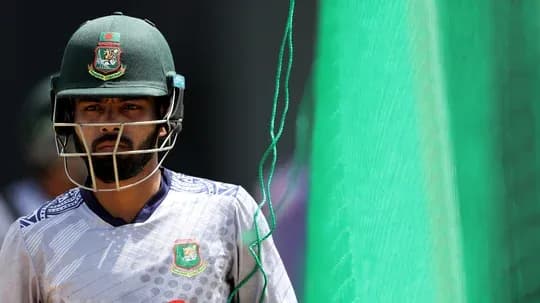
Potchefstroom has always meant something to Towhid Hridoy. It is where he lifted the ICC Under-19 World Cup in 2020. Now it is the ground where he has rewritten Bangladesh’s first-class record books.
Drafted into the Bangladesh A squad almost as an afterthought, Hridoy walked out in South Africa and produced an unbeaten 350 against South Africa A – the highest first-class score by a Bangladeshi batter, eclipsing Tamim Iqbal’s 334* and Raqibul Hasan’s 313*. He did it at a venue that already carried his happiest cricketing memories. It now carries his loudest statement.
From stand-by to centre stage
He was not meant to be the headline act of this tour. Injuries and visa complications forced the selectors’ hand, prompting a late reshuffle that saw Hridoy, Nurul Hasan, Rishad Hossain and Mohammad Saifuddin sent to South Africa to bolster the A-team ranks. It was a patch-up job, a move to make sure there were enough cricketers on the plane.
So when Hridoy spoke to reporters at the airport in Dhaka, there was no grand talk of Test redemption or four-day domination. He barely mentioned the red ball. His eyes were on something else.
“The preparation is very important and as we have a national team tour and the World Cup (ODI), will try to prepare for it,” he said before boarding, framing the A tour as a chance to understand South African conditions ahead of a white-ball series against the Proteas and next year’s ODI World Cup.
This was supposed to be a tune-up. Not a takeover.
A Test dream bruised, not broken
The lack of Test talk was not accidental. Hridoy’s relationship with red-ball cricket at the highest level has been brief and brutal. He waited more than three years after his white-ball debut to finally break into the Test side, only to be discarded after just three days of Test cricket – a solitary appearance in whites in the second Test against Zimbabwe in Harare, where he failed to make a mark.
His selection back then divided opinion. Some felt he had been rushed into the format. Others questioned whether his technique, so fluent in limited-overs cricket, could truly stand up to the longer game. Very few argued loudly for his continued presence in the Test team.
The selectors have long maintained that breaking into the national side is hard, but once in, a player will receive enough chances to prove himself in any format. Hridoy’s experience cut straight across that narrative. One game, one failure, and the door slammed shut.
No wonder he has grown wary of talking about Test ambitions. The scars are still fresh.
A triple hundred, and a question for the selectors
In Potchefstroom, that reluctance may have helped him. Freed from the weight of chasing a Test recall, Hridoy batted like a man with nothing to lose and everything to show. Ball by ball, session by session, he turned a routine A game into a landmark performance, becoming only the third Bangladeshi to score a triple hundred in first-class cricket.
The innings was not just long. It was loud. It demanded attention from those who had doubted his red-ball credentials, and from those who had quietly moved on from his name when drawing up Test squads.
When asked after the game about what this meant for his red-ball future, Hridoy did not bite. He stayed firmly in the lane he has chosen for now.
“This is not entirely my call, as a professional player I always want to do well, I have said this on many occasions before, how many matches I will play for the national team will depend on the selectors, if I get the opportunity I will try to do well,” he said.
No campaigning. No pleading. Just runs on the board and the responsibility pushed back where it belongs – onto the selectors’ table.
The next move
His 350* ensures one thing: Hridoy will be impossible to ignore when Bangladesh’s next Test squad is discussed. This is not the sort of innings that slips through the cracks of a selection meeting. It sits in the middle of the table and stares back.
Yet the real challenge for Bangladesh cricket is not simply finding a place for him in a Test squad. It is convincing him, and the dressing room, that this time will be different. That a batter who has just produced the highest first-class score by a Bangladeshi will not be judged on a single failure and discarded again.
For now, Hridoy appears unburdened by those questions. His apparent indifference to red-ball politics has turned into a blessing in disguise, allowing him to bat with a freedom that many lose once the word “Test” enters the conversation.
He has done what players are always told to do: score so many runs that no one can look away. The next move is no longer his.