.svg&w=384&q=75 "logo")
Pakistan Cricket's Structural Chaos: A Deep Dive
Pakistan cricket has known chaos before. This is different. This feels structural.
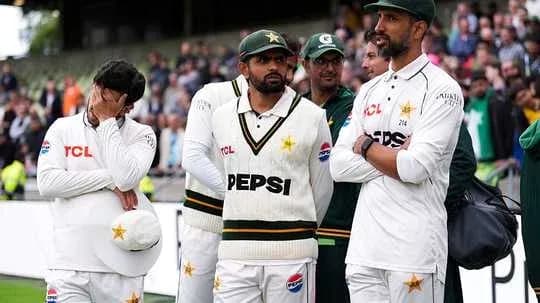
A 3-0 hammering in England in 2026 – defeats by an innings and 103 runs, 194 runs and eight wickets – was not just another bad tour. It was England’s second clean sweep of Pakistan in four years, after 2022-23. It was also Pakistan’s 11th series loss by a 0-3 margin, their sixth whitewash in 12 multi-Test series over the last four years, and their ninth 0-3 defeat in a three-Test contest this century – more than any other side, with Sri Lanka next on five.
The numbers paint a bleak picture. The reaction has been even more telling.
Firefighting, not planning
The moment the series was lost at Lord’s, the Pakistan Cricket Board reached for the axe. Head coach Sarfaraz Ahmed was sacked. Bowling coach Umar Gul followed. Seven players were sent home. White-ball coach Mike Hesson was handed the Test side as well.
It was dramatic. It was also familiar.
Former Test coach Jason Gillespie had already questioned the PCB’s frequent U-turns, and this was another one in a long line. Selection, structure, long-term vision – all back under the microscope. Pakistan remain a side capable of flashes of brilliance, but almost allergic to sustained success, especially in Test cricket and major tournaments.
The churn is relentless. Since the start of the second World Test Championship cycle in August 2021, Pakistan have played 37 Tests. They have named an unchanged XI just three times – in Dhaka in 2021, in Colombo in 2023 and in Rawalpindi in 2024. They won all three and sealed each series.
They have not learned from that.
Across those 37 Tests, Pakistan have used 43 players. After the first XI, 32 more cricketers were cycled through the next 36 matches – almost a new player every Test. Among WTC teams, only South Africa have turned over more, and that is skewed by the second-string side they sent to New Zealand during the SA20.
No specialist bowler has featured in more than 18 of those 37 Tests. Noman Ali leads that list. Shaheen Afridi, the spearhead of the pace attack, has played just 17. No batter has been ever-present either: Babar Azam has appeared in 33 Tests, Mohammad Rizwan in 32, Salman Agha in 28.
Pakistan have handed out 23 Test caps in this period. Only South Africa (26) and England (24) have more debutants. Thirteen of Pakistan’s new faces have been specialist bowlers. The consequence is obvious: a side in constant flux, denied the continuity needed to build a hardened, coherent Test unit.
A carousel in the dressing room
It is not just the players. The dressing room door has revolved just as quickly.
Since September 2021, when Misbah-ul-Haq and Waqar Younis resigned, Pakistan have rattled through coaches. Saqlain Mushtaq, Grant Bradburn, Mickey Arthur and Mohammad Hafeez all came and went. The PCB then tried a split model in 2024: Jason Gillespie for Tests, Gary Kirsten for white-ball. Both were gone within months.
Aqib Javed stepped in as interim, before Mike Hesson took over the white-ball side in May 2025.
Sarfaraz Ahmed was appointed red-ball head coach ahead of the 2026 Bangladesh Tests. His tenure lasted only a few months. Defeats at Leeds and Lord’s ended it. Pakistan sacked Sarfaraz and Gul, sent seven players home and gave Hesson the Test team as well.
Since May 2023, Pakistan have had seven different Test coaches. Across formats, there have been 11 coaching changes in five years. Shan Masood’s 3-12 record as captain came and went; Babar Azam was reinstated. Every bad result seems to trigger a reset.
Test cricket does not respond well to panic. Systems take time. Pakistan have not allowed any to bed in.
Sliding down the WTC table
The World Test Championship table tells the story of that instability.
In the 2021-23 cycle, Pakistan finished seventh with a points percentage of 38.1%, winning four of 14 Tests. In 2023-25, they slipped to ninth with 27.98%, again five wins in 14. In the current cycle, they sit bottom: just two wins in nine Tests, and a points percentage of 14.81%.
Since the start of the second WTC cycle, Pakistan’s win-loss ratio in Tests is 0.5 – the second-worst among WTC teams. Only West Indies, at 0.4, are below them.
The broader historical marker is even starker. Pakistan’s overall Test win-loss ratio has dipped below 1.0 for the first time since 1987. They now stand at 153 wins and 155 defeats from 474 Tests, a ratio of 0.987.
At home, where strong teams usually build their aura, the slide is brutal.
- South Africa’s home win-loss ratio since 2021-23 is 5.5.
- Australia’s is 5.0.
- England’s 2.2.
- India sit at 2.0, with 14 wins and seven defeats.
- New Zealand and Sri Lanka both stand at 1.43, with 10 victories each.
- Pakistan? Four wins and nine defeats in 17 home Tests. A win-loss ratio of 0.444 – the worst among WTC sides, only ahead of Zimbabwe’s 0.285. Bangladesh (0.727) and West Indies (0.875) are both ahead.
The away record offers no escape. Since August 2021, Pakistan have won seven and lost 13 of 20 Tests on the road. Only England (17) and West Indies (15) have more away defeats in that time. Pakistan’s away win-loss ratio of 0.538 ranks fifth, well behind Australia (2.4), South Africa (1.25), New Zealand (1.125) and India (1.1).
Outside Asia, the drought is now glaring. Since the start of the second WTC cycle, Pakistan have not won a Test outside Asia, barring West Indies. They are winless in their last 19 Tests in SENA countries (South Africa, England, New Zealand, Australia) since 2018, losing 17 and drawing two. The last such victory came at Lord’s in May 2018. No other Asian side has gone that long without a SENA win since 2019.
Batting in freefall
The batting numbers are not those of a heavyweight. They are those of a side permanently under siege.
Since the start of the 2021-23 WTC cycle, Pakistan have been bowled out for under 250 in 32 innings across 37 Tests. Eighteen of those totals were below 200.
On the recent England tour, they were dismissed for under 200 in five consecutive innings before finally crossing 400 in the third innings at Edgbaston. That five-innings sequence – 171, 135, 110, 194 and 133 – was a first in their Test history. Those innings lasted an average of just 41.3 overs.
Across the whole period, Pakistan’s combined batting average is 28.46, sixth among the nine WTC teams. Only South Africa, Bangladesh and West Indies have fared worse. Pakistan’s batters have produced the fourth-fewest centuries among WTC sides in this span.
Even Babar Azam, the side’s premier batter and current captain, has hit a wall in the longest format. He has now gone 40 consecutive Test innings without a century. His last hundred came against New Zealand in Karachi in December 2022.
Seven Pakistan batters have scored 1000-plus Test runs since the start of the second WTC cycle. None averages above 45. Babar tops their charts with 2602 runs at 43.4. Shan Masood, the previous captain, has 1548 at 32.25, ranking sixth among those seven, just ahead of Imam-ul-Haq’s 1380 at 39.42. Rizwan has 1862 runs at 35.8, with only two hundreds – the fewest among the seven.
Across the rest of the WTC landscape, 51 batters have topped 1000 runs in this period. Eleven of them average more than 45. Pakistan’s best are solid, not elite. In a struggling side, that gap is exposed.
Pace legacy, spin reality
For decades, Pakistan’s Test cricket identity was written in seam and swing. Imran Khan, Wasim Akram, Waqar Younis, Mohammad Asif – the script was familiar. Fast bowlers led, spinners supported.
The current era has flipped that script at home.
Since the 2021-23 WTC cycle, Pakistan’s success on familiar pitches has leaned heavily on spin. Noman Ali, Sajid Khan and Abrar Ahmed have prospered with accuracy, attacking fields and surfaces tailored to turn.
The pace numbers are a sharp contrast. Pakistan’s quicks have taken 305 wickets in this period at an average of 32.7 – second-worst among WTC teams, ahead of only Bangladesh. Their strike rate of 55.7 is also the second-worst. Opposition pacers, by comparison, average 27.4 against Pakistan and strike every 48.7 balls.
It is not just that Pakistan’s batters struggle against pace. It is that their own fast-bowling attack no longer intimidates.
Shaheen Afridi remains the standout: 68 wickets in 17 Tests at 26.89, the most by any Pakistan pacer in this stretch. Mohammad Abbas, back in the fold since November last year, is the only other quick with more than 45 wickets. In 10 Tests, he has four five-wicket hauls and 31 wickets at 21.06 in 2026 alone – second only to Josh Tongue’s 33 at 25.67 this year.
Among Pakistan bowlers, only Noman Ali (85 wickets in 18 Tests), Sajid Khan (75 in 14) and Shaheen have more wickets than Abbas in this period, and they have all played more matches.
The spin reliance has been stark in certain series. Against England at home in 2024, Noman and Sajid took 39 of England’s 40 wickets in the final two Tests – the highest haul by a bowling pair in a two-Test series. They claimed all 20 wickets in Multan and all 20 in Rawalpindi. Pakistan’s specialist pacers did not bowl a single delivery in that Rawalpindi Test.
Across that series, spin accounted for 73 wickets, 43 of them to Pakistan’s spinners.
In 2023 and 2024, spin underpinned rare high points. Pakistan beat West Indies in Multan with their spinners taking all 20 wickets, and South Africa in Lahore with 16 wickets to spin. They had earlier claimed 13 wickets in a series win in Bangladesh in 2021. Since then, though, Pakistan have lost two Test series to Bangladesh – one at home in 2024 and one away in 2026.
The pattern extended to the West Indies again, where Noman became the first Pakistan spinner to take a Test hat-trick. Their last away series win, in Sri Lanka in July 2023, was also driven by spin.
Strip away the spin dominance, and the record is stark. Since the start of the second WTC cycle, Pakistan have won 11 of 37 Tests. Nine of those victories came when their spinners took 11 or more wickets in the match, including a 14-wicket haul in the West Indies earlier this year. That win remains their only success in their last 12 away Tests.
A crossroads, not a blip
This is not a bad month or an unlucky tour. The data stretches across cycles, coaches, captains and continents.
Pakistan’s Test team has become a side built on short-term fixes, heavy on turnover and light on stability. The pace attack that once defined them now trails most of their rivals. Their batting, beyond Babar and a small core, does not carry the weight of an elite Test side. Their home record has eroded. Their away record is threadbare.
The spinners keep dragging them back into contests, and sometimes across the line. But how long can a team with Pakistan’s history lean on patches of turn and moments of individual brilliance?
At some point, the question shifts from who should be dropped or which coach should go, to something more fundamental: what kind of Test team does Pakistan actually want to be in this era – and how long are they prepared to stick with a plan to get there?