.svg&w=384&q=75 "logo")
Kevin Pietersen Joins England as Mentor for World Cup
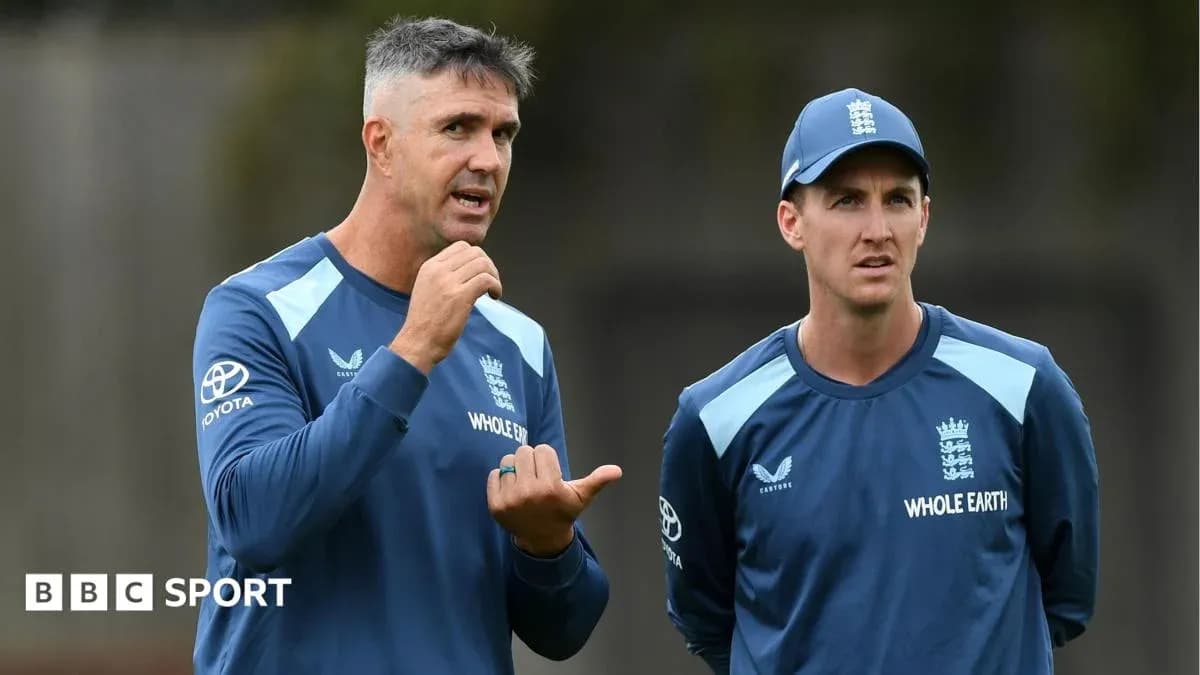
Kevin Pietersen back with England. Not in the middle, but in the dressing room. And that, for all the baggage and history, might be exactly what this one-day side needs.
The news that Pietersen has joined England’s coaching ranks as a mentor in the build-up to next autumn’s 50-over World Cup in South Africa landed with a jolt. His last formal interaction with the ECB was that brutal 2014 meeting at Lord’s, when he was told he’d never play for England again. Since then, his world has been YouTube shows like The Switch, commentary gigs, and a life built well away from the corridors of power at St John’s Wood.
So how has he ended up back inside the tent?
Strip away the noise and it starts to make sense. Those who shared a dressing room with him remember a player whose intensity in practice bordered on obsessive, whose standards could drag others with him, and whose blunt honesty cut straight through the polite murmur of an international squad.
Pietersen never did “gentle” nets. He’d stride in, bat under his arm, and announce he was going to smash you everywhere and not get out. It was part wind-up, part challenge. Bowlers would respond by cranking up their pace, sharpening their lengths, desperate not to let him dominate. Training sessions suddenly felt like mini-Tests, not warm-ups. That edge hardens a team.
Those net battles mattered. Arguments would flare over whether a mis-hit would have gone to hand, or how many runs a shot was really worth with a realistic field. Pietersen wanted more than throwdowns and shadow batting; he wanted competition. He wanted practice to feel like the real thing, because that’s how you steel your mind for the highest level.
He was ahead of his time, too. The inventor of the switch hit. The loudest early evangelist for the IPL when English cricket still treated it with suspicion. The flamingo flicks through mid-wicket in Test matches, the audacity to hit Glenn McGrath back over his head for six at Lord’s in 2005. Shots that felt outrageous then, but would sit comfortably in a 2026 highlights reel.
Yet for all the swagger, he never behaved as if he’d solved the game.
In 2012, in Colombo, he turned up at the SSC an hour before training for a warm-up game, already in the nets facing local left-arm spinners. Left-arm spin had troubled him on and off. Under the watchful eye of Andy Flower, of all people, he drilled and drilled, tinkering with technique, searching for answers.
The payoff came in the form of one of his great Test innings: a brutal, inventive 151 against Rangana Herath in the second Test, taking Sri Lanka’s premier spinner apart. Later that year in India, he repeated the trick, scoring crucial runs in Mumbai that underpinned a historic away series win. Those knocks didn’t appear from nowhere. They were born out of lonely, unseen hours when no cameras rolled and no crowds roared.
He wasn’t just obsessed with his own game either. Perth, 2013-14 Ashes. Mitchell Johnson, moustache bristling, terrorising England’s order. Tailenders sat in the dressing room, staring into the middle distance, dreading the walk out to face another barrage of short balls.
Pietersen spotted it. He came over, even to players not in the starting XI, and said: “Let’s go practice facing the short ball in the nets.” He fired bouncers at heads, worked through options, helped them find a method – or at least a way to evade – the short stuff. Maybe he just wanted an excuse to escape a suffocating dressing room. It didn’t matter. It helped.
That is the kind of intervention he can make as a mentor. He sees a weakness, he goes at it. Not softly, not diplomatically, but with a clear demand: do the work.
He was never shy in debriefs either. If he thought the team’s approach was wrong, he said so. If he believed a training session was a waste of time, he let people know. The dissent towards a fitness-based fielding session before the 2014 Sydney Test was one example among many. Some will argue that bringing such a spiky presence into a white-ball set-up that appears to be evolving well is a risk.
Yet this is where Brendon McCullum’s influence looms large. The Test side’s revival came not from everyone nodding along, but from a culture that embraced challenge, demanded clarity, and refused to coast. McCullum understands the value of a disruptive voice, as long as it’s anchored in hard work and a desire to win.
Pietersen is a product of an era when Test cricket paid the bills and defined careers. If you wanted a decent living, you ground away at your technique. You survived, then you expanded, then you took those skills into other formats. The modern landscape looks very different. The power now lies with players who can hop from franchise to franchise, making their money in short bursts of T20.
That shift has left the 50-over game in an awkward middle ground. Yet it’s also what makes this appointment intriguing. The tempo of top-level one-day cricket has crept closer to that of modern Test matches than to the helter-skelter of T20. It still rewards sound fundamentals. It still asks for an innings to be built, not just blasted. It still has long passages where bowlers seize control and batters have to find a way to survive, then counter.
Pietersen’s mindset fits that space. Technique first, work ethic second, flair on top. He will demand intensity in preparation and honesty in self-assessment. He will not allow players to drift through sessions or hide behind their reputations.
Over the next 14 months, as England build towards South Africa, his presence offers something this side has not really had: an unfiltered internal critic with a proven record at the very top. There is no better time to introduce a voice of challenge than when results are good and confidence is high. That’s when complacency sneaks in, when habits loosen, when standards slip almost imperceptibly.
Pietersen will not let that slide. He will question. He will prod. He will irritate some. He will energise others.
What he will not be is an echo. And in a dressing room chasing another World Cup, that might be the most valuable role of all.