.svg&w=384&q=75 "logo")
India Dominates Sri Lanka to Win Fourth Women’s T20 Asia Cup
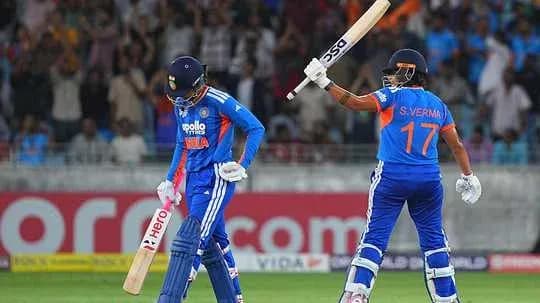
Smriti Mandhana and Shafali Verma walked out in Mirpur on Sunday like they owned the place. An hour later, they more or less did.
By the time Sri Lanka finally separated them, the final had already been ripped out of contest. India, already the class of this Women’s T20 Asia Cup, underlined that status with a ruthless 72-run victory to lift their fourth title, powered first by a record-chasing opening stand and then by a pack of relentless spinners.
Shafali ignites, Mandhana steers
Shafali didn’t start with fireworks. She started with touch.
Two gentle deflections off Mithali Ayodhya – one guided past gully, the next nudged to midwicket – both ran away for four. No slogging, no wind-up. Just timing. Then she saw Chamari Athapaththu’s pace and length, and the mood changed.
Arms freed, field pushed back, Shafali launched two sixes in four balls off the Sri Lankan captain. The tone of the final shifted right there.
What followed was an assault of rare control. Having eased herself in, Shafali suddenly hit fast-forward, racing to the fastest fifty in Women’s T20 Asia Cup history, getting there in 24 balls – one quicker than Mandhana’s own benchmark from 2022. This time, the record belonged to her.
Mandhana, usually the one dictating the tempo, slipped into the role of anchor with barely a fuss. She opened her account with a boundary first ball, then settled into a rhythm of busy running, stitching singles and doubles between the odd four. Where Shafali blazed, Mandhana kept the innings stitched together.
Chamudi Praboda copped the worst of it. Shafali picked off her loose lengths for another set of back-to-back fours, punishing anything even slightly off. Her third fifty of the tournament arrived in the eighth over; India were already in a position most sides would take at the halfway mark.
By the 12th over, the scoreboard read 120 without loss. The two left Sri Lanka not just chasing runs, but gasping for ideas. In the process, they matched the world record for the most 100-plus stands for any wicket in women’s T20Is – six of them now, a partnership that has become a statistical habit.
At that stage, the final was slipping away from Sri Lanka at alarming speed.
A wobble, but enough damage done
They needed something, anything, to break the stranglehold. It came in the 13th over.
Shafali’s dismissal finally cracked open the door. India’s momentum, so assured until then, suddenly juddered. What followed was the kind of chaos that can creep into even the most dominant displays: Harmanpreet Kaur and Mandhana collided in thought and running, and Mandhana’s innings ended in a messy run-out that left both players fuming.
The tempo dipped. The middle order, chasing the high bar set by the openers, tried to keep the rate surging and instead tumbled. Wickets began to fall to ambition rather than necessity, as Sri Lanka’s bowlers at least dragged the scoring rate back into human territory.
Yet the damage was done. The platform was too strong, the base too high. India still surged past 180, helped by a last-ball six from G Kamalini, brought in for Pratika Rawal and determined to leave a mark on the occasion. It was a sting in the tail that restored the sense of dominance the middle overs had briefly blurred.
For Sri Lanka, the equation was brutal: chase down a total that had only once before been overhauled in a Women’s T20 Asia Cup – and that solitary success had come in their favour, against this very India side, in the 2024 final.
History gave them a sliver of hope. India’s new-ball attack promptly took it away.
Early blow, brief resistance
Imesha Dulani tried to set a tone of her own. First ball, she unfurled a lap shot, a daring statement in a steep chase. Four balls into the innings, she tried it again.
This time, Kranti Gaud was waiting.
Charged up, Gaud ripped one through, rattling the stumps and then sending Dulani off with a fired-up celebration. The message was clear: there would be no repeat of 2024 on India’s watch.
Sri Lanka crawled through the first three overs, feeling the squeeze. Then Athapaththu, as she so often does, chose defiance.
She slog-swept Shafali for six, took 12 off the all-rounder’s first over, and with that one swing of intent, she dragged the chase to life. Vishmi Gunaratne settled alongside her, the pair working the gaps and refusing to let the innings stagnate. They pushed Sri Lanka past 50 without further loss, and for a handful of overs, the chase felt alive again.
Athapaththu then turned her attention to Prema Rawat, taking 11 from the over with a six and a four in successive balls. The required rate still loomed, but Sri Lanka had a captain in rhythm and a partnership with purpose.
Just as the contest seemed to find its edge, India’s spinners tore it away.
Deepti and Charani slam the door
Deepti Sharma’s second over swung the final decisively.
Athapaththu, eager to keep forcing the pace, charged down to the off-spinner. Deepti saw it, pulled her length back just enough, and the stumping was clinical. Sri Lanka’s heartbeat was gone. With that one dismissal, India wrested back complete control.
Three balls later, Gunaratne’s stumps were shattered as well. Two set batters gone in the same over, and with them went Sri Lanka’s realistic hopes.
From there, Shree Charani took over and continued the story of her standout 2026. She sliced through the middle order, hitting hard lengths and sharp lines, ensuring there would be no late twist. Every over felt like a step closer to the inevitable.
Beyond the top three, only Nilakshika Silva reached double figures. There was no counterpunch, no lower-order surge, only a slow, inevitable slide. Wickets fell, the asking rate climbed into the absurd, and the chase dissolved into formality.
Sri Lanka were bowled out for 111. The margin – 72 runs – now stands as the second-biggest victory in the final of any five-plus team Women’s T20I tournament, behind only Australia’s 85-run hammering of India in the 2020 T20 World Cup final at the MCG.
On that night in Melbourne, India were on the wrong side of a statement win. In Mirpur, they delivered one of their own, with bat, with ball, and with a ruthlessness that suggests this Asia Cup might not be the last they dominate.