.svg&w=384&q=75 "logo")
Anshuman Hooda: From Engineer to Fast Bowler Star in Delhi Premier League
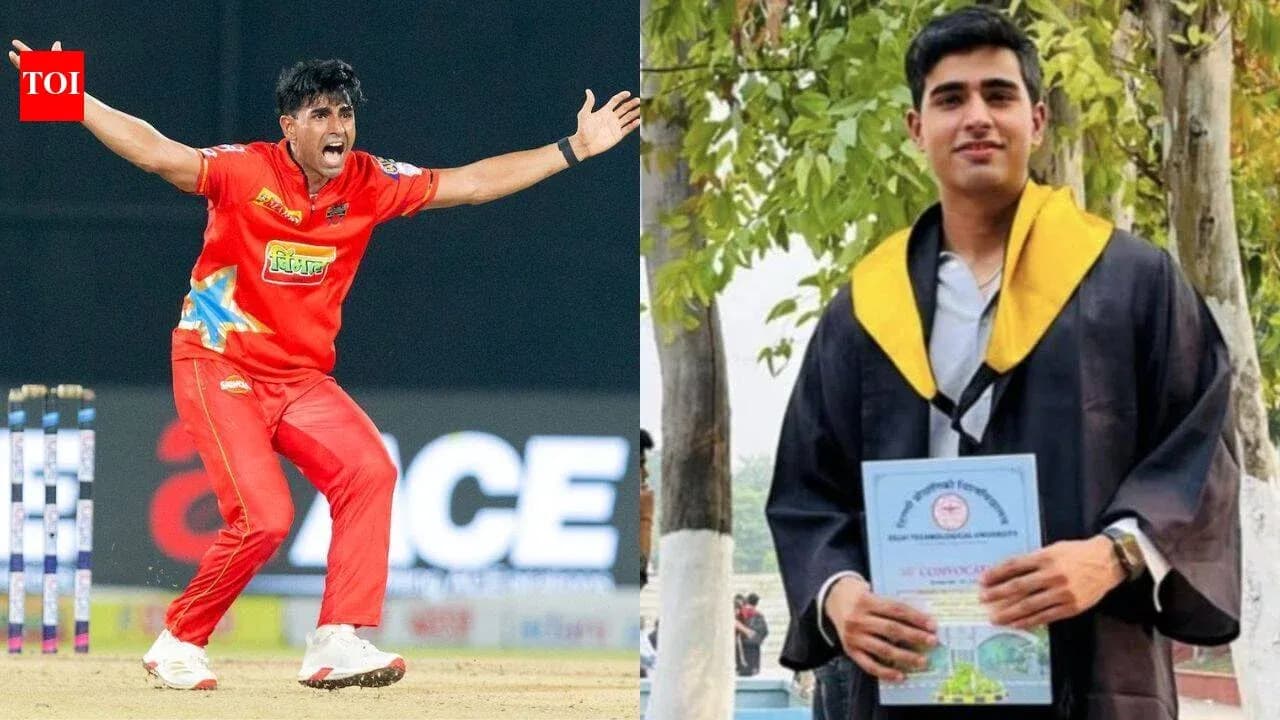
In a small room in New Delhi, the choice is laid out in the simplest possible terms: office laptop or cricket ball?
Anshuman Hooda doesn’t even pretend to think about it. He laughs, the way only someone who has already made up his mind can laugh, and says his cricket ball is his “best friend”. The 25-year-old engineer knows that sounds romantic. It’s also beginning to sound like a plan.
Because this season, in the third edition of the Delhi Premier League, that “best friend” brought him 22 wickets, the Purple Cap and a title with South Delhi Superstarz. It also dragged him into a conversation he once thought would never involve his name: first-class cricket, IPL trials, maybe even India.
Not bad for a fast bowler who nearly quit before he had even started.
‘I thought I should quit cricket’
There was a point, not long ago, when the sensible thing seemed obvious.
Anshuman had an engineering degree from Delhi Technological University, a job at EY through campus placement, and no age-group cricket behind him. No Under-16, no Under-19, no Under-23 success. Twice he went for Under-23 trials. Twice he came back with nothing.
“I tried for Under-23 for two years, but I couldn’t make it,” he recalls. “I thought it would be very difficult because I hadn’t played any professional cricket or age-group cricket. It would have been very difficult to directly get selected for the Ranji Trophy or first-class cricket.”
So he did what thousands of young Indian cricketers eventually do. He told himself it was time to stop dreaming.
“So at that time, I thought I should quit cricket and pursue my career in engineering or something.”
At home, his parents had always wanted security first. His mother, Prem Lata Singh, a primary school teacher with the Municipal Corporation of Delhi, had asked the same question many parents ask: where is the job? His elder brother, Vikram, had gone down the conventional path — science, engineering, work. Anshuman followed.
The difference is that he couldn’t quite let go of the ball.
The coach who said: one more year
Just as he was preparing to walk away, one man refused to let him.
In 2019, coach Harish Dagar had noticed Anshuman at university. Not as a polished quick. As a raw, restless athlete. Tennis-ball cricket, natural pace, arm speed, a body that moved well. The ingredients were there; the craft was not.
By 2023, Anshuman had graduated and landed his corporate job. For him, that felt like closure. For Dagar, it felt like the worst possible time to stop.
“It was in 2023. He had just graduated. He had got the job through campus placement and was ready to move on with his life,” Dagar remembers. “I pleaded with him to give it one more year. I asked him to come to my academy four days a week for a year, and if nothing would pan out, I would let him pursue his corporate job.”
The academy was Delhi Cricket Hub in Paschim Vihar. The deal was simple: one year of serious work. No excuses. No half-hearted sessions.
Dagar knew he wasn’t just building a bowler. He was fighting a mindset.
“His body alignment was natural. His strength was natural, and his pace was natural. But he didn't have enough strength in his body initially. That's why I told him that if you don't maintain your fitness along with your natural pace, you will face problems.”
The problem? Time. Anshuman was working from home, but his days were still split into deadlines and dreams.
“He was also busy with his job. He couldn't always take proper sessions. He would come at night, then have to go to the gym and take practice sessions. It was very hectic,” Dagar says.
So the coach attacked the biggest barrier first.
“I worked on his mind 80-85 per cent. I made him mentally strong. I told him never to think that he was tired or burdened. Once I worked on his mindset and the roadmap was clear in front of him, he knew what he had to do. At one point he had to focus on fitness, at another he had to do his job, and then he had to come to me for his sessions.”
The roadmap was on paper. The grind was on the ground.
From roller skates to red ball
Anshuman’s story doesn’t start with a cricket bat or a plastic ball in a narrow Delhi lane. It starts with roller skates.
Growing up, he was a national-level roller skater. Cricket hovered in the background, mostly through Vikram, who played the game before him. The pattern at home was predictable: the elder brother chose science, so did the younger. The elder brother chose engineering, so did the younger.
Cricket, though, refused to follow the script.
It wasn’t until college that leather-ball cricket entered his life properly. He joined the college team, picked up the ball, and something clicked.
“I just started playing in college, and that’s when I got into leather-ball cricket professionally, playing for the college team and all. That’s when I fell in love with bowling fast, getting wickets and the aggression that comes with it. I just loved bowling fast.”
The roller skater had found a new way to chase speed.
Building a fast bowler, not just a fast ball
Fast bowling is seductive from the outside. On the inside, it’s brutal.
“Fast bowling is not a very comfortable activity for the body,” Anshuman says. “You accelerate, then your whole body has to absorb the impact before you bowl. It definitely takes a toll on the body.”
He learned that quickly. Niggles, soreness, the constant cycle of sprint, jump, land, repeat. For someone working a full-time job, the demands could easily have broken him.
Instead, they shaped him.
Dagar’s plan was detailed and relentless: periodisation, rest, strength work, workload management, diet, physiotherapy, technical refinement. The aim wasn’t to chase a number on the speed gun for social media clips. It was to create a bowler who could stay fit, stay fast and stay accurate.
Anshuman had to develop a stock ball and then layer in variations — leg-cutter, off-cutter, change of pace — without losing his main weapon.
The motivation never really needed coaching.
“It was just the love for the sport and the love for bowling fast that kept me motivated and helped me come back stronger every time,” he says.
The love was there. The stage arrived with three letters: DPL.
DPL: the door opens
The Delhi Premier League changed the conversation.
In 2024, Anshuman got a chance with South Delhi. Opportunities were limited at first. A few overs here, a short spell there. Enough to tease, not enough to define.
Then came one of those spells that fast bowlers dream about and batters dread. The kind of spell that makes selectors sit up and teammates turn their heads. It shifted how people looked at him.
The next season, his role grew. He took a five-wicket haul. Wickets came in clusters. Pace and aggression caught the eye. By the 2026 edition, he was no longer a fringe quick. He was the Purple Cap holder, with 22 wickets and a title-winning campaign behind him.
With the wickets came attention. IPL franchises began to track him as a net bowler and a trial option. For someone who once thought there was no route into the system, the shift was dramatic.
The moment it truly sank in came from the top.
Shikhar Dhawan, owner of South Delhi Superstarz, sought him out after his performances.
“Shikhar Dhawan himself, the team owner, surprised me. He came and we had a little conversation. He gave me some very good tips and a direction to work towards from here,” Anshuman says.
Dhawan later praised him on social media. For a bowler who had grown outside the conventional Delhi junior structure, that recognition mattered. It was more than a pat on the back. It was a signal: you belong here.
Chasing 140 kmph – and beyond
At around 140 kmph, Anshuman already owns the one thing that can transform a seamer’s career overnight: pace.
He wants more.
“Definitely, speed is what I want. If I can, I will definitely look to bowl even faster and build the strength and skills to do that, while making sure there is no compromise on accuracy and line,” he says.
That last line is where careers are made or broken. Pace opens doors. Accuracy keeps you in the room.
For Anshuman, the next step isn’t just about bowling one ball at 145 kmph. It’s about sustaining high pace over long spells, especially with the red ball.
“These are the things we prepare for. Who bowls in a four-day or five-day game and bowls long spells with the same effort? That is what I am preparing for. If I get an opportunity, I will definitely do that.”
The ambition is unambiguous. First, Delhi. Then regular first-class cricket. From there, IPL. And beyond that, the biggest dream.
“The eventual goal is to play and win matches for the country. That is my ultimate goal,” he says.
Job security vs the unknown
Away from the nets, another contest runs quietly in the background.
On one side: a degree in Production and Industrial Engineering from DTU, a job at a multinational, work-from-home flexibility and even a promotion before the latest DPL season. A clear, predictable path.
On the other: a career where one bad spell, one injury, one selection call can alter everything.
“Currently, I have joined back,” Anshuman says of his job. “But as I have seen some substantial progress in my cricket in recent months and in this tournament, I might, in the coming times, shift my whole focus to cricket and give it my all.”
It’s a measured sentence, but the meaning is sharp. The engineer who once decided to quit cricket is now contemplating quitting the comfort of engineering instead.
His family’s stance has evolved with him. Vikram says their mother is happy now that he has both a job and a rising cricket profile. The old concern — “he needs a job” — has been answered. The new question is different: what happens if he really goes for this?
Anshuman, at least, knows his answer.
“I will give it my all. Let’s see what happens ahead.”
For a 25-year-old fast bowler who came late to the game, who skated before he bowled, who almost walked away before anyone knew his name, the next ball he releases might define far more than a single over.