.svg&w=384&q=75 "logo")
Abhishek Sharma's Explosive 82 Leads India to Victory Over Afghanistan
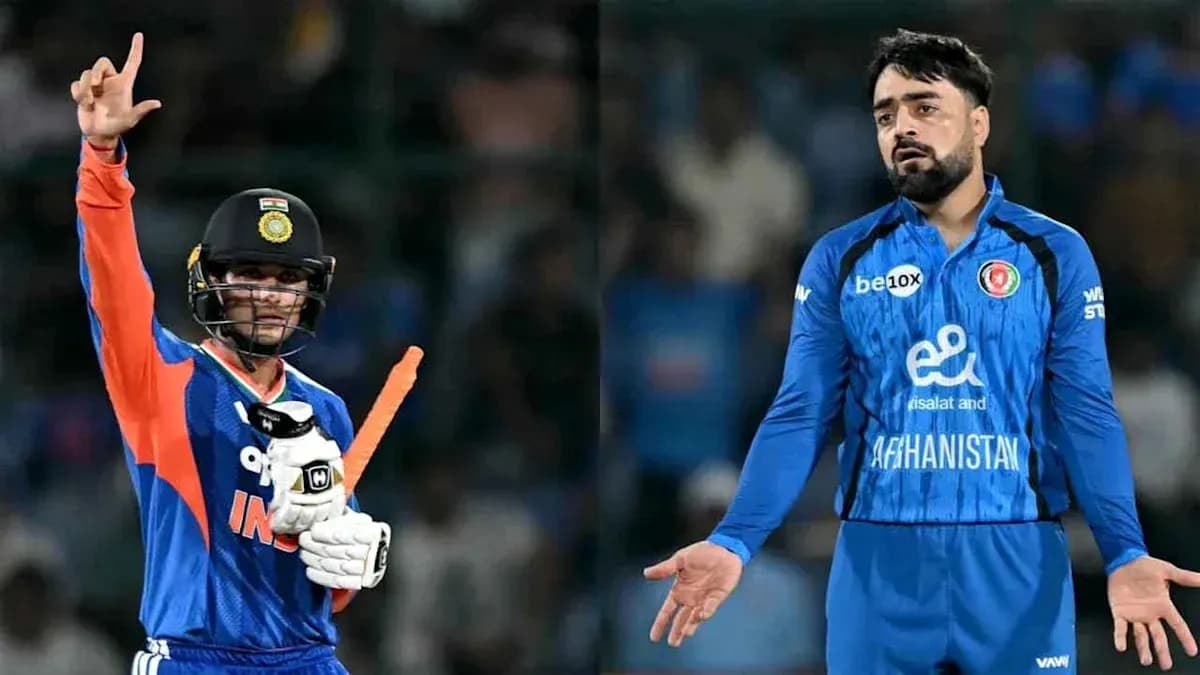
Under the Delhi lights at the Arun Jaitley Stadium, Abhishek Sharma didn’t just play an innings. He detonated one.
An 82 off 32 balls in a T20I is the kind of knock that usually lives in highlight reels and fever dreams. On Sunday, it was very real, and Afghanistan’s bowlers — Rashid Khan included — wore the full force of it as India cantered to a seven-wicket win and a 1-0 lead in the three-match series, chasing 157 in only 13.4 overs.
A record-breaking assault on Rashid Khan
Plenty of batters have tried to take Rashid on. Very few have walked away with numbers like these.
Across T20 cricket where ball-by-ball data exists, 113 batters have faced at least 30 deliveries from Rashid Khan. Against that elite benchmark, Abhishek now sits alone at the top: 101 runs from 43 balls at a staggering strike rate of 234.88 — the highest of the lot.
This wasn’t a one-night fluke either; Sunday’s onslaught simply underlined a pattern. Rashid, the bowler who so often dictates terms, found himself repeatedly dragged off his lengths, forced to recalibrate as Abhishek stepped out, swung hard, and refused to yield an inch.
Every time Rashid tossed it up, Abhishek met him with a clean arc of the bat. When he went shorter, the response was the same: power, timing, and no respect for reputation.
Seven fours, seven sixes, and no let-up
Abhishek’s 32-ball 82 was brutal in its clarity. Seven fours. Seven sixes. No time wasted.
He walked in early, after Sanju Samson’s brief stay ended on 10, and immediately seized the chase by the collar. India needed 157. He batted as if it were 200.
Afghanistan’s seamers tried to drag the length back. He picked them off. They went fuller. He drilled them straight. Spin was supposed to bring control, but Abhishek simply expanded his range, clearing midwicket, long-on, and extra cover with the same ease.
The result was a powerplay that broke the chase wide open. By the end of six overs, India had raced to 82 for 1, Abhishek and Ishan Kishan in full charge and the target already reduced to a formality.
Ishan Kishan joins the surge
Abhishek needed a foil. Ishan Kishan became much more than that.
Ishan’s 42 off 33 balls might look understated next to Abhishek’s fireworks, but his tempo and intent kept Afghanistan under constant pressure. He rotated strike when needed, then cashed in when the bowlers missed.
Together, they stitched a second-wicket stand that shredded both the scoreboard and the record books: 121 runs off just 53 balls. A scoring rate of 13.70 runs per over in a 100-plus partnership — the fastest ever against Afghanistan in T20Is.
The previous best? Rohit Sharma and Rinku Singh’s unbeaten 190 off 93 balls in Bengaluru in 2024, scored at 12.25 an over. Abhishek and Ishan pushed that bar higher, and did it in half the time.
By the time both left the stage, the contest had long since tilted decisively India’s way.
Chase wrapped with overs to spare
After the carnage of the first half of the innings, the finish was almost subdued.
Abhishek and Ishan departed later in the chase, but the damage was irreparable from Afghanistan’s point of view. The required rate had collapsed. The fielders’ shoulders had dropped.
Shreyas Iyer, unbeaten on 8, and Tilak Varma, 3 not out, simply walked India over the line, nudging and pushing the ball around as the target vanished in the 14th over. India closed the chase at 13.4 overs, a seven-wicket win that felt even more emphatic than the margin suggests.
Series advantage secured, questions for Afghanistan
India now hold a 1-0 lead with two to play, and they won’t have to change hotels or routines — the second T20I comes at the same venue on Tuesday.
Afghanistan, though, have plenty to think about. Their attack, usually disciplined and streetwise, was stripped of control, their trump card Rashid Khan forced into damage limitation against a batter who refused to be dictated to.
India, on the other hand, have unearthed a fresh, fearless presence at the top in Abhishek Sharma. If this is how he begins a series, what happens when bowlers know what’s coming and still can’t stop it?