.svg&w=384&q=75 "logo")
The Evolution of the US Open: From Tradition to Premiumization
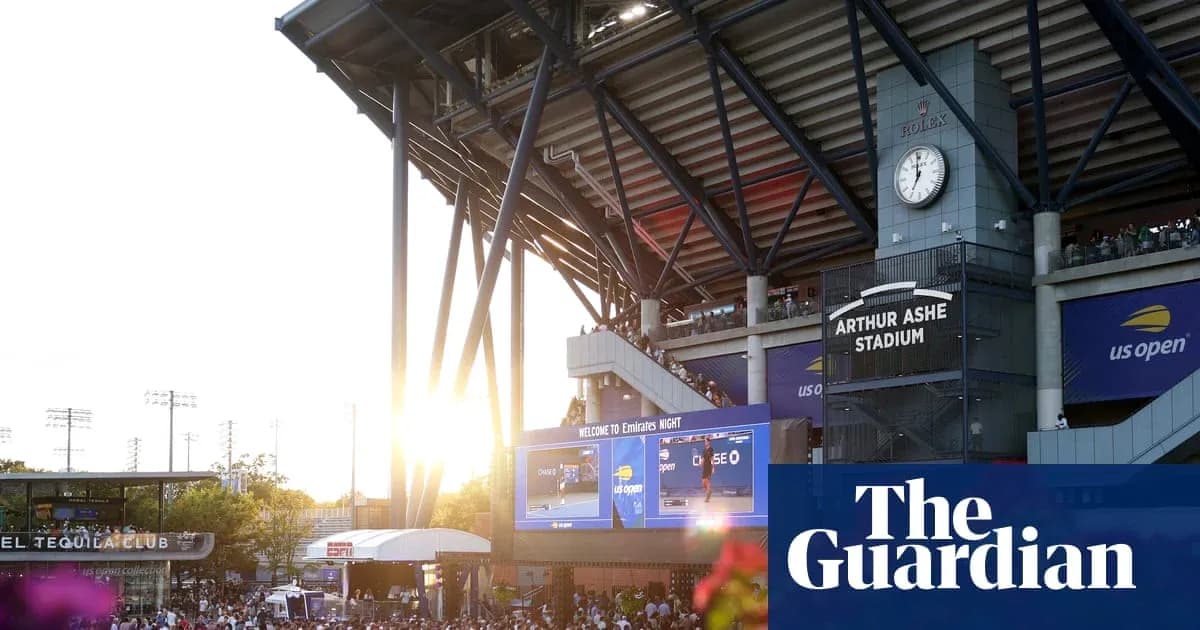
The year is 2041 and the walk from the subway to Flushing Meadows feels less like a pilgrimage to a tennis tournament and more like a queue for a theme park. You clear security and step into the USTA Liquid Death National Tennis Center, a place that used to be a stadium complex and is now, unapologetically, an ecosystem.
On Practice Court 23, Myla Rose and Leo Federer are knocking off the rust before their first-round match in the US Open Mixed Doubles, a draw now prefixed and suffixed by sponsors – in this case, Botoxxify, the tournament’s official neuromodulator partner. A few hours from now, Jake Paul, the 50th president of the United States, will roll in for opening night with first lady Jutta Leerdam-Paul and labor secretary Dana White in tow. Venus Williams has just accepted a wildcard into the women’s singles, a familiar name in an unfamiliar world. You’re still a couple of Klarna installments away from finally paying off last year’s Honey Deuces.
Welcome to the Disneyland of tennis. Craig Tiley’s phrase, once tossed out in 2026 as blue-sky branding, has become a mission statement.
Back then, it sounded like marketing. Longtime Open diehards used it as a punchline, muttering it between curses on the outer courts during qualifying week, when you could still get in for free if you knew the routine. Tiley, barely a month into his job as chief executive of the United States Tennis Association, meant it as aspiration, not satire. That told you everything about where this late-summer collision of sport, fashion and conspicuous consumption was heading.
His vision was simple and relentless: more. More entertainment. More “experiences.” More reasons to spend time – and money – on the grounds. At a tournament where a humble grounds pass already fetched hundreds on resale and $100 chicken nuggets came dusted with Petrossian caviar, the obvious question hung in the air.
More what?
The answer stands all around you now. Layers of access. Premium seating sliced into finer and finer grades. Branded “activations” on every walkway. A slow, almost invisible erosion of value-for-money that would make the Airline Deregulation Act of 1978 blush.
Before you even step through the turnstiles, the US Open Experience app invites you to choose your place in the new hierarchy: Grounds Pass, Grounds Pass Plus, Grounds Pass Platinum, or Grounds Pass Presented by FTX – yes, they’re back. Tennis, notably, is included with Platinum. If you actually want to watch a match, you can buy a FastPass to skip the regular queue for the escalator to the 300 level of Blackstone Court at Arthur Ashe Stadium. For another $85, FastPass+ lets you briefly make eye contact with a player. Not a selfie. Eye contact.
Thirsty? The Emirates Luxury Hydration Pavilion offers a $31 bottle of water with a commemorative cap shaped like a miniature Anna Wintour in sunglasses. Over at the Grey Goose Food Court, the Mega Honey Deuce has become a social feed staple: a 96-ounce vodka lemonade in a souvenir fishbowl, garnished with six melon balls and one month of complimentary credit monitoring. Hungry fans join the line for the $55 chopped cheese from Hajji’s Blue Sky Deli, now absorbed into the Wonder empire and mass-produced as another viral “moment.” You’ll want to get there early.
If you prefer something that sounds vaguely healthy, an Erewhon sits beneath Mamdani Grandstand, occupying the space Lululemon left behind after the Great Athleisure Correction of 2037 sent it into bankruptcy. Nearby, the merch stands have long since become a Fanatics Experience™, which is a polite way of saying you should think twice before putting your $80 T-shirt anywhere near a washing machine.
On court, even the sport has been trimmed and packaged. All matches are best-of-three Fast4 sets, a format born of market research that decided spectators wanted “digestible content windows” rather than marathons. The final-set tiebreak still exists, but if watching it without a little financial jeopardy feels flat, the tournament is ready for you. The app offers an array of “immersive second-screen engagement opportunities,” from predicting the winner of the next game to guessing whether a 19-year-old qualifier ranked 746 in the world will double-fault at 30-all.
Tiley saw this coming. During his time running the Australian Open, that tournament became the first grand slam to sign an official betting partner. William Hill’s courtside ads lasted a single event before disappearing under the weight of match-fixing scrutiny. The betting didn’t vanish; it simply needed a cleaner outfit.
By 2026, the USTA had announced Kalshi as the US Open’s first Official Prediction Market Partner, selling the deal as a way to “pioneer that next generation of fan engagement while ensuring the integrity of our sport.” The same fans were soon bombarded with push notifications pushing those markets as they wandered the grounds, eyes fixed on their phones while live tennis played out a few feet away.
Now, in 2041, the integration is complete. Every seat in Ashe comes with a small Bloomberg terminal, streaming live markets on every point. The chair umpire pauses briefly between rallies so spectators can lock in their positions. Players themselves remain barred from partnering with betting companies, of course. Tennis has standards, and the optics to protect.
If you prefer your gambling old-school, the sport has you covered there too. A short walk down the boardwalk past the No 7 subway station sits a brick-and-mortar Hard Rock casino and sportsbook, planted by Steve Cohen – the compliance-challenged billionaire hedge-fund manager and New York Mets owner. Inside, your eight-leg parlay can still implode the traditional way.
The calendar has shifted as well. The main draw starts on Saturday now. Once, the first round spanned two days: 64 matches per day, noon to midnight, tennis spilling from every court in a kind of controlled chaos. In 2025, organizers stretched it to three days with a Sunday start. The next step was inevitable. Shrinkflation won.
Any outrage over ticket prices burned out years ago, sometime after the nonprofit USTA outsourced its ticketing to Ticketmaster and let dynamic pricing squeeze every last cent the market would tolerate. Digital layaway plans smoothed the pain. The idea of a fixed price for a seat feels as quaint as paper tickets.
The scruffy, democratic charm of the old US Open has faded into the same nostalgic haze as Aqueduct and Jimmy’s Corner. Yet if you know where to look, the old tournament still peeks through the gloss.
Court 17, with its bullring intimacy, remains the best show in the house – when you can get in. A fan with a basic grounds pass can still stand on Court 5 and watch three matches at once, head swivelling like a linesperson from another era. A late-night doubles match on an outer court, where influencers rarely bother to roam, can still feel like the most important thing happening in New York.
Even inside Ashe, a few relics survive. The tournament still holds back 400 non-premium seats, a throwback to the days when sitting in the upper deck was less “hospitality overflow” and more “cheap way in.” Those fans, wedged above the swelling ranks of suites and Chase Sapphire lounges, can still just about make out a tennis match taking place far below.
Some call the transformation “enshittification.” The industry prefers “premiumization.” The USTA’s financial reports have a simpler word: growth. Tournament director Morgan Riddle frames it as meeting fans where they are, not dragging them somewhere new.
The context is bigger than one event. Across the United States, from Wrigley Field to the Rose Bowl to Belmont Park, ordinary seats have given way to clubs, suites and hospitality decks. Corporations and wealthy patrons pay multiples of what displaced regulars once did. The arithmetic is brutal and obvious.
Can you really blame the USTA for treating its flagship event like the scarce asset it is? A night at Ashe has become one of the toughest tickets in American sport. Who wouldn’t empty the coffers to watch a 37-year-old Coco Gauff chase one last title, one last lap around the court, one last roar in the New York night?
There is enormous demand. There is enormous money. There are highly paid executives whose job, alongside the less glamorous work of getting more kids to pick up a racquet, is to squeeze that demand for every available dollar.
Maybe Tiley saw it more clearly than anyone back in 2026. Maybe the only way forward was to lean into the growth, build the suites, sell the “experiences,” and accept that the US Open belongs as much to the once-a-year visitor chasing a ring-light Honey Deuce selfie as to the diehard who used to spend qualifying week on the outer courts for free.
Those who preferred the old place had their era. This is someone else’s Open now. The question is whether tennis can still breathe beneath all the branding, or whether, one day, even the sport itself becomes just another premium add-on.