.svg&w=384&q=75 "logo")
Rashid Khan on Afghanistan's Cricket Journey and Powerplay Challenges
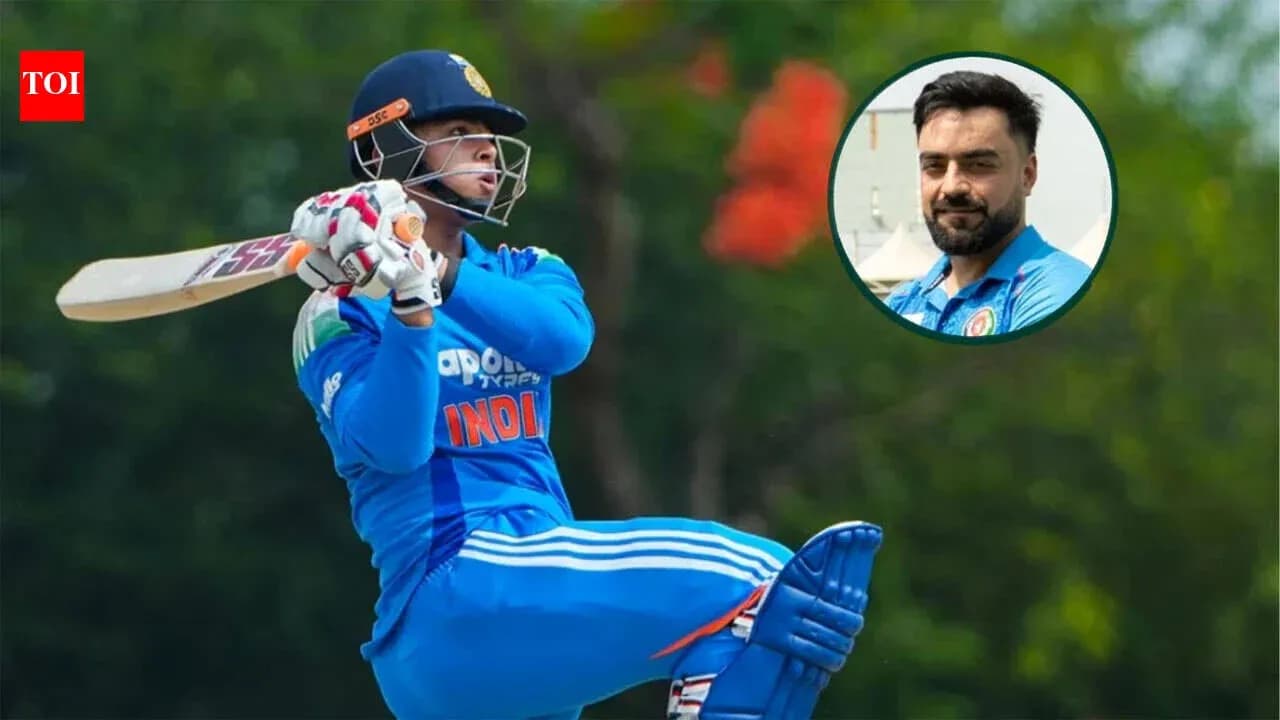
Rashid Khan has lived every chapter of the India–Afghanistan story. From the days when Afghanistan turned up hoping to compete, to nights when they now expect to win. The rivalry has grown teeth. So has his team. But in Rashid’s mind, there is still a clear gap – and it starts in the first 10 overs.
On the eve of the third and final ODI against India, the Afghanistan captain cut through the noise in a candid chat with TimesofIndia.com. The message was blunt: the powerplay will decide how far this team can really go.
Powerplay problem, mindset gap
“We still have to do a lot of hard work in our batting department,” Rashid admitted, zeroing in on the top of the innings. For him, the lesson from this India tour is simple: Afghanistan must learn to live in high-scoring games, not just survive them.
Delhi’s flat tracks have exposed that weakness. India’s batters have piled on runs, while Afghanistan’s top order has struggled to match that intent and volume. Rashid doesn’t dress it up. His team needs the mentality – and the method – to post and chase “big runs under any condition, in any situation, against any bowler”.
With the ball, the issue is just as stark. “If you are giving more than 70-80 runs in the powerplay, it doesn't matter if you are defending 200 or 230,” he said. That is the fault line. Afghanistan’s spinners remain world-class, their middle-overs control is proven, but when the new ball disappears, the rest of the plan collapses.
The takeaway from this series, in his eyes, is not about pride in competing. It is a to-do list. Tighten the powerplay, sharpen the batting intent, and build a collective solution rather than hunting for a single hero spell or cameo.
A “dangerous” India side led by youth
Rashid has seen enough Indian teams to recognise patterns. This one, led by Shreyas Iyer and loaded with fearless hitters, feels different.
“It is a very dangerous side, a destructive side,” he said. The word “dangerous” keeps coming back. Not because India bat deep, but because so many of them go big. Hundreds in T20 cricket are no longer rare events in this group; they are markers of how they approach the format.
They don’t deal in 20s and 30s. They take the game deep, they finish, and they do it without blinking. That, to Rashid, is the real separation. Fearless cricket, backed by genuine skill, not just bravado. In T20, he believes, that is exactly how it should be played.
Abhishek Sharma: the “big package” waiting to explode
Among India’s next wave, one name lights up Rashid’s face: Abhishek Sharma. The two shared a dressing room at Sunrisers Hyderabad, and the Afghan captain has seen enough to make a bold call.
He calls Abhishek a “very big package” for India’s future. The batting is already on display, but Rashid is adamant that the left-hander’s bowling is still underrated. In his view, Abhishek is not just a part-time option; he has the skill to operate in the middle overs and change games with the ball as well.
That dual-threat profile, in Rashid’s mind, is exactly what modern international cricket demands. India have found one. Afghanistan, he knows, must keep finding their own.
Vaibhav Sooryavanshi: the 15-year-old who doesn’t blink
Then there is Vaibhav Sooryavanshi. Fifteen years old. Already an international cricketer. Already facing Rashid Khan.
Rashid has bowled to him, watched him up close, and what strikes him is not just talent. It is clarity. Shot selection. Game awareness. “He knows his game plan against any side, any bowler, anytime,” Rashid said. That is not something you usually say about a teenager.
The word he keeps coming back to is “fearless”. But this is not reckless slogging. Sooryavanshi backs his skills, understands his options, and marries power with hand-eye coordination that Rashid describes as “very different”. He calls it “god-gifted talent” – the kind you rarely see.
When asked if the youngster reminds him of a young Rashid Khan, he doesn’t take the bait. “I wasn't that talented, to be honest, at that age,” he admitted, half-joking, half-serious. The six-hitting power Sooryavanshi already shows, Rashid insists, is on another level. The fact that the teenager has already translated IPL promise into performances for India only cements the impression: this is not a fleeting sensation.
From underdogs to contenders – and the next leap
Afghanistan’s rise has not been built on one moment, but Rashid can trace the turning point. It began in India at the 2023 World Cup. Beating England. Beating Pakistan in a bilateral T20 series before that. Then Sri Lanka. Then Pakistan again at the World Cup. A semi-final run at the 2024 T20 World Cup in Australia and New Zealand.
Those results rewired the dressing room. They no longer see themselves as plucky outsiders. They see themselves in the bracket of teams who can “beat big teams”. That belief, though, comes with a responsibility: to sustain it.
“It’s about us now, how we are going to manage and how we keep this continuing,” Rashid said. The dream is no longer to cause an upset. It is to live in that space where beating England or Pakistan is not a headline, but a habit.
Ibrahim Zadran and the art of leading from the front
In that context, the choice of Ibrahim Zadran as T20I captain matters. Rashid, who has worn that armband and felt its weight, speaks about Ibrahim with quiet conviction.
He likes the opener’s work ethic. The way he wants to lead from the front. The consistency. The honesty. These are not buzzwords for Rashid; they are the traits he believes a young team needs to follow.
Ibrahim, he says, is always trying to “set an example for the youngsters and show them this is the way to go.” Rashid has stepped into the senior statesman role, offering support without smothering. The key lesson he passes on? Do not drown under the captaincy.
As a leader, Rashid admits he once put too much pressure on himself, tried to carry everything. It backfired. The correction came when he learned to strip it back: focus on his own skills, his own game plan, and the process rather than obsessing over results. That is the message he now repeats to Ibrahim – stay calm, trust the process, let the rest follow.
The next Afghan wave: Noor and pace from Abdollah
For all the talk about India’s young guns, Rashid is just as excited about the names coming through in his own camp.
Noor Ahmad has already made his mark. Another left-arm wrist-spinner from Afghanistan, another mystery option for batters to decode. Rashid believes Noor can “get to the next level” and stack up serious performances in the years to come.
The more urgent need, though, lies in the fast-bowling department. Rashid is frank: it is an area Afghanistan must improve. One name gives him hope – Abdollah Ahmadzai. The young quick is already in the national set-up, already bowling with serious pace. Managed properly, Rashid believes, Abdollah can become “a very quick bowler and a good future for Afghanistan cricket”.
That is the blueprint: spin remains the heartbeat, but genuine pace must join it if Afghanistan are to keep troubling the best on all surfaces.
Rashid 2.0: fewer matches, clearer body, same hunger
Rashid’s own journey has shifted gears. The teenager who once hopped from one league to another, chasing games and experience around the world, has turned into a seasoned pro carefully managing his body.
Those early years, he says, were invaluable. Constant cricket gave him knowledge of conditions across continents, an education no nets session can replicate. Then came surgery. The grind caught up. The schedule had to change.
He has since cut down his workload and gone deep into the science of his body. A recent stint at the Red Bull Athletic Performance Centre in Austria gave him what he calls a “very clear image” of where he stands physically. Tests, scans, consultations with physios and doctors – all of it fed into a simple output: what to avoid, where to play, how much cricket is sustainable.
It is a more calculated Rashid now. The tricks and variations remain, but the calendar is curated, not crammed.
One unfinished line in the story
For all the franchise titles, for all the global recognition, Rashid Khan’s career still has a glaring blank space.
“One unfinished thing is to win the World Cup for team Afghanistan,” he said. Not a vague dream, but a specific target. The 2024 T20 World Cup semi-final run hurt for that reason – they were close enough to see the final, but not close enough to walk out in it.
He wants an ICC trophy in his book. T20 World Cup or 50-over World Cup, it doesn’t matter. What matters is that Afghanistan lift one while he is still playing.
The rivalry with India will keep throwing up storylines. So will the rise of talents like Abhishek Sharma, Vaibhav Sooryavanshi, Noor Ahmad and Abdollah Ahmadzai. But for Rashid, everything now bends towards one question: can this Afghan generation turn belief into a World Cup in their hands?