.svg&w=384&q=75 "logo")
Protect College Sports Act Advances in Senate
The future of college sports took a sharp turn in Washington on Tuesday.
In a decisive move, the Senate voted 74-24 to advance the Protect College Sports Act, an NCAA-backed, bipartisan bill that would redraw the power map of the college game. It needed 60 votes. It cleared that mark with room to spare.
What comes next is less clear. The timing for a final Senate vote is still up in the air, and even if it passes there, the bill must survive the House. But the message from this first test was unmistakable: Congress is now fully in the business of deciding what college sports should look like.
A National Rulebook for a Fractured System
The Protect College Sports Act is the latest, and most aggressive, attempt to impose a single national standard on a landscape that has splintered in recent years.
State courts and temporary injunctions have shredded long-standing NCAA rules, often overnight. Transfer restrictions have crumbled. Athletes can move from school to school with far more freedom than ever before. Direct compensation from schools, once unthinkable under amateurism, has become a live issue rather than a distant threat.
This bill aims to pull all of that back under one federal umbrella.
It targets core issues: how many years athletes can compete, how often they can transfer, what forms of compensation they can receive, and the broader framework that governs their careers. In short, it seeks to answer the questions that courts and statehouses have been answering piecemeal — and often in conflict with one another.
The NCAA’s Big Prize: Antitrust Protection
At the heart of the measure sits a prize the NCAA has chased for years: an antitrust exemption.
If passed, the bill would shield the NCAA from future legal challenges over many of its rules. That would mark a dramatic shift. For decades, athletes and advocates have used antitrust law as their primary weapon against restrictions on compensation and mobility.
Professional leagues like the NFL and NBA operate with antitrust protections of their own, but with a crucial difference: their players collectively bargain. College athletes do not. That gap sits at the center of the fiercest criticism of the bill.
Still, for the NCAA, this is the protective wall it has long wanted. After a wave of state rulings that have redefined everything from name, image and likeness to transfer rules, the association is turning to Congress to restore control.
Cruz, Cantwell and a Rare Alliance
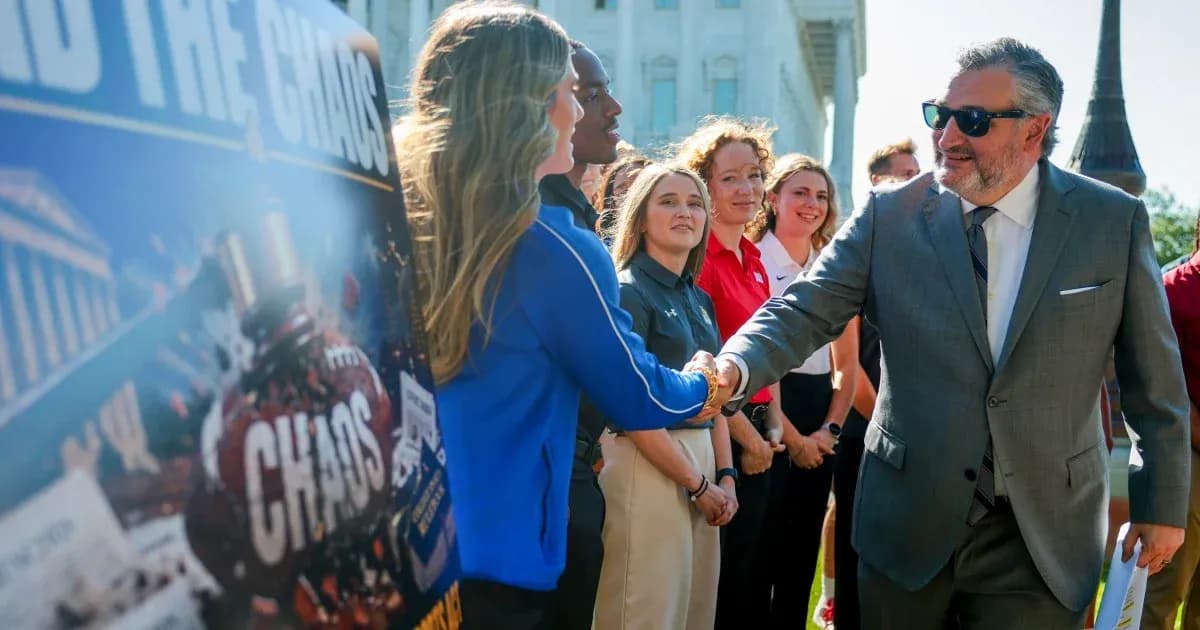
The bill carries the names of Sen. Ted Cruz, R-Texas, and Sen. Maria Cantwell, D-Wash., an unlikely pairing that underscores how far the issue has cut across party lines.
The NCAA has spent years lobbying for exactly this kind of sweeping federal law, particularly as college football and men’s and women’s basketball have evolved into multibillion-dollar industries with increasingly professional dynamics. On Tuesday, that lobbying paid off in the form of a broad coalition on the Senate floor.
Coaches have stepped into the political arena as well. Gonzaga men’s basketball coach Mark Few, speaking Monday alongside Cruz and Cantwell, did not pretend the proposal solved everything. “This bill might not be perfect, but it’s far, far away the best thing we got out there right now,” he said, framing it as the least chaotic option in a sport that has lurched from ruling to ruling.
A Powerful Backlash
The opposition is just as organized — and just as loud.
The Congressional Black Caucus and the NAACP have lined up against the Protect College Sports Act, warning that it would lock in a system that already leans heavily on Black athletes while limiting their economic power.
One of the bill’s most relentless critics, Sen. Chris Murphy, D-Conn., sharpened the argument Monday. “This bill protects the billions of dollars that coaches and sports industry executives are making over the suppression of compensation for some of the most highly valued athletes in the world,” he told reporters.
He didn’t stop there. “What we’re being asked to do is to basically allow colleges and conferences and the NCAA to illegally collude.” In Murphy’s view, the antitrust shield is not a guardrail; it’s a license.
The Battle for Public Opinion
The fight has already spilled far beyond committee rooms and floor debates.
Cruz has taken the campaign directly to fans, appearing on ESPN’s “College GameDay,” the flagship pregame show of college football, to sell the bill to a national audience. It was a clear signal: this is not just a legal or political fight; it’s a cultural one.
Murphy answered on a different stage, using Stephen A. Smith’s “Straight Shooter” podcast to push back and frame the bill as a move to protect institutions, not athletes.
Both sides know what’s at stake. Whoever wins the narrative off the floor could shape what happens on it.
For now, the Protect College Sports Act has momentum, a commanding first vote, and the full weight of the NCAA behind it. The question is whether that will be enough once the political pressure intensifies and the broader sports world realizes just how much this bill would change the game.