.svg&w=384&q=75 "logo")
Pakistan's Test Struggles Continue at Edgbaston
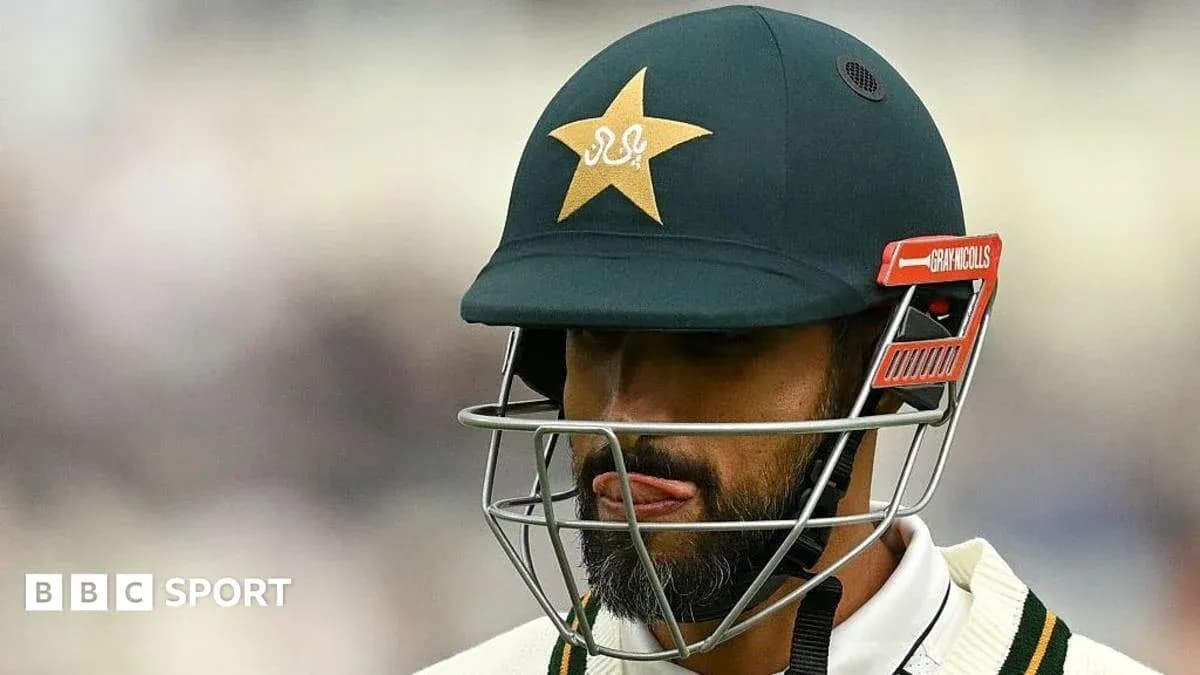
The skies over Edgbaston were grey. Pakistan’s mood was darker.
By lunch on the opening day of the third Test, a tour already weighed down by controversy and upheaval had lurched into something close to humiliation. A raft of Pakistan Cricket Board changes was billed as the electric shock that might jolt this side back to life. Instead, after just 23 overs, the scoreboard read 100-7 and the series looked effectively over.
If you’ve got tickets for the later days in Birmingham, you may already be wondering whether to make other plans.
A team unravelling
Former captain Ramiz Raja did not bother with sugar-coating. Watching on for Test Match Special, he called Pakistan’s “technique and mindset” “pretty ordinary” and pointed straight at a dressing room buckling under the strain.
“There’s mental fatigue and turmoil in the dugout, I can understand that,” he said. “But from an individual point of view, I think Pakistan have been waiting for the ball to come and damage them completely. They have not been proactive at all. They have to have a plan. This is a flat pitch, it’s not a demon-like pitch, like the third day at Lord’s.”
That last line cut deepest. Because he was right.
Yes, the surface misbehaved at times. CricViz’s bounce inconsistency rating clocked this pitch at 5.7 – significantly higher than the 2.6 against India in 2025, 3.2 against West Indies in 2024 and 3.3 against Australia in 2023. But this was no minefield. It was a test of courage and method. Pakistan failed both.
England’s seamers sensed weakness and pounced. Under Autumnal skies, Joe Root won the toss, handed the new ball to his four-pronged pace attack and watched them hit their lengths with clinical precision. The ball nipped, climbed, occasionally misbehaved. Pakistan’s top order crumbled.
Former England captain Michael Vaughan summed up the carnage: Pakistan, he said, were “clearly shot for confidence” after a wretched week off the field. “I feel for Pakistan because this is embarrassing with everything they’ve had to cope with in the last week,” he added.
History of the wrong kind
The Thwaite Memorial scoreboard told a brutal story. Pakistan’s top five were all back in the pavilion with just 48 on the board.
That collapse dragged them into unwanted history. It was only the 12th time in Test cricket that a team’s top five had all been dismissed for single figures. Never before had it happened in a first innings.
And this is no isolated failure. It fits a pattern that has defined their entire tour.
No side has ever begun innings in England as badly as Pakistan are threatening to. Their second wicket has fallen at 6 and 13 at Leeds, 16 and 7 at Lord’s, and 14 at Edgbaston on Wednesday. Across the series, that’s 56 runs for the first two wickets – an average opening stand of 5.6 and just 11.2 runs before the fall of the second wicket.
They are tracking beneath a record that has stood since 1888, when Australia averaged 16 for the fall of their second wicket in England. It took 136 years for a team to flirt with that low watermark. Pakistan are on course to smash through it.
Harsh conditions, harsher truths
There is room for sympathy. Some of this is structural, not just mental.
Take Saim Ayub. Thrown into this Test as part of the PCB’s reshuffle, the left-hander is playing his first first-class match since October 2025. His return came not on a benign domestic surface but against Ollie Robinson under a heavy sky, on a pitch with erratic bounce, in a series Pakistan are already losing badly.
From the moment he marked his guard, his dismissal felt almost inevitable.
Yet the chaos wasn’t only about rust and nerves. At times, Pakistan batted as if it were the final day of a long, lost season. Lapses in judgment, loose drives, airy wafts. An end-of-term feel when what the situation demanded was stubborn, old-fashioned discipline.
With four wickets down, Saud Shakeel and Babar Azam were still flashing extravagantly outside off stump. Two players in their thirties, both with serious experience, both fully aware of English conditions. They should have been the ones to shut the door, not fling it open.
The numbers underline the recklessness. Pakistan’s false-shot percentage in the morning session hit 40% – the second highest recorded in the first session of a Test since 2006. England did not have to winkle them out; the batters offered chance after chance.
Saud survived until lunch. Babar did not. About 40 minutes before the interval, he dragged on against Josh Tongue, then turned to glare at the pitch in frustration. The gesture said one thing; the scorecard another.
“He [Babar] disintegrated. It’s tough for him,” Ramiz Raja observed. “He’s got to explain all this mayhem and then he has to look after himself and then he’s got to work with the lot that are more T20 in nature than Test cricket.”
It was as much diagnosis as criticism. A captain caught between an unsettled board, a fractured squad and a format that demands patience from players groomed for the white-ball rush.
“This innings is in serious turmoil,” Ramiz concluded.
So is the tour. The question now is not just whether Pakistan can salvage this Test, but whether anyone in that dressing room can halt a slide that already feels bigger than a single bad morning in Birmingham.