.svg&w=384&q=75 "logo")
Pakistan's Collapse and Hope at Edgbaston
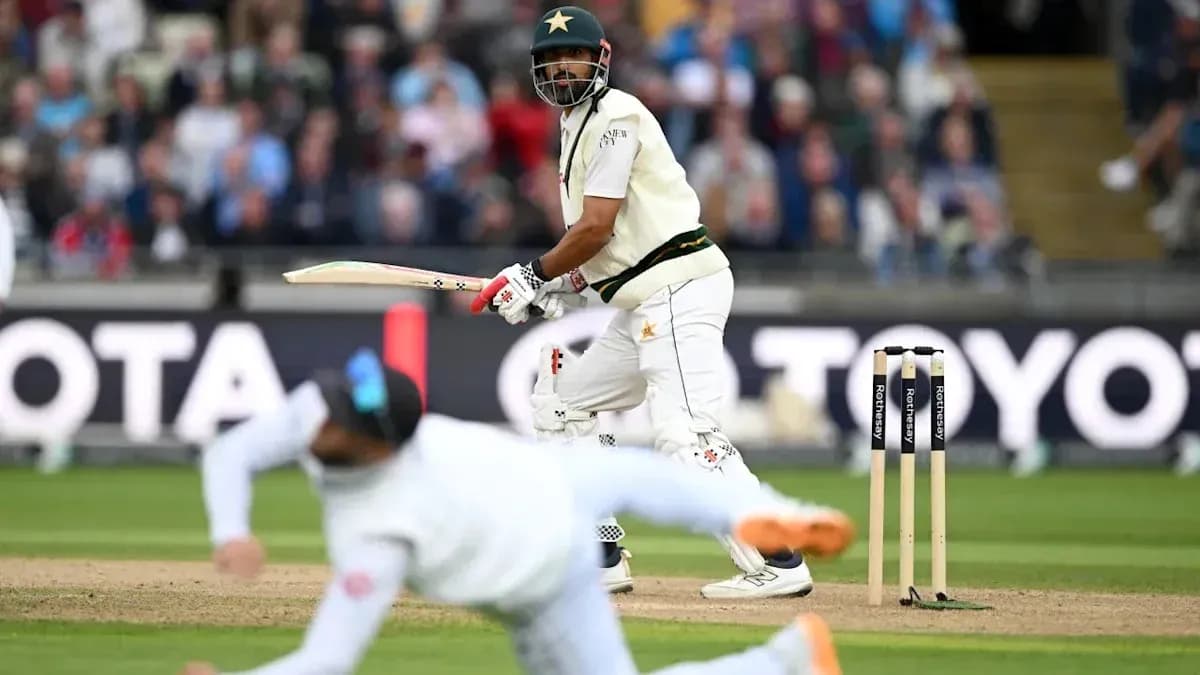
It takes a special kind of collapse to inspire hope in a country that barely plays the game. Pakistan managed it at Edgbaston.
On a final day that should have been a procession, England completed a 3-0 series whitewash with an eight-wicket win, chasing 130 in just 25 overs. The scoreline was brutal. The manner of it, even more so. And somewhere far to the north, Iceland Cricket saw enough in Pakistan’s brief resistance to fire off the sharpest line of the tour.
“We believe we won't be hopeless at cricket forever, and Pakistan's fight in the Third Test gave us exactly that hope. We aim for world cricketing domination by the year 2082. If we can do it sooner than then, we will, because our Board will all be dead in 2082.”
It was a joke. It also stung because it landed close to the truth.
A spark, then the familiar slide
For a fleeting spell, Pakistan threatened to turn a routine chase into a scrap.
Razaullah Khan had already dragged them off the canvas with a brisk 81 in the second innings, ensuring England had to bat again and sparing his side the indignity of an innings defeat. That alone said plenty about the state of their tour: the standout memory, a lower-order counter-attack in a match they were still destined to lose comfortably.
With 130 on the board, Pakistan needed something extraordinary. Mohammad Abbas briefly supplied it.
First ball of the innings: Ben Duckett, gone. Edge, dismissal, a jolt through Edgbaston. A few deliveries later, Emilio Gay followed in the same over. Two down for two. England, who had strolled through so much of this series, suddenly felt a hand on the collar.
This was Pakistan as they like to imagine themselves: dangerous, awkward, spoiling a coronation.
Then reality reasserted itself.
Root and Cox shut the door
Joe Root and Jordan Cox did what Pakistan’s batters had failed to do all tour: absorb pressure, then own the moment.
Root survived on 23 when Mohammad Ali bowled him, only for the umpire to call a no-ball. It was Ali’s 17th no-ball of the series, a statistic that summed up Pakistan’s lack of discipline more ruthlessly than any dressing-room inquest. Another chance went begging when Root, on 38, edged Abbas between first and second slip. Neither fielder committed. Neither took responsibility. The ball, and the match, slipped between them.
From there, England barely offered a sniff. Root settled, Cox grew in authority, and Pakistan’s brief surge of belief faded into the background noise of another one-sided day.
Root finished unbeaten on 62, his 110th Test innings of fifty or more, with 41 of those converted into hundreds. Cox, composed and unfazed, ended on 59 not out. The chase was done with eight wickets in hand, the series wrapped up in clinical fashion.
Root, speaking afterwards, chose to respect the fight he had faced rather than mock it.
“Fair play to Pakistan, they threw some punches last night,” he said. “They made it very difficult for us and in some ways it's a good thing to go through that.”
For England, it was a minor examination in a dominant campaign. For Pakistan, it was the closest thing to a positive in a tour drowning in negatives.
Chaos off the field, collapse on it
The numbers tell their own story. This was Pakistan’s 16th defeat in their last 21 Tests. That alone would trigger alarm. Wrapped around it, though, was a level of dysfunction that turned a bad run into a full-blown crisis.
Seven players were removed from the squad after the second Test. Head coach Sarfaraz Ahmed and assistant Umar Gul were both sacked mid-tour. A disciplinary inquiry led to phones being confiscated in camp. The captain, Babar Azam, discovered some of the changes to his own squad via a press release.
This wasn’t just a team losing matches. It was a system eating itself.
On the field, the rot started early. Pakistan were bowled out for 133 in the first innings on what Babar himself called the best surface of the series. On a good pitch, they delivered soft dismissals and limp resistance.
“We had a couple of good moments. I think we have bowled well, but I think the first innings cost us. Too many soft dismissals,” Babar admitted.
He wasn’t wrong. That first-innings surrender framed everything that followed. Razaullah’s defiance, Abbas’s double strike, the short-lived squeeze on England’s top order – all of it came from a position of deep disadvantage created by their own batting failures.
The joke with a jagged edge
So why did Iceland Cricket’s barb resonate so widely?
Because it captured a grim reality. When a country with barely any cricketing footprint can look at Pakistan’s second-innings effort and talk, even in jest, about “hope” and “domination by 2082,” it highlights how far Pakistan have drifted from their own standards.
The punchline worked because it reflected what everyone could see: a proud cricketing nation reduced to clinging to a spirited 81 from the lower order and a brief burst of new-ball magic as its main takeaways from a 3-0 drubbing.
This is not about a bad week or a tricky tour. It is about structure, planning, and clarity of purpose – or the lack of all three.
England’s whitewash did more than expose technical flaws. It exposed a vacuum. No coherent long-term plan. No visible alignment between board, selectors, coaches, and captain. Constant churn, zero stability.
The scoreboard at Edgbaston showed 3-0. The real damage runs much deeper.
The question now is stark: does Pakistan treat this summer as just another crisis to be patched over, or as the moment they finally confront the culture and chaos that allowed even Iceland Cricket to hold up a mirror and laugh?