.svg&w=384&q=75 "logo")
Pakistan's Grim 200th Women's T20I Against India
In Dubai, under a hard desert sun and the weight of history, Pakistan’s 200th women’s T20I turned into a grim landmark they will struggle to forget.
Opting to bat in this Asia Cup clash against India, they had the platform. They had the start. At 27 without loss, with the ball not quite gripping and the field still spread, there was a hint of something substantial. Then the entire innings fell off a cliff.
From 27/0 to 35/6. From control to chaos in the space of a handful of overs. From opportunity to their lowest-ever total in women’s T20I cricket: 55 all out.
From steady start to freefall
The openers did the early work. Muneeba Ali, after a couple of early alarms, looked to settle, scratching her way to 13 off 15. Shawaal Zulfiqar matched her intent with 14 off 14. It wasn’t electric, but it was stable, and in a low-scoring format stability can be gold.
Then Shafali Verma broke through. Muneeba, having survived those early scares, finally lost her stumps, and with that, the thin layer of calm peeled away.
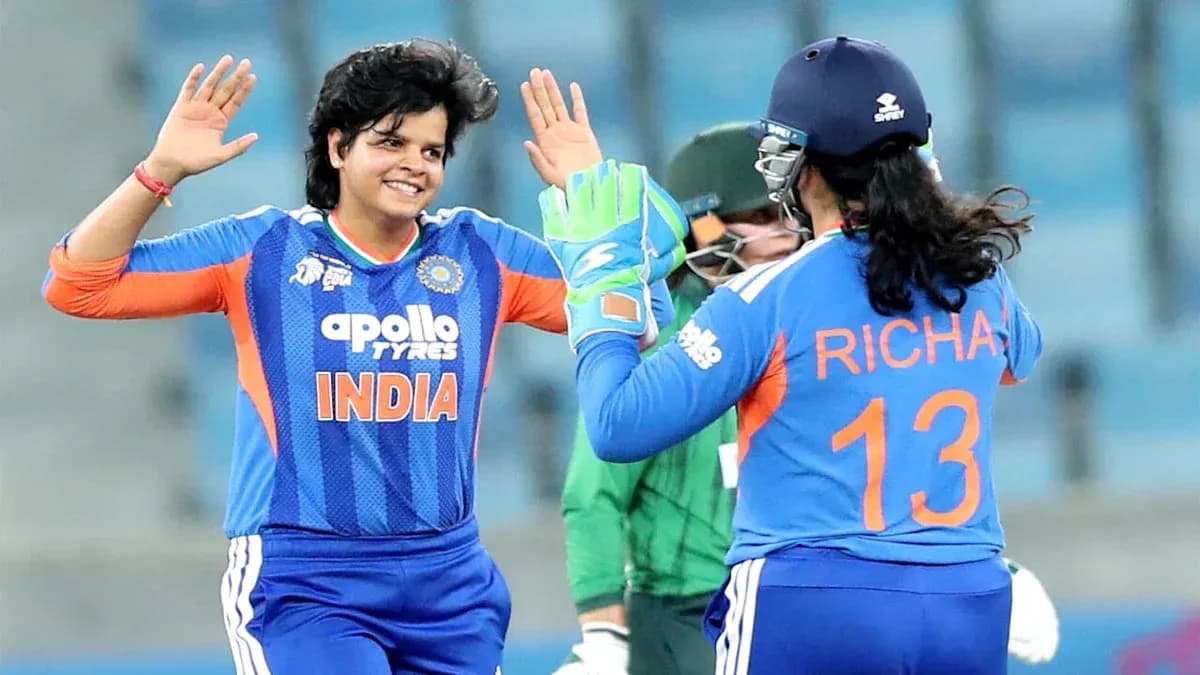
The real damage arrived with Sree Charani in the final over of the powerplay. Two strikes, sharp and decisive, and Pakistan’s innings buckled. What had been a measured platform suddenly looked like a trapdoor. Indian spinners crowded the batters, fielders ringed the inner circle, and the pressure thickened.
The numbers tell the brutality of it. Six wickets for eight runs. A team that had ambled to 27 without loss now gasping at 35/6, unable to stitch together even a modest partnership after the openers.
Charani and Rawat rip through
India’s attack did not let go. Charani, with a clear, uncluttered plan, finished with a remarkable 3 for 7. She bowled tight lines, gave the ball revs, and forced Pakistan’s batters into indecision.
Her own explanation at the break was stripped of glamour, but it matched the performance: bowl to her strengths, more revs on the ball, work on the arm ball, and hit the yorker more accurately. Simple ideas, executed with ruthless clarity.
From the other end, Prema Rawat matched her impact. She grabbed 3 for 9, turning the middle order into a procession. Deepti Sharma, miserly and relentless, chipped in with 2 for 5, while Shafali’s early strike set the tone.
Wickets kept tumbling. No rebuild. No counter-attack. No late flourish. Pakistan were bowled out for 55 in 18.1 overs, never once looking like they could drag the total into something awkward.
For India, it was the kind of bowling performance that justifies pre-match confidence. They had already sealed a semi-final spot with wins over Thailand and Hong Kong. This display underlined why they arrived at this rivalry game knowing their attack could dictate terms.
A landmark match turned sour
The backdrop made the collapse sting even more. This was Pakistan’s 200th women’s T20I, a milestone that should have carried the promise of a statement performance. Instead, it delivered an unwanted record.
Their previous lowest all-out total in the format was 56, also in Dubai, against New Zealand in 2024. Before that, there had been 60 against England in Taunton in 2009, 63 against India in Guangzhou in 2012, 65 against West Indies in St Andrew’s in 2011. Now 55 sits at the bottom of that list, a new low in a city that has already hosted some of their harshest T20 lessons.
For India, the script was far more familiar, and far more enjoyable. This collapse added another dominant entry to their recent record against their neighbours. Coming into this game, India had won nine of the previous ten T20I meetings between the two sides, the only blemish in that run the 2022 Asia Cup defeat. On this evidence, that loss remains the exception, not the rule.
Harmanpreet’s historic day
All of it unfolded on a day when Indian captain Harmanpreet Kaur quietly made history of her own. This was her 150th match as a T20I captain, a record across men’s and women’s cricket. No one has led more in the format.
Her bowlers marked the occasion in the most emphatic way possible: by turning a rivalry game into a mismatch and a landmark for Pakistan into a statistic they will want to erase.
India’s job with the ball was brutal and efficient. Pakistan’s task now is far harder: finding a way to ensure that their 200th T20I becomes a turning point, not just a number pinned to their lowest score.