.svg&w=384&q=75 "logo")
The End of the Trae Young Era: Atlanta Hawks' New Identity
The Atlanta Hawks walked into the offseason with a rare kind of clarity. No more hedging between timelines, no more wondering if Trae Young could be the centerpiece of a contender. They traded their franchise guard, didn’t bring back a single future pick or blue-chip youngster in the deal — and somehow emerged looking more dangerous right now.
Last season’s 46-36 finish and first-round exit don’t tell the whole story. Atlanta was a different animal after the All-Star break, posting the biggest post-break jump in efficiency any team has managed in nearly three decades. They were 11.0 points per 100 possessions better, climbing from a minus-1.3 team to a plus-9.7 juggernaut. That’s not a blip. That’s a shift in identity.
At the center of it all: Quin Snyder, a deep roster, and a defense that suddenly bites back.
A New Backbone, Not a Rebuild
The headline move was obvious. Young out, CJ McCollum in. No draft haul. No “process.” Just a bet that a steadier veteran guard, paired with a rising core, could raise the floor and sharpen the ceiling.
The numbers backed it up immediately. With McCollum in uniform, the Hawks went 27-14, surging from ninth to sixth in the East over the final two months. Yes, the schedule eased up — only eight of their 20 post-break wins came against teams that finished with winning records — but the team’s structure changed. They stopped leaning on one creator and started playing grown-up basketball.
Now they’re deeper. And meaner.
Luguentz Dort arrives to join a perimeter group that already includes Dyson Daniels and Nickeil Alexander-Walker. Aaron Wiggins, fresh off meaningful minutes in Oklahoma City’s 2025 title run and 2026 Western Conference Finals push, slides in as a ready-made rotation piece. Kingston Flemings and Zuby Ejiofor add rookie intrigue. Ryan Nembhard and Henri Veesaar are more tools in Snyder’s box.
This isn’t a top-heavy roster anymore. It’s a toolbox.
Jalen Johnson’s Leap Changes Everything
The Hawks don’t need a traditional “superstar” if Jalen Johnson keeps playing like this.
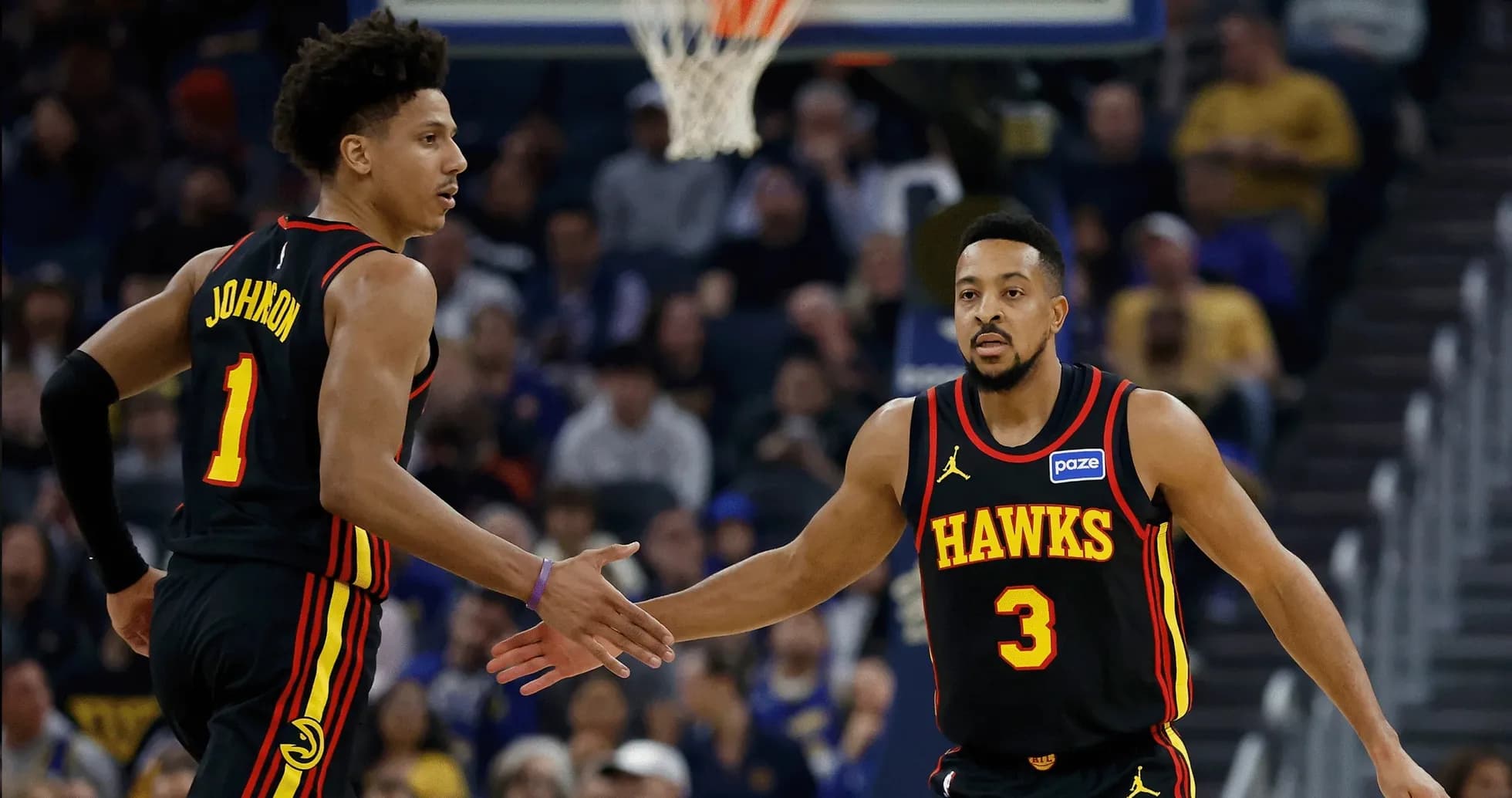
He didn’t just make his first All-Star team last season; he landed on an All-NBA squad while averaging 22.5 points, 10.3 rebounds, 7.9 assists and 1.2 steals. Those are franchise-pillar numbers. They’re also system-defining numbers. Johnson doesn’t just score — he drives the offense, rebounds like a big, and passes like a guard.
Put that kind of do-everything forward next to McCollum’s 18.7 points per game and Alexander-Walker’s breakout, and Atlanta suddenly has three players hovering around the 20-point mark. Alexander-Walker, the league’s Most Improved Player, was no fluke: 20.8 points, 3.7 assists, 3.4 rebounds with elite efficiency (45.9% from the field, 39.9% from deep, 90.2% at the line). Those are “you can’t leave him” numbers.
Onyeka Okongwu quietly rounds out the projected starting five. Fifteen points, 7.6 boards, 3.1 assists. Mobile, physical, and increasingly comfortable as a decision-maker. If Snyder opens the season with McCollum, Alexander-Walker, Daniels, Johnson and Okongwu, he’ll have a lineup that can defend, run, and shoot at every spot.
And if he doesn’t? He has options.
Depth, Defense, and Forty Threes a Night
Snyder has made his preferences clear. He wants a defense that turns you over and an offense that punishes you for every mistake. Transition attacks, quick decisions, and a barrage of 3s — close to 40 attempts per game.
That’s where this roster gets interesting.
If Daniels and Dort share the floor, opposing guards are in for a long night. Throw in Alexander-Walker’s length and instincts, and Atlanta’s perimeter can swarm. One bad pass becomes a runout. One lazy dribble turns into three points the other way.
Behind the starters, Snyder can mix and match based on opponent and feel. Dort, Wiggins, Jock Landale, Ejiofor, Flemings, Asa Newell, Buddy Hield, Corey Kispert and Nembhard give him combinations for every matchup. Need shooting? Hield and Kispert. Need physicality? Dort and Landale. Need energy and length? Wiggins, Flemings, Newell.
Last season, the Hawks finished 14th in offensive efficiency and 10th on defense. Solid, not spectacular. But they already showed they can hit a higher gear: they had the Knicks, the eventual champions, down 2-1 in the first round and looked like the better team for stretches. New York needed to win three straight to escape, then lost only once more the rest of the playoffs.
Atlanta didn’t feel far away. Now they’re deeper, more versatile, and fully committed to this style.
Aaron Wiggins: The Quiet Breakout Candidate
On a roster full of names, Aaron Wiggins might be the one who sneaks up on people.
He was a role player in Oklahoma City, but a valuable one — part of a 2025 championship rotation and another deep run in 2026. In five seasons with the Thunder, he never averaged more than 24.2 minutes per game, and only once did he crack double figures in scoring (12.0 points per game in 2024-25).
The efficiency, though, has always been there. For his career, Wiggins shoots 48.7% from the field and 38% from three. Give a player like that more volume in an offense that encourages quick-trigger threes, and the math starts to tilt.
Atlanta was already a good 3-point shooting team last season but needed cleaner efficiency. Wiggins fits that gap perfectly. He doesn’t need the ball, doesn’t hijack possessions, and punishes teams that help off him. On a deep roster, he won’t see 35 minutes a night, but he doesn’t have to. Fifteen sharp minutes can swing games.
If Snyder trusts him early, Wiggins has the tools to turn “solid rotation guy” into “season-long X-factor.”
The Schedule Will Test Their Nerve
The Hawks won’t have to wait long to find out who they really are.
On Oct. 21, they host the Orlando Magic in a Southeast Division clash that already feels like a measuring stick. The division is crowded with ambition — at least four teams see themselves as playoff material — and last year the top four were separated by just three games. Atlanta and Orlando finished 1-2. The tone for the race can be set in one night.
Then comes emotion. On Nov. 29, the Knicks return for a rematch of that bruising 2026 first-round series. Atlanta led 1-0 and 2-1. The Knicks never looked like a future champion in that matchup, but they walked out of it, regrouped, and dropped just one more game on the way to the title. That night in Atlanta will carry memory and edge.
Feb. 1 brings a different kind of charge: Wizards vs. Hawks, Trae Young’s first game back in Atlanta since the trade. The building will buzz. The fanbase will weigh nostalgia against the new reality on the floor.
A week later, on Feb. 8, the Heat visit in what could be a battle for the division’s top spot, with the trade deadline looming three days later. Decisions, pressure, and playoff implications all wrapped into one.
And as the regular season winds down, the grind hits. On April 4, the Hawks face the star-studded 76ers in what will be their eighth road game in an 11-game stretch. By then, the standings will be tight and the margin for error thin.
Preseason Questions for a Team That Suddenly Has Many Answers
Snyder’s first big task: choose a starting five, then carve out a rotation that keeps everyone engaged without diluting the identity that turned last season around.
The data from last year is compelling. With McCollum, Alexander-Walker, Daniels, Johnson and Okongwu on the floor, the Hawks went 20-10 with a monstrous plus-20.3 net rating. That group defends, moves the ball, and fits Snyder’s blueprint. But now Dort and Wiggins are in the mix, and there’s a case for both to start or close depending on matchup.
Preseason will also be a proving ground for Kingston Flemings, the lottery pick. How quickly can he absorb lessons from McCollum? How ready is he to handle real rotation minutes on a team that expects to win now, not later?
Behind Johnson, the backup power forward spot is up for grabs. Mouhamed Gueye, Asa Newell and fellow rookie Zuby Ejiofor will battle for that role. Whoever emerges will likely find themselves on the floor in meaningful games, not just garbage time.
Atlanta’s transformation isn’t theoretical anymore. They’ve already shown they can play like a top-four team over a sustained stretch. They’ve already taken a swing by moving on from their most recognizable star.
Now the question is simple: in an Eastern Conference that just watched the Knicks storm to a title, are the Hawks ready to crash that party — or are they still one more leap away?