.svg&w=384&q=75 "logo")
Czechs Defeat United States Again in Davis Cup Thriller
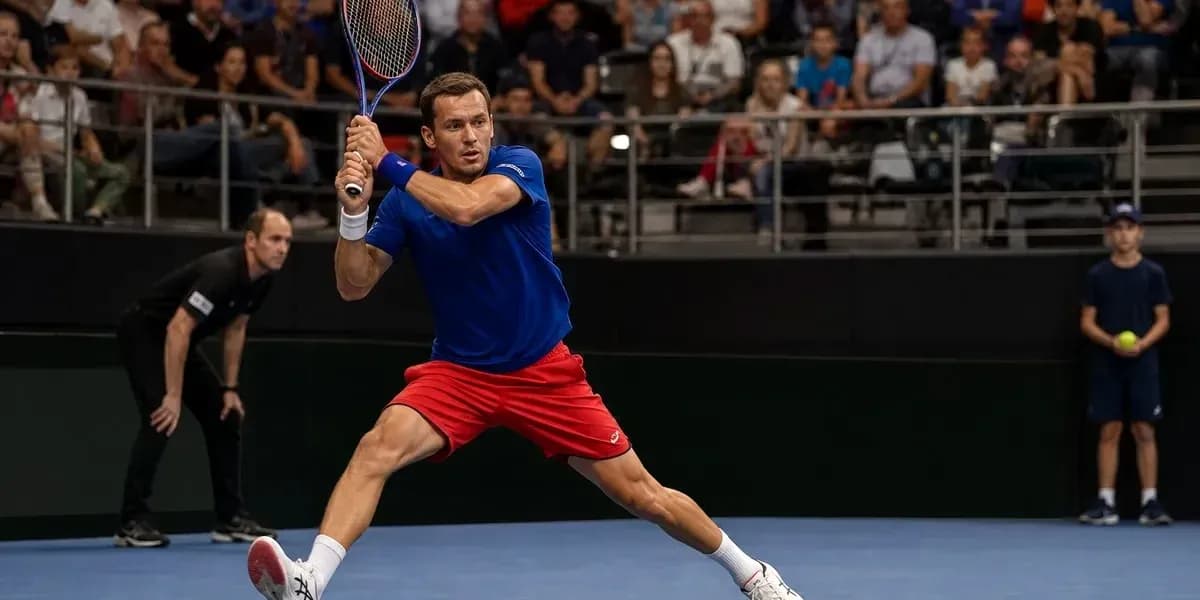
Jiří Lehečka dragged his shirt over his face, roared toward the Prague crowd, and only then allowed himself a smile. The Czech No. 1 had just finished what this team has made a habit of doing: sending the United States out of the Davis Cup in a deciding rubber.
On home clay and under real pressure, the Czechs edged the Americans 3–2 to book their place in November’s Davis Cup Finals in Bologna. Lehečka delivered the final blow, beating Learner Tien 6–3, 7–5 to close a tie that swung wildly across a tense day in Prague.
Czechs repeat the dose
For the second straight year, the United States ran into a Czech wall at the same stage of the competition and fell at the last hurdle. Twelve months ago in Delray Beach, it was Jakub Menšík who stunned Frances Tiafoe in the decisive match. Different city, different opponent, same outcome. The Czechs again held their nerve when it mattered most.
They started the day locked at 1–1, with everything to play for. The visitors struck first. Christian Harrison and Austin Krajicek clawed the U.S. into a 2–1 lead, outlasting Adam Pavlásek and Patrik Rikl 5–7, 6–3, 7–6 (10–8) in a doubles thriller that seemed to tilt the tie decisively.
The Americans stared down four match points in that deciding tiebreak and survived them all. Each escape cranked up the volume on their bench, each save felt like a theft. By the end, the Czech pair walked off shell-shocked, while Harrison and Krajicek roared in the direction of their teammates. Momentum, for the first time in the weekend, wore stars and stripes.
Menšík turns the tide
Then Menšík walked on court and ripped it away.
Facing Ben Shelton, fresh from a run to the US Open final and brimming with confidence, Menšík refused to be overpowered. Shelton took the opening set 7–5 and looked ready to slam the door on the home team. Menšík refused the script.
He tightened his baseline game, found more first serves, and dragged Shelton into longer exchanges. The American’s forehand firepower began to misfire under the weight of Czech resistance. Menšík flipped the match with a 6–4 second set, then ran away with the third 6–3, turning a precarious 1–2 deficit into a 2–2 deadlock and igniting the arena.
Without that comeback, as Lehečka himself later pointed out, there would have been no deciding rubber for him to play.
Lehečka finishes the job
Lehečka had already beaten Shelton in straight sets the previous day, a statement win that underlined his status as the home leader. Against Tien, though, he had to work harder than the scoreline suggests.
Tien broke early in the opening set, quieting the crowd and hinting at an American rescue act. Lehečka answered with authority. He steadied his serve, stepped inside the baseline, and began dictating with his forehand. The break vanished, the set swung, and at 6–3 the Czechs were halfway home.
The second set looked, for a few minutes, like a nightmare rerun of the doubles. Tien surged to a 3–0 lead, striking freely and playing with nothing to lose. The arena tensed. The U.S. bench came alive again.
Lehečka refused to panic. He chipped away at the deficit, game by game, point by point. Once he broke back, Tien’s early freedom shrank under the noise and the moment. The Czech No. 1 pressed harder on return, hunted short balls, and earned himself match points. Tien saved three of them, echoing the doubles drama, but on the fourth Lehečka finally closed the door and sent the Czechs to Bologna.
For Lehečka, the win carried a different weight. This is not the week-to-week grind of the tour; this is a team on your back, a country in the stands. He made it clear that Menšík’s win over Shelton gave him the platform. He just had to finish what his teammate had started.
History for South Korea, relief for Austria
While Prague delivered high drama, other qualifying ties rewrote history elsewhere.
In Seoul, South Korea reached the Davis Cup final eight for the first time. Kwon Soon-woo took on the responsibility and delivered, dismantling Sumit Nagal 6–1, 6–2 to seal a 3–1 victory over India. It was clinical, ruthless, and historic all at once, a performance that pushed Korean tennis into new territory.
Vienna brought its own celebration. Austria punched its ticket to the Finals with a 3–1 win over Belgium. Jurij Rodionov handled the decisive match with composure, beating Zizou Bergs 7–6 (8–6), 6–3 to close out the tie in front of home fans. A tight first-set tiebreak, a more controlled second, and Austria could finally exhale.
They all now converge on Bologna, where hosts Italy will chase a fourth straight Davis Cup crown, trying to extend a modern dynasty on home soil. The United States, the most decorated nation in the competition’s history with 32 titles, will watch from the outside again, their drought stretching back to 2007.
The Czechs, riding another American scalp and a growing belief in a young core, will not be going there just to make up the numbers.