Alex Eala's Hopeful Journey After Tokyo Loss
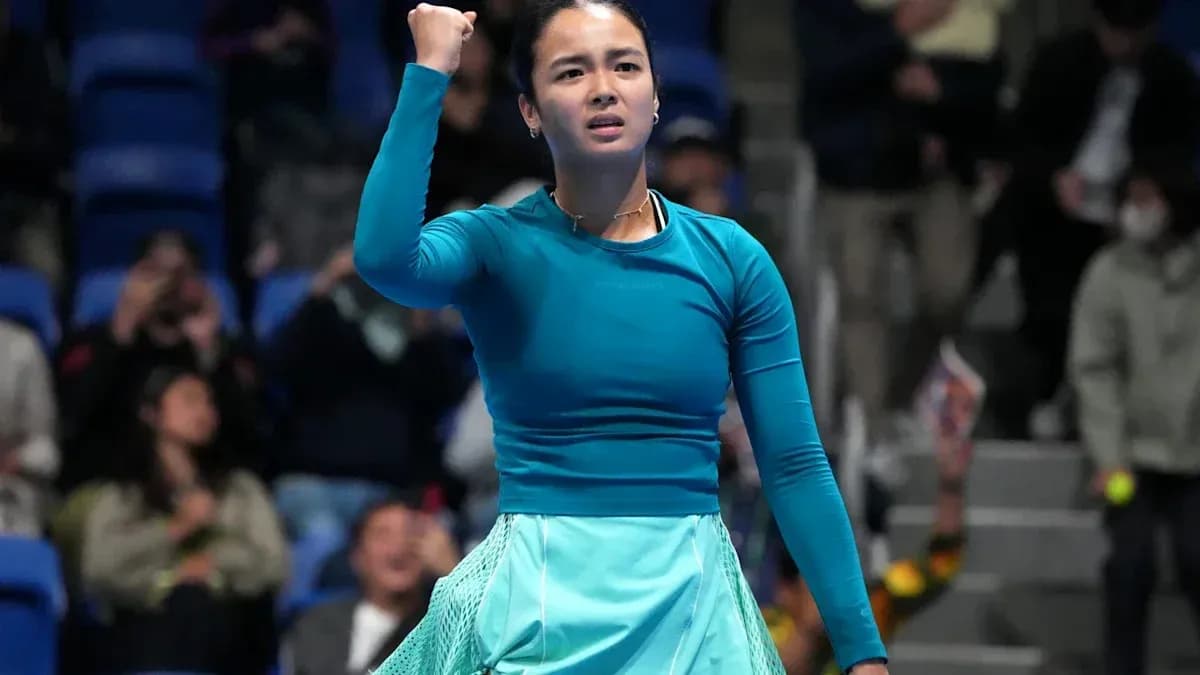
Alex Eala walked out of Tokyo with a quarter-final defeat on her record, but the story of her week in Japan is far more complicated – and far more encouraging – than a simple last-eight exit.
This has already been the season that changed everything for the 21-year-old. Her first WTA title in Washington. A run to the fourth round at Wimbledon. A debut in the world’s top 20. For a few months, Eala stopped being a promising prospect and started looking like a problem for the rest of the tour.
Then came the post‑US Open drag.
Since the final major of the year, the Filipina has won just three of seven matches on the WTA Tour. The ball wasn’t coming off the strings with the same conviction, the early-round exits started to pile up, and the rhythm that carried her through the summer suddenly deserted her.
Twice in that stretch, the player across the net has been Diana Shnaider. Twice, Eala has walked away beaten. But Tokyo felt different.
Pushing the champion to the edge
Their meeting at the Tokyo Open turned into a three-set scrap that said as much about Eala’s level as it did about Shnaider’s resilience. Eala flew out of the blocks, taking the first set 6-2 and putting the Russian under real pressure. Shnaider had to claw her way back, edging a tense second-set tiebreak 7-6(5) before grinding out a 6-4 decider.
It wasn’t just another three-setter. Eala stood two points from a straight-sets win over the player who would go on to lift the trophy.
Shnaider’s title run – her first tournament victory of the 2026 season – ended with a win over Leylah Fernandez in the final, underlining the quality of opposition Eala faced in that quarter-final. Others managed to drag Shnaider the distance in Tokyo, but none came closer to stopping her outright than Eala.
For a player searching for momentum again, that matters. It shows the gap has narrowed. It shows that, even in a stretch of “relatively disappointing results,” as the numbers suggest, her level against a future champion still holds.
The margins are brutal at this level. One player leaves as quarter-finalist, another as champion, and sometimes the difference is a couple of points in a second-set breaker. In that sense, Tokyo was arguably Eala’s sharpest showing since New York.
A different kind of threat in Hong Kong
Now comes the last stop of her 2026 campaign: the Hong Kong Open.
There will be a quiet sense of relief that Shnaider’s name is nowhere in the draw. The threat, though, hasn’t disappeared; it has simply changed shape.
Eala opens against Alycia Parks, a dangerous first-round opponent with the kind of power that can rip through hard courts if she finds her range. On paper, the path from there could run through Tereza Valentova, Xinyu Wang, Maria Sakkari and Sorana Cirstea, based on current rankings.
History offers a mixed picture. Eala is level at 1-1 in her head-to-heads with Parks, Wang and Cirstea, but crucially, she won the most recent meeting against each of them. Those are the kinds of small psychological edges players bank at this stage of the year.
Valentova is a different story.
The 19-year-old Czech, who burst through last season and climbed as high as world No. 42 in May, has been a problem Eala has yet to solve. They have met twice – at the Japan Open in 2025 and the Qatar Open in 2026 – and both times Valentova walked away with the win.
Injury issues and a drop in form have since pushed Valentova outside the top 80, but the matchup remains awkward. For Eala, she might be the most surprising major threat in this Hong Kong field: not the highest-ranked, not the most decorated, but the one she has never managed to beat.
That clash is not guaranteed. Eala must first get past Parks in the opening round, while Valentova needs to handle qualifier Himeno Sakatsume in her own first match. Only if both advance will their mini-rivalry pick up again.
The main draw in Hong Kong begins on Monday, November 2, with Eala and Valentova scheduled to start on Tuesday. One is trying to turn a promising season into a definitive one. The other is fighting to prove that Tokyo was not a near-miss, but a warning of what’s coming next.