.svg&w=384&q=75 "logo")
Bali International Oval: Indonesia's Cricket Hub for the Olympic Era
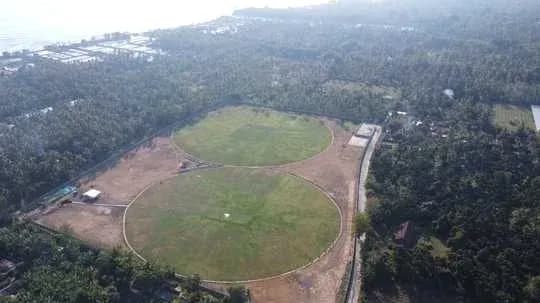
On the quiet, rural stretch of North Bali, far from the island’s crowded beaches and tourist bars, Indonesia is pouring concrete and ambition into a patch of land it hopes will change the country’s sporting future.
Cricket Indonesia is building the Bali International Oval (BIO), a two-oval complex designed not as a showpiece for the occasional tournament, but as the beating heart of the sport in the country – and, if the vision holds, a high-performance hub for the wider Asia-Pacific.
A year-round cricket engine, not a postcard venue
BIO will feature two full-sized turf ovals, both laid out and already taking shape. The footprints are in, the centre-wicket blocks are emerging, and the site is moving from blueprint to reality.
The plan is clear: this is not a stadium that wakes up only when a trophy arrives. It is a year-round facility, built to host international cricket and to grind through the daily work of elite training.
At its core will sit the Garuda National Cricket Academy, the high-performance centre embedded inside the complex. From there, Indonesia’s senior and age-group teams will operate, train, and prepare. The academy is also being pitched as a base for visiting international teams, academies, coaches and curators – a place where touring sides can train, experiment, and recover without leaving the island.
The next construction phase underlines that intent. Wicket maturation, surface refinement, and extensive drainage and irrigation work are scheduled, alongside the installation of specialist ground machinery. Around the playing surfaces, high-performance spaces, team facilities and broadcast infrastructure will rise, turning the ovals into a venue capable of hosting serious international cricket rather than just exhibition fixtures.
A regional hub in the making
Cricket Indonesia is thinking beyond its own borders. The organisation sees BIO as a potential high-performance hub for the Asia-Pacific, a single venue where training, sports science, coach education, athlete recovery and tournament operations can all live under one roof.
If it comes off, Bali could become a regular stop on the calendar for regional teams seeking intensive camps or neutral venues. A place where a developing cricket nation can share space with more established sides, and where coaches and curators can swap ideas in the same nets and on the same squares.
The spark for this ambition was lit in January 2024, when the Asian Cricket Council held its Annual General Meeting in Bali and formally welcomed Indonesia into the ACC family. Jay Shah, then ACC President, played a central role in those proceedings, but what lingered longest for the hosts was the message, not the ceremony.
“When the ACC came to Bali in 2024, the message I took away was bigger than membership. Inclusive leadership had opened a pathway for Indonesia. I felt our responsibility was to build the infrastructure that would allow our players to use that opportunity for generations,” says Abhiram Singh Yadav, chairman of Cricket Indonesia.
The response to that “pathway” has taken physical form in North Bali.
Building for the Olympic era
Timing matters. Cricket is on its way back to the Olympic Games, and Indonesia wants to be ready when that door opens.
BIO is being developed with that horizon in mind. Cricket Indonesia hopes the facility can do two things at once: give young Indonesian players a credible Olympic pathway, and lure international teams and programmes to Bali, sharpening local standards in the process.
“The Olympic return changes the imagination of cricket. A young Indonesian should be able to dream not only of international cricket, but of an Olympic pathway. Our infrastructure must be ready for that era,” Yadav says.
The message is blunt. Dreams need bricks, turf and floodlights.
As the centre-wicket blocks harden and the irrigation lines go in, Bali International Oval is still a construction site. But for a country newly plugged into the regional cricket network and staring at an Olympic future, it already represents something more: a statement that Indonesia intends to be part of the conversation, not just an invited guest.