.svg&w=384&q=75 "logo")
Steve Smith Returns to South Africa: The Legacy of the Sandpaper Scandal
Steve Smith walks back into South Africa this week carrying two things: a bat, and a story that refuses to die.
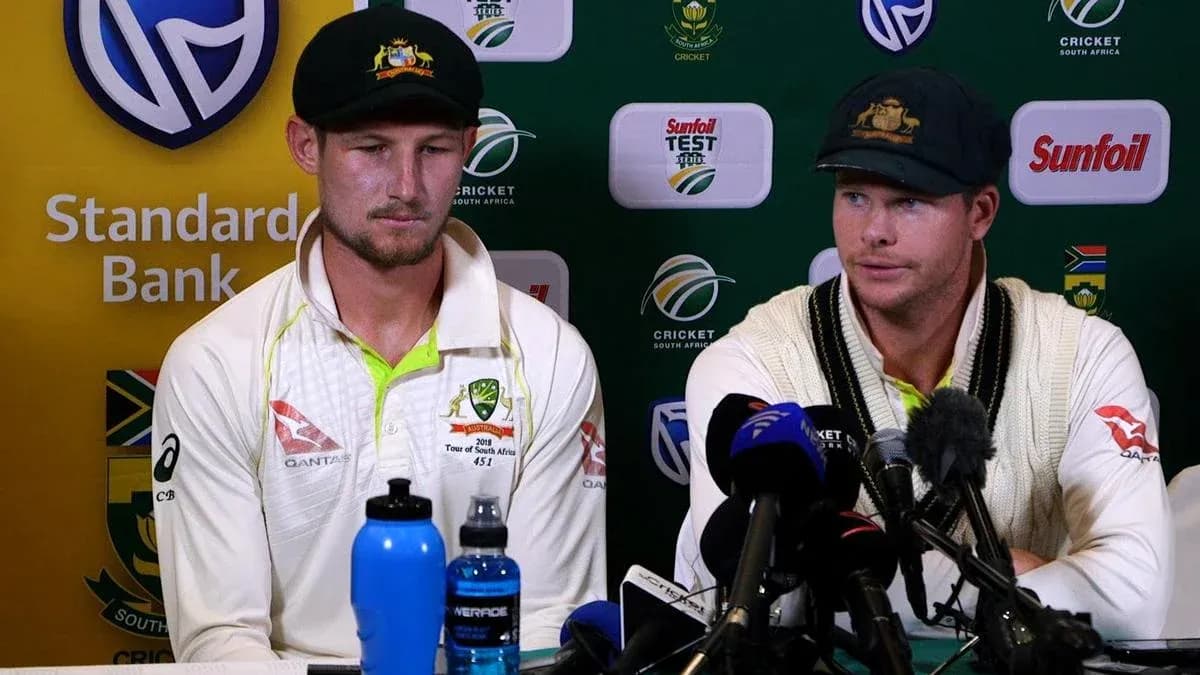
Eight years on from the sandpaper scandal in Cape Town, Australia are back for their first Test series in the country since that extraordinary, shaming afternoon. Last time they were here, Smith was captain, David Warner his vice-captain, and Cameron Bancroft the junior player sent out with sandpaper in his pocket to illegally alter the ball. The laws of the game were clear. So were the cameras.
Smith has since spoken of being “traumatised” by the fallout. The bans, the headlines, the tears at the airport. The sense that he had been, in his own words, “thrown to the wolves.”
The reaction to that line still lingers. Thrown to the wolves? From a man who had pushed a younger teammate towards the fire so that he might avoid it himself.
Redemption, or just runs?
Smith’s cricket since the ban has been astonishing. When he walked out at Edgbaston in 2019, it was to a soundtrack of boos, sandpaper masks and sustained hostility from an English crowd that had no intention of forgiving or forgetting.
He answered with 144 in the first innings. Then 142 in the second.
Over that Ashes series he piled up 774 runs, batting as if insulated from the noise by some private, obsessive forcefield. It was a performance dripping with guts and defiance. For some, it was the beginning of redemption. For others, it only sharpened the question: does scoring runs cleanse what came before, or simply distract from it?
Across the pitch, Warner lived a very different story. In the same series he scraped together 95 runs in 10 innings, dismissed seven times by Stuart Broad, repeatedly exposed, repeatedly walking off to the smirk of a bowler who had him on a string. Then came the response: an unbeaten 335 against Pakistan, the highest score by an Australian in Tests against them. A monument of an innings, yet still not enough to shift the public mood.
As Geoff Lemon, who wrote the definitive book on the scandal, has noted, public opinion eventually settled into a simple frame: Warner the villain, Smith the naive accomplice. One the criminal, the other the bystander.
Reality, as ever, was messier.
Greatness and the blind spot
On the field, Smith is a modern giant. Among players with over 10,000 Test runs, he owns the best average. For a long stretch he sat above 60, second only to Don Bradman in the game’s long statistical memory. His technique is unorthodox, his hunger relentless, his record undeniable.
Yet the way his story is often told — the focus on what the scandal did to him rather than what it did to his team, his opponents, or the game — exposes a gap between self-obsession and self-awareness. The pain is real. So is the selective framing.
Cricket writer Gideon Haigh once summed up the most unsettling part of that Cape Town episode. It was not just that the Australians cheated. It was how quickly the plan was hatched, how easily it was agreed to, how strangely oblivious Smith and Bancroft appeared at the press conference that followed.
That mindset did not emerge from nowhere. It belonged to a culture that had been carefully built: entitlement, aggression, a “win-at-all-costs” mantra that the Australian board happily rode because it produced victories, headlines, eyeballs, sponsorships. The equation was simple. Winning excused everything.
Until it didn’t.
The cost of an artificial game
Smith has said he was “thrown to the wolves” when the scandal exploded. It was a revealing choice of phrase. Here was the captain, the senior man, claiming victimhood in the same breath as he sought sympathy for his own trauma, despite having sent a junior player out to do the dirty work.
Yet it is not hard to see how a cricketer so utterly consumed by batting and by winning might become more human through suffering. He served his ban. He returned to the crease. He faced the boos. He kept batting. Somewhere in that grind, perspective shifts.
There was a time when some argued for a life ban. The anger felt righteous. Then another thought intruded: cricket is, in the end, a game. An elaborate, beautiful, emotionally loaded game, but still an artificial construct to which we attach our own values.
Because it is artificial, we can demand a higher standard of behaviour from it than we manage in the real world. We can insist on ideals that are impossible elsewhere. We can write a “spirit of cricket” and staple it to the front of the laws as a plea, almost a warning, that the unwritten rules — the pride and essence of the sport — are being eroded.
That need says less about cricket itself and more about the players, and the times, that forced such a preamble into existence.
The weight of a single act
Many international cricketers felt the bans on Smith, Warner and Bancroft were harsh. They pointed to the broader “Australian way” — the sledging, the chest-beating, the line that was always being pushed — as a deeper culprit.
Trevor Chappell knows what it means to be defined by one act. He was the bowler instructed to deliver an under-arm ball to a New Zealand batter in 1981 to prevent him from hitting a six to tie a one-day match. The incident became a national stain. For decades, Chappell carried it.
“(Smith and the others) will struggle for the rest of their lives,” he said. “I haven’t been able to shake off what happened to me in 37 years. I come up on Google as the man who took the lead role in Australian cricket’s darkest day. It’s a relief I can finally drop that title.”
That dubious crown now sits with Smith and Warner.
When Smith returned to South Africa on a white-ball tour, the reception was gentler than many expected. No baying mobs, no endless chorus of abuse. Just the odd jeer, the occasional reminder that the past never quite goes away.
He knows it will be the same this time. Every ground holds a chant ready-made for him. Every innings begins with that history trailing behind him like a shadow.
The bans ended long ago. The real sentence — the one handed down by memory, by crowds, by the way his name will always be introduced — is still being served.