.svg&w=384&q=75 "logo")
Razaullah's Six-Hitting Masterclass Sparks Pakistan's Incredible Comeback
Edgbaston expected a procession. It got pandemonium instead.
On a day that was supposed to rubber-stamp England’s three‑Test sweep, a 21-year-old debutant with a brand-new passport and the No.9 on his back tore up the script and launched Pakistan into a position nobody saw coming.
Pakistan, humiliated in Leeds and at Lord’s, skittled for 133 in the first innings and 320 behind after England’s 453, were meant to fold. Instead, they roared to 449 all out in the last over of day three, carved out a lead of 129, and dragged this Test into a fourth day that felt unthinkable on Thursday night.
England now need 130 on Sunday to complete their first three-Test whitewash since 2024 at this very ground. They will have to earn it.
From crisis to counter-attack
This was a Pakistan side in chaos a week ago. Seven players sent home, the head coach sacked, three debutants parachuted into a shell-shocked squad. Across the first two Tests they hadn’t reached 200 once or lasted 50 overs. Their first innings here? 133 all out. The series looked like a mismatch.
England’s 453, built with ruthless assurance, seemed to end the contest. Pakistan began their second innings 0-2 on Thursday evening and looked on course for another bruising.
Instead, across a remarkable Friday, they peeled off 397 runs in 84 overs, stitched together their first two century stands of the tour, and turned a dead rubber into a live fire.
The pitch softened. The ball stopped misbehaving. England’s discipline frayed. Joe Root’s captaincy came under the microscope as fields scattered and plans dissolved. For the first time in the series, England were the ones grinding.
By lunch, Pakistan were 184-3, the mood transformed by a 125-run stand between left-handers Shan Masood and Azan Awais. Awais, compact and busy, punched 10 fours in an 84-ball 59 before a feather behind was finally confirmed on review.
Masood, nimble on his feet and intent on driving Pakistan out of trouble, survived a sharp chance at point and moved past fifty from 81 balls. He looked nailed on for a cathartic hundred until Dan Lawrence flung himself low in the slips, scooping up a superb ankle-high catch to give Gus Atkinson his first wicket of the match. Masood fell for 95, five short of a landmark that would have echoed around this dressing room.
Babar steadies, then falls
If Masood laid the foundation, Babar Azam restored belief. The captain, searching for his first Test century in 20 matches, played with the quiet authority Pakistan have been desperate to see from him in this format.
He threaded gaps, picked up length early and, for long stretches, looked untouchable. England tried to ruffle him with the short ball. They thought they had him on 69, only for substitute fielder Theo Wylie to brush the boundary rope and hand Babar a reprieve.
The warning wasn’t heeded. Just before tea, Josh Tongue went short again, Jordan Cox flung himself to complete an acrobatic catch, and this time there was no escape. Babar was gone for 76, another innings that promised a hundred but fell short.
At 306-6, when Saud Shakeel — having quietly moved past 2,000 Test runs and repeatedly dropped the ball just out of reach of frustrated fielders — finally succumbed to a Jofra Archer bouncer for 29, Pakistan’s last recognised batter was gone. The deficit still loomed. England sniffed blood.
Atkinson, who had only one wicket all series before this day, then cut through the lower order. Debutant Ghazi Ghori departed at 312, Mohammad Imran at 318. Pakistan were still two runs away from making England bat again.
The script said collapse. The crowd braced for it.
Then Razaullah walked in.
Razaullah rewrites the day
He has a first-class century to his name, but nothing in his brief career hinted at what followed. On debut, having only just secured his first passport, Razaullah Khan turned Edgbaston into his personal launching pad.
His method was simple, his intent unmistakable. “I just had to bat. You were the ones who enjoyed it,” he told Sky Sports in translated comments afterwards. He talked about taking it “long and deep”, about seeing the ball in the slot and going after it. He insisted he never felt fear. The evidence backed him up.
His very first six hauled Pakistan into the lead. The celebration was understated; the statement was not.
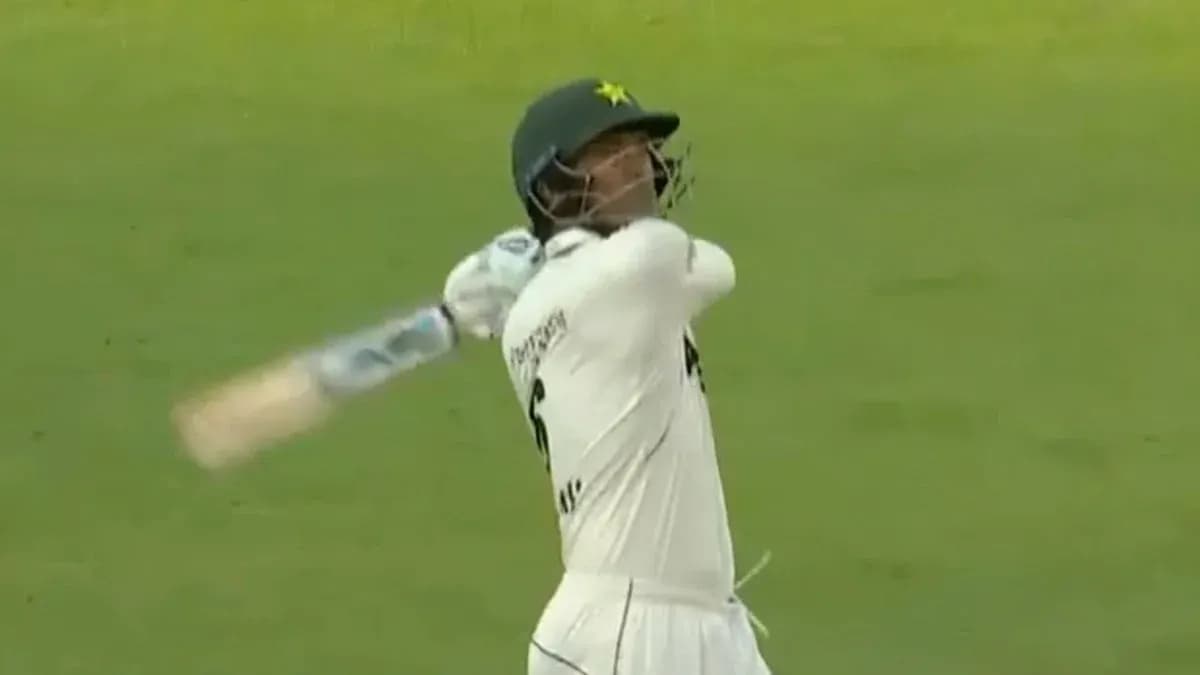
Gus Atkinson copped the first sustained barrage. One over disappeared for three towering sixes as Razaullah swung with brutal clarity, clearing his front leg and sending the ball deep into the stands. Archer then wore the next wave. Razaullah’s fifth six, off Archer, brought up a 43-ball fifty. The next, also off Archer, carried Pakistan to 400 and sent the dressing room to the balcony in disbelief.
England’s lines disintegrated. Fields scattered to the rope. Every misjudged length was punished. The noise inside Edgbaston shifted from English expectation to a kind of stunned admiration.
At the other end, Mohammad Abbas played the perfect foil. Traditionally a bowler who bats deep in the order, he produced the innings of his life: 42 runs, two sixes, five boundaries, and a calm presence as the ninth-wicket stand swelled into something historic.
Together they added 121 runs from 123 balls, the highest ninth-wicket partnership against England since 1984. Every over seemed to tilt the game further away from a formality and towards a contest.
Abbas eventually fell, caught for his career-best 42, and walked off to a standing ovation that captured the sense of what Pakistan had salvaged. Razaullah followed him soon after, stumped for 81 from just 63 deliveries, having equalled the record for most sixes in a Test innings in England — nine, level with Ben Stokes’ famous 2023 Ashes onslaught at Lord’s.
He left the field to the same ovation, his name already echoing as a new cult hero. As former Pakistan captain Ramiz Raja put it on the BBC: “The first time he's been out for Pakistan ever, and absolutely lights up the show.”
England rattled, series reignited
By the time the last wicket fell in the final over of the day, Pakistan had surged to 449. From 0-2 on Thursday night and 320 behind on first innings, they now stood 129 runs ahead, the mood in the ground transformed.
England’s attack, rampant all series, finally looked human. The ball refused to swing, the pitch refused to misbehave, and the lines and lengths wavered under pressure. Questions followed Root off the field about his tactics, his fields, his use of his quicks.
Pakistan, written off and reshaped in panic only days ago, suddenly looked alive. They had unearthed a player with the kind of fearless, modern Test-game tempo that selectors crave. “They've unearthed a gem,” former England captain Michael Vaughan said on the BBC, summing up the sense of discovery around Razaullah.
Now the equation is brutally simple. England need 130 to finish the job and complete their whitewash. Pakistan need early wickets, noise, and one last surge of belief.
After a day like this, who dares predict how it ends?