.svg&w=384&q=75 "logo")
Miami Heat's New Era: Giannis Joins the Team
The Miami Heat spent years circling the idea of a megastar to reboot their timeline. This summer, they stopped circling and crashed straight through the door.
Giannis Antetokounmpo is in Miami.
A two-time MVP, an NBA champion, the most destructive transition force of his era — and now the centerpiece of a franchise that finished 43-39 last season and slipped out of the playoffs in the SoFi Play-In Tournament. The move doesn’t just change Miami’s ceiling. It rewrites the way this team will look, feel and play.
From Play-In Frustration to Frontcourt Superpower
Last season’s Heat were feisty but flawed. Tenth in the East, too often grinding in the half court, living on effort and edge more than overwhelming talent.
That’s over.
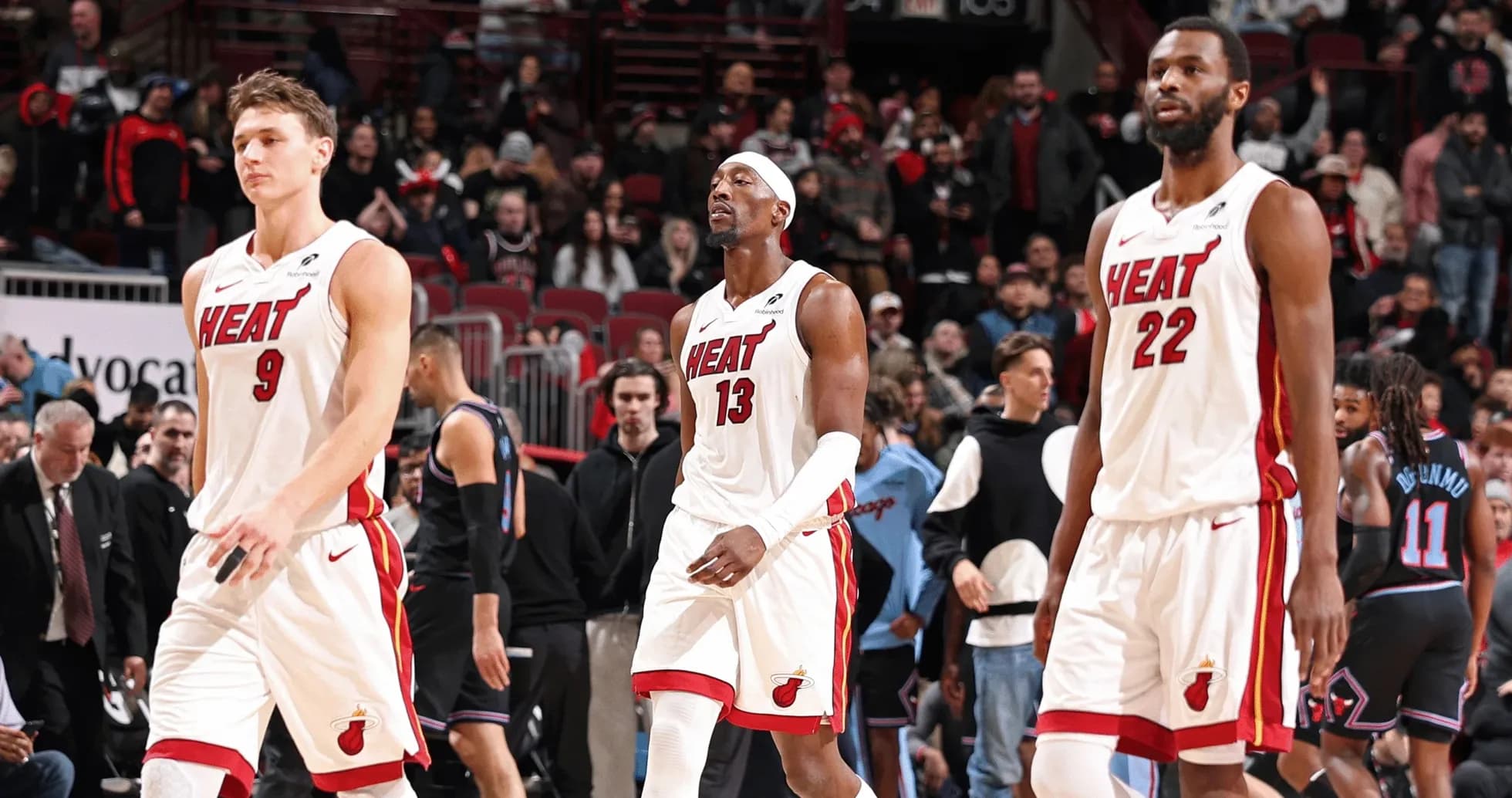
Antetokounmpo joins Bam Adebayo to form what might be the most terrifying frontcourt in the league. Two elite defenders. Two paint protectors. Two playmakers who can grab a rebound and instantly turn defense into offense. Opponents will see a wall, and behind that wall, another wall.
Half-court spacing will still be a question. Neither Antetokounmpo nor Adebayo stretches defenses from deep. But Miami has attacked that issue with intent, not hope.
- Tim Hardaway Jr. arrives after drilling 224 3-pointers last season at 40.7%.
- Klay Thompson, even after a dip from his peak, still hit 202 triples at 38.3% and should feast on cleaner looks with defenses collapsing on Giannis.
- Andrew Wiggins quietly knocked down 138 threes at 41.4%.
- Bobby Portis, one of the league’s deadliest stretch bigs, hit 135 and an absurd 45.6% from beyond the arc, one of just two players in the past five years to finish top five in 3-point percentage at least twice.
The question of “Where will the shooting come from?” now has a simple answer: everywhere around the stars.
Veteran Edge, Championship Scars
This is a grown team.
Antetokounmpo, Adebayo, Wiggins, Portis, Thompson and Hardaway have all logged at least nine NBA seasons. Between them: championship rings, Finals runs, All-NBA nods, an MVP, a Sixth Man of the Year candidate and years of playoff battles.
Erik Spoelstra doesn’t have to teach this group how to compete in May and June. He just has to figure out the best way to get them there.
Davion Mitchell brings on-ball pressure and toughness in the backcourt. Portis adds scoring and nastiness off the bench. Nick Richards provides size and physicality at center. This isn’t a rebuild. It’s a retool around a superstar.
Spoelstra now walks into a coach’s dream and a headache all at once: too many options, too many combinations, and a mandate to make it all sing.
A Team Built to Run
The Heat already reinvented themselves once. Last season, 24.9% of their possessions came in transition — the highest rate in the 22 seasons Synergy has tracked play types. They stopped waiting for the half court to save them and leaned into chaos, pace and early offense.
Now they’ve added the best transition battering ram in basketball.
Over the last five years, Antetokounmpo has averaged 1.21 points per possession in transition. The rest of the league sits at 1.13. Give him a runway and a sliver of space, and the possession is almost over before the defense can organize.
Half-court offense will still have its rough nights. Packed paints, daring Giannis and Bam to shoot. But with those two erasing mistakes on the back line, Miami can gamble, press and fly. The Heat should keep running — only now, every miss or turnover by the opponent feels like a potential avalanche.
Pelle Larsson’s Window
Lost in the noise of star power is a quieter, intriguing subplot: Pelle Larsson.
On a roster featuring Antetokounmpo, Adebayo, Wiggins, Thompson and Hardaway Jr., a third-year guard doesn’t get many headlines. He will have to take them.
Larsson averaged double figures for the first time last season — 11.4 points per game — while shooting 49.6% from the field. He had 26 games with at least 15 points, a sign he can scale up his aggression when needed. The issue is clear: his career 3-point mark sits at 32.8%. On this team, with this spacing puzzle, that number has to climb.
The early signs are encouraging. In FIBA World Cup qualifying with Sweden, Larsson has averaged 26 points over his last four games, including 31 against Finland and 23 against France in late August. Different game, different stage, but the confidence translates. If he can carry even a slice of that scoring punch into the NBA season, Miami’s depth gets dangerous.
On a veteran-heavy roster, there’s a lane for one young guard to break through. Larsson has the ball in his hands. What he does with it may decide how versatile this rotation really becomes.
Spoelstra’s Lab
Training camp in Miami will feel less like drills and more like experimentation.
Antetokounmpo’s integration is priority one. How often does he handle? How often does he screen? Does Spoelstra lean into Giannis-at-center lineups with shooters everywhere, or keep him tethered to Adebayo to form an impenetrable defensive spine?
The projected starting five of Mitchell, Thompson, Wiggins, Antetokounmpo and Adebayo offers length, shooting and switchability. It also raises questions: who initiates late-clock offense? How do they stagger Giannis and Bam to keep one elite playmaker on the floor at all times?
Behind them, the bench is a blend of youth and experience that needs definition. Nikola Jović offers size and skill on the perimeter. Simone Fontecchio brings more shooting and movement. Richards gives Spoelstra a traditional big to soak up minutes when Bam or Giannis sit.
Then there’s the backup point guard riddle. Does Spoelstra go by committee, leaning on Mitchell, Larsson and secondary playmaking from Wiggins and Giannis? Or does Miami use an open roster spot to bring in a more traditional organizer?
Those are not minor details. On a team with this much star wattage, the margins — the eighth, ninth, tenth men — often decide playoff series.
Dates That Will Define the Story
Some nights will carry more weight than others.
Opening night, Oct. 21, against the Timberwolves, is the first real glimpse of Giannis in Heat colors. The first transition break, the first pick-and-roll with Adebayo, the first time the crowd roars as he barrels through a backpedaling defense.
On Nov. 27, the Knicks visit during a brutal stretch where Miami faces eight playoff teams from last season in a nine-game span. In the middle of that gauntlet sits Antetokounmpo’s first meeting with his old team, the Bucks — the lone non-playoff opponent in that run, but emotionally, the loudest.
Christmas Day brings the Celtics to Miami. Boston made its own push for Giannis and came up short. The league rarely needs extra drama on Dec. 25. This one has it built in.
Jan. 28 in Milwaukee will be different. Antetokounmpo’s first return, under the bright lights of Prime Video, a night that will double as a tribute to his 13 seasons with the Bucks and the 2021 title he delivered. A celebration for one fan base, a reminder for another of what they’ve just acquired.
And then there’s April 8. LeBron James and the 76ers in Miami, third-to-last game of the regular season. The Heat chased James too this summer. He chose Philadelphia. By then, the standings will add another layer: seeding, tiebreakers, and perhaps a preview of a playoff collision.
A New Standard in Miami
The Heat didn’t trade for Antetokounmpo to be interesting. They traded for him to contend.
They already lead the league in pace-shifting ambition, turning nearly a quarter of their possessions into transition chances last season. Now they have the most devastating open-floor weapon of his generation, a retooled shooting cast, and a coach who relishes turning complexity into an edge.
The play-in is no longer the bar. The question now is sharper, colder, and exactly how Miami likes it:
With Giannis in the building and Spoelstra on the sideline, anything less than a deep run — how long will this city tolerate that?