.svg&w=384&q=75 "logo")
Japan's Asian Games Squad Reflects Pathway Development
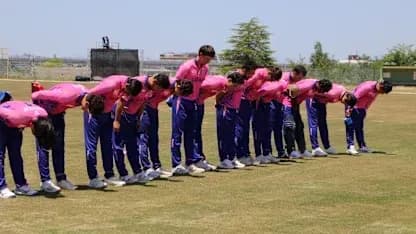
Japan have drawn a clear line in the sand for their Asian Games campaign, sacrificing some of their most recognisable T20I options to build a squad that fits the tournament’s stricter eligibility rules – and, crucially, reflects the depth of their own pathways.
By choosing not to select players who qualify for T20Is under ICC regulations but fall short of Asian Games criteria, the selectors have opened the door for a different kind of side. Less star power. More continuity. A group stitched together from schools, age-group triumphs and years of patient development.
At the heart of it is Jake Kusuda-Nairn. The spin-bowling all-rounder has forced his way in the old-fashioned way: weight of performances in domestic cricket. No shortcuts, no sentiment. His call-up underlines the message that Japan’s domestic scene now produces players ready to step into international multi-sport events without leaning on overseas-based stop-gaps.
There is also a sense of a circle closing with the recall of Tsuyoshi Takada. He first pulled on Japan colours at the ICC East Asia-Pacific Twenty20 Championship in 2013. A decade on, he returns to a national set-up that looks very different – more structured, more layered – but still needs his experience as it chases credibility on a bigger stage.
Squad Composition
The squad list reads like a roll call of Japanese cricket’s most important experiments. Wataru Miyauchi and Makoto Taniyama both came through Japanese schools running cricket Bukatsu programs, proof that the once-ambitious idea of embedding the game in the country’s club-based school culture now has tangible results.
Taniyama carries more than just a neat backstory. A leg-spinner who taught himself by watching Shane Warne clips on YouTube, he bowls in the shadow of a legend and wears shirt number 23 in tribute to the Australian icon. The homage is not hollow. He stands as Japan’s leading wicket-taker across all pathway and international competitions, the statistical backbone of a side that often leans on spin to close the gap on more established nations.
Youth success also threads through this group. Charlie Hara-Hinze, part of the Japan U19 team that famously beat Tanzania at the U19 Cricket World Cup, steps back into the spotlight. That victory was a landmark moment for the country’s age-group programme; now, players from that campaign are being asked to carry the same belief into senior colours.
There is a quieter but significant boost with the return of spinner Benjamin Ito-Davis. His East-Asia Pacific T20 World Cup 2028 Sub-Regional Qualifier ended abruptly with a hand injury, cutting short a promising tournament. Now fit again, he slots back into a spin unit that already looks like Japan’s strongest suit.
Competitive Landscape
All of this sits against the backdrop of a team still alive in the race for the 2028 T20 World Cup. Japan finished second at that Sub-Regional Qualifier, level on points with Papua New Guinea and separated only by net run rate, despite beating the Barramundis on the final day. The margins were brutal, but the message was clear: Japan are no longer turning up just to learn; they are turning up to compete.
So the Asian Games squad is more than a list of names. It is a statement of intent. A bet on local pathways, school Bukatsu programmes and a generation raised on streamed footage and long train rides to weekend fixtures.
The question now is simple: can this homegrown core turn promise into a breakthrough on one of Asia’s biggest sporting stages?