.svg&w=384&q=75 "logo")
British Tennis: Progress Amidst Frustration
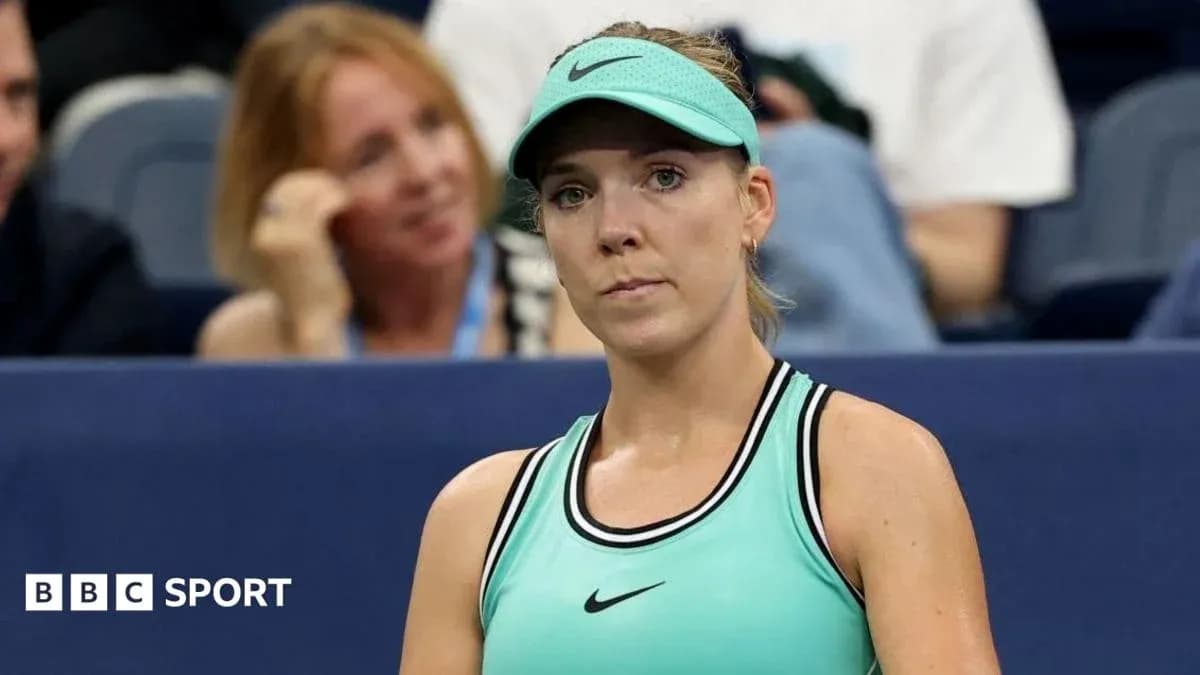
British tennis will once again watch the second week of a major from the outside looking in. For the fourth time in the past five Grand Slams, there will be no British singles player involved when the US Open narrows to its business end.
This used to trigger full-scale inquests. It did after the Australian Open. It did after Roland Garros. It certainly did after Wimbledon. This time, the mood is different. Frustration, yes. Alarm, no.
“I always think there's things that British tennis could do better. So yes, definitely,” said British women's number three Francesca Jones. “Do I think it's something that's concerning? No, not at all. The level is getting better and everyone is dangerous on their day.”
That tension – between progress and underachievement – now defines the state of the British game as the Grand Slam year closes.
Fery’s breakout and the case for optimism
Strip 2024 down to its sharpest highlight and one name stands out: Arthur Fery.
The 24-year-old arrived at Wimbledon ranked 114 in the world, in on a wildcard, and with modest expectations outside his own circle. He left as a semi-finalist, the only British player to reach the second week of any Slam this year and an emblem of what the Lawn Tennis Association insists is a system starting to bear fruit.
Nobody saw that run coming. Not at that scale, not with that composure. It gave the home crowd a new face to cling to and gave British tennis bosses a tangible example when they talk about “pathways” and “productivity”.
They can point to the numbers, too. Nine Britons made the US Open main-draw singles this year, the highest total since 1981. That tally does not even include 2021 US Open champion Emma Raducanu or Jack Draper, both sidelined by long-term injuries.
“We obviously want more and more competitors in the second week of Slams – just like the British public,” said LTA chief executive Scott Lloyd. “But the fact we've had four different British players make Grand Slam semi-finals since 2021 – you have to go back 30 years before Andy Murray to have four – shows there is no question that the direction of travel has improved.
“We've just got to keep driving for more – and that's what we're trying to do day in and day out.”
On the rankings sheet, there are signs of depth, at least on the men’s side. After the US Open, five British men are set to sit inside the world’s top 100: Fery, Cameron Norrie, Jan Choinski, Toby Samuel and Jacob Fearnley. That is the strongest male presence since February 2024.
The women’s picture is thinner but not empty. Katie Boulter and Raducanu will both be in the top 100, with Jones and Harriet Dart nudging back towards that bracket after runs to the second round at Flushing Meadows.
“We've sent 12 players to the world's top 100 over the past eight years and four of those have played Grand Slam semi-finals,” said LTA performance director Michael Bourne. “I'm not sure what other period in the modern era where we've had that level of productivity. Hopefully the number in the top 100 will rise over the next year.”
The weight of expectation
And yet, the questions never really go away.
Britain hosts Wimbledon. It enjoys a rich tennis history and a financial base most nations envy. Against that backdrop, five top-100 men and two top-100 women feel like a modest return. The sense that Britain still punches below its weight lingers.
Injuries have muddied the picture. Draper, once tipped as a top-10 lock and a future standard-bearer, has barely played over the past year because of an arm injury. Sonay Kartal, who broke into the top 50 last year, has slipped outside the top 100 after a serious back problem.
Those absences matter. They strip away not just ranking points but momentum and visibility, the sort of regular second-week appearances that normalise British success on the biggest stages.
Even with that context, the global comparison is stark. Britain has fewer players in the top 100 than the United States, Australia and France, all of whom also enjoy the financial muscle that comes with hosting a Grand Slam. It also sits behind Spain, Italy, the Czech Republic and Argentina, countries routinely praised for the sheer volume of high-level players they produce.
Bourne, though, rejects the idea that Britain can simply copy and paste a foreign model.
Every nation, he argues, has its own “tennis ecosystem” – its own culture, geography, climate, funding structures. What works in Spain’s clay-court crucible or Argentina’s club-driven scene does not automatically translate to Britain’s indoor-heavy, weather-dependent set-up.
Lloyd backs that stance but knows the optics.
“We're competing in one of the most internationally elite sports out there and the landscape is vastly different to 40 or 50 years ago in terms of the number of countries which have representation at the top,” he said. “We're ambitious, we want to drive for more, but we honestly believe the indicators are positive. We're moving in the right direction and stronger than where we have been historically.”
The pipeline problem
For all the talk of rankings and semi-finals, the real battle starts much earlier – with a child picking up a racquet for the first time and deciding to come back the next week.
On that front, the raw participation numbers look impressive. According to Lloyd, 4.3 million juniors play tennis in Britain each year, with 1.9 million playing every month. Both figures are all-time records.
Draper, Raducanu and Fery offer the template: talented kids who entered the LTA system early and climbed through its layers to the top of the professional game. The question is how many more can follow without falling away.
Because beneath the headline figures lies a familiar fear – that too many promising players are being lost, not through lack of talent, but through lack of access.
Bourne concedes the point from a structural angle. Britain, he says, needs a “higher base” of quality coaches. One of the LTA’s key strategies is to “spend time and effort” developing that coaching pool so that more juniors, in more places, receive the sort of guidance that turns enthusiasm into excellence.
On the ground, the picture looks harsher. Chris Marshall, a senior performance coach with more than 25 years in the sport and founder of the Young Champs programme, sees families hitting a financial wall long before their children hit a competitive ceiling.
“To fund a 12-year-old at county level right now requires anywhere from £500 to £1,000 a month for coaching, travel, and tournament fees,” Marshall told BBC Sport. “It is a massive, stressful financial barrier that makes the sport a non-starter for the vast majority of British families.
“We can't sit around lamenting the lack of British interest in the second week when we are restricting the pipeline that feeds it.”
That is the crux. Britain can celebrate record junior participation and point to a handful of breakthrough stories, but if the route from public court to pro tour remains this expensive, the sport will keep drawing from too narrow a pool.
Progress or plateau?
So where does that leave British tennis as the Grand Slam season shuts its doors for another year?
On one hand, there is a clear uptick in depth, more players in and around the top 100, and a recent run of semi-finalists that would have felt fanciful in the years before Andy Murray. On the other, there is the cold reality of another second week without a British flag on the singles schedule and a global landscape in which rivals keep churning out top-50 talent.
Jones insists there is no cause for panic. Lloyd and Bourne talk of direction and indicators, of systems and strategies. Marshall talks of cost and access. The numbers offer encouragement and indictment in equal measure.
The next wave – the children now filling those record participation charts – will decide which story wins.