.svg&w=384&q=75 "logo")
Aatif Nawaz Critiques PCB's Purge After England Series
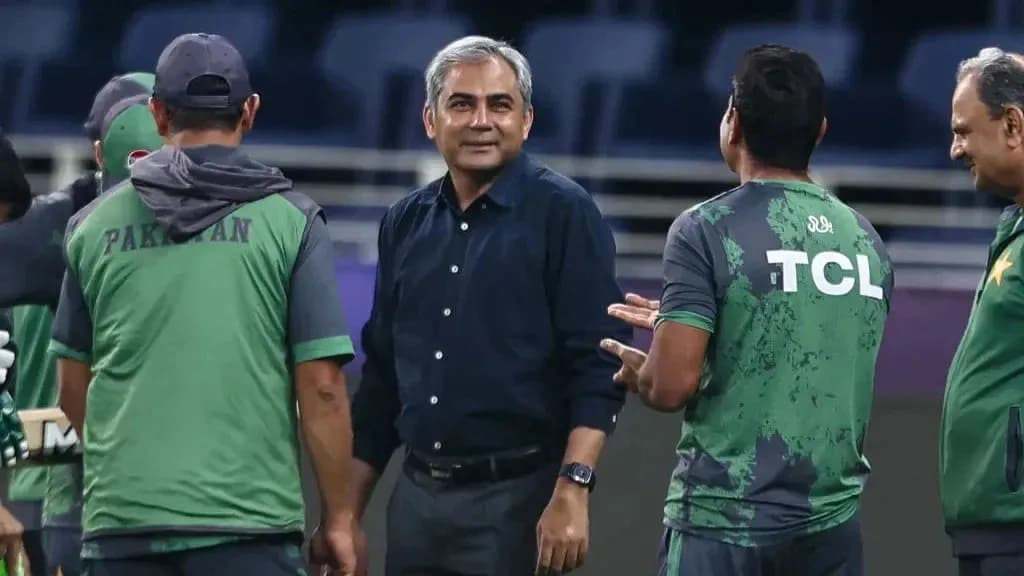
The inquest into Pakistan’s bruising tour of England has quickly turned on the Pakistan Cricket Board, and one voice cut through the noise with particular clarity. British-Pakistani broadcaster Aatif Nawaz, speaking on the *For The Love Of Cricket* podcast with Stuart Broad and Jos Buttler, took aim not at the players who failed with the bat, but at the decision-makers who responded with a sweeping cull.
Pakistan’s 2-0 series defeat was confirmed at Lord’s. Within hours, the PCB detonated the set-up: seven players ordered home, head coach Sarfaraz Ahmed dismissed, bowling coach Umar Gul also removed, and five uncapped players summoned for a dead-rubber third Test at Edgbaston.
The batting had been a shambles. Across four innings, Pakistan never once reached 200. Nawaz did not try to defend that. What he questioned was the logic of a response that seemed to ignore where Pakistan actually competed.
“Get rid of your head coach, get rid of your bowling coach. What’s the bowling coach done? His bowlers took enough. They took all the wickets,” Nawaz said on the podcast. “At least the bowlers at Lord’s got the wickets. It just seemed like the kind of move you do when you’re trying to placate the angry voices in your country.”
That was the nub of his argument. Pakistan’s attack had done its job. The batsmen had not. Yet the clear-out swept through both departments as if nuance no longer mattered.
The instability, Nawaz argued, is no longer a quirk of Pakistan cricket. It is a defining feature.
“It’s very hard to keep track of who’s the batting coach, who’s the bowling coach, who’s your chief selector, who’s your captain, who’s your vice captain,” he said. Roles change so quickly that players can scarcely keep up. “He could be captain one game and then the 12th man the next, as Salman Agha found out in this test series.”
One Test, one bad week, and careers are suddenly in limbo. That is the environment Nawaz sees developing, and it worries him far more than a single scoreline.
He did acknowledge the one argument the PCB might cling to. The third Test is a dead rubber. Pick the same XI and they probably get steamrollered again by an England side in full flow. So, the reasoning goes, why not rip it up and try something radically different?
“It’s a dead rubber,” Nawaz said. “You could say if you play the same 11, they would be bound to get dominated by England again. So you have to try something drastically different. That’s the defence of the move, I suppose.”
But his real fear lies beyond Edgbaston, beyond this tour, in the message such volatility sends to anyone dreaming of a long red-ball career in Pakistan colours.
“What kind of message are you sending to the next generation of Pakistan cricket players who want to play red-ball cricket for Pakistan? Why would they want to do that?” he asked. If Test caps come with no security, if one poor series can trigger a public execution of careers, why would a young player not turn his back on the format and chase the stability and money of white-ball leagues?
Pakistan already loses players to the franchise circuit. Test cricket cannot compete financially. Now, Nawaz warns, it may not even be able to compete on security. A board that discards seven players and two coaches in one announcement after one wretched week simply confirms every fear those players already harbour.
The detail that lingers is the bowling coach. At Lord’s, Mohammad Abbas took nine wickets and etched his name onto the honours board. Pakistan’s attack, under Umar Gul’s watch, did what any coach would demand: they created chances, they finished them, they gave their side a foothold.
Days later, Gul was out of a job.
Whatever the failings of the top order, punishing the one department that functioned turns this from a reset into something else entirely. It looks like a meltdown driven by fury rather than thought, a gesture to calm the noise rather than a plan to fix the cricket.
For Nawaz, that is the real danger. Not the defeat at Lord’s. Not even the series scoreline. It is the creeping sense that in Pakistan’s red-ball set-up, nobody is truly safe, not even when they’ve done their job.