.svg&w=384&q=75 "logo")
Will Jacks Stars as England Defeats Sri Lanka by 89 Runs
England didn’t just edge ahead in the series at Chester-le-Street. They stamped on the accelerator and never really let Sri Lanka up for air, closing out an 89‑run win built on Harry Brook’s authority, Joe Root’s history-making calm and a breakout all-round performance from Will Jacks.
Brook leads, Root passes 23,000, Jacks finishes the job
Put in on a surface that always threatened to keep bowlers interested, England’s 265 all out in 48.1 overs looked, for long stretches, like a score that might leave the game delicately poised. Brook made sure it never slipped into mediocrity.
Promoted to lead the innings, the captain played with the kind of tempo that bends a game his way. His 67 from 69 balls was busy, assertive, and perfectly judged for a day when stroke-making carried risk. He picked off anything loose, forced the field to keep moving, and repeatedly dragged the momentum back when Sri Lanka’s seamers threatened to squeeze.
Around him, Root did what Root has done for more than a decade: absorb pressure and quietly rewrite record books. His 44 was not the most fluent knock he has ever played, but it was exactly what England needed after early probing with the new ball. In the process, he crossed 23,000 international runs across formats – a landmark that underlined just how long he has been the spine of English batting.
Ben Duckett’s 32 at the top and Jos Buttler’s 31 in the middle added important scaffolding. Neither innings was headline material, but both helped England avoid the kind of collapse that has so often turned good starts into fragile totals.
The late surge came from Jacks. Walking in with the innings in danger of petering out, he changed the tone. Unbeaten on 46 from 47 balls, he found gaps, ran hard, and punished anything short. It wasn’t slogging; it was controlled acceleration, the kind that nudges a total from “maybe enough” towards “defendable with a fired-up attack.”
Sri Lanka never allowed England to disappear into the distance. All five bowlers took wickets, and they shared the workload with real discipline. On debut, legspinner Sachindu Colombage impressed with 3 for 44, showing the kind of control and bravery that bodes well for his future. Asitha Fernando matched him with 3 for 53, his hit-the-deck pace and subtle movement repeatedly asking questions. Dilshan Madushanka, Dushmantha Chameera and Dunith Wellalage chipped in with one each, ensuring England were bowled out before using their full 50 overs.
At the break, 265 felt like a par score with teeth. It would need defending. It would also need someone to seize the game. Jacks was about to do both.
Sri Lanka start solidly, then run into Jacks and Overton
Chasing 266, Sri Lanka began with composure. Pathum Nissanka, always elegant when he has time, moved to 27 from 37 balls and, in the process, crossed 3,000 ODI runs – a milestone that underlined his status as the bedrock of this batting order. At 84 for 2 in the 20th over, the visitors were not cruising, but they were certainly in the contest.
England’s seamers had chipped away without quite breaking it open. The game sat in that uneasy middle ground: one partnership from Sri Lanka could tilt it, one burst from England could end it.
The burst arrived.
Jamie Overton struck twice in quick succession, ripping out key wickets and snapping the spine of the chase. Those twin blows didn’t just change the scoreboard; they changed the body language. Sri Lanka, from a position of relative comfort, suddenly looked exposed.
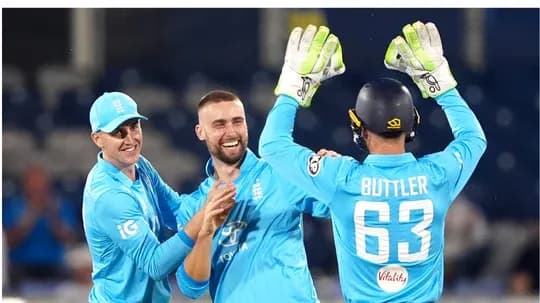
That was Jacks’ cue. Having already anchored the end of England’s innings, he turned the match into his personal stage with the ball. Bowling with flight, dip and a sharp sense of opportunity, he ripped through the middle and lower order to claim his maiden five-wicket haul in ODIs.
Figures of 5 for 22 from seven overs tell their own story, but the timing of those wickets was brutal. Every time Sri Lanka tried to rebuild, Jacks intervened. An attempted counterpunch here, a cautious restart there – all met with the same outcome. Stumps rattled, catches offered, momentum drained.
Only Kusal Mendis and Wellalage offered real resistance. Mendis, with a composed 42, tried to anchor the chase, picking gaps and refusing to panic while wickets fell around him. Wellalage, later, swung hard and clean, blazing 45 from just 36 balls in a spirited attempt to drag his side back from the brink.
His counter-attack briefly unsettled England. For a handful of overs, the ball flew to the fence, and the required rate stopped climbing. But the damage inflicted earlier was too severe, the support too thin. With regular wickets tumbling, Wellalage was fighting a losing battle, and Sri Lanka’s innings closed on 176 in 37 overs.
A statement win – and a new all-round force?
When the dust settled, the scorecard said England by 89 runs. The manner of it said more.
Brook led with the bat. Root moved into another statistical stratosphere. The bowlers hunted as a pack. But this was Jacks’ day – 46 not out, then 5 for 22, and a Player of the Match award that felt like a marker for what he can become in this format.
For Sri Lanka, there were bright spots in Colombage’s debut, Nissanka’s milestone, and Wellalage’s fearless hitting. The structure is there; the fight is there. What’s missing is the sustained, collective resistance that turns promising positions like 84 for 2 into genuine winning chances.
England, by contrast, found exactly that collective edge. If Jacks continues to deliver with this kind of authority at both ends, how different might this ODI side look by the time the series is done?