.svg&w=384&q=75 "logo")
Wasim Akram's Brutal Assessment of Pakistan Cricket
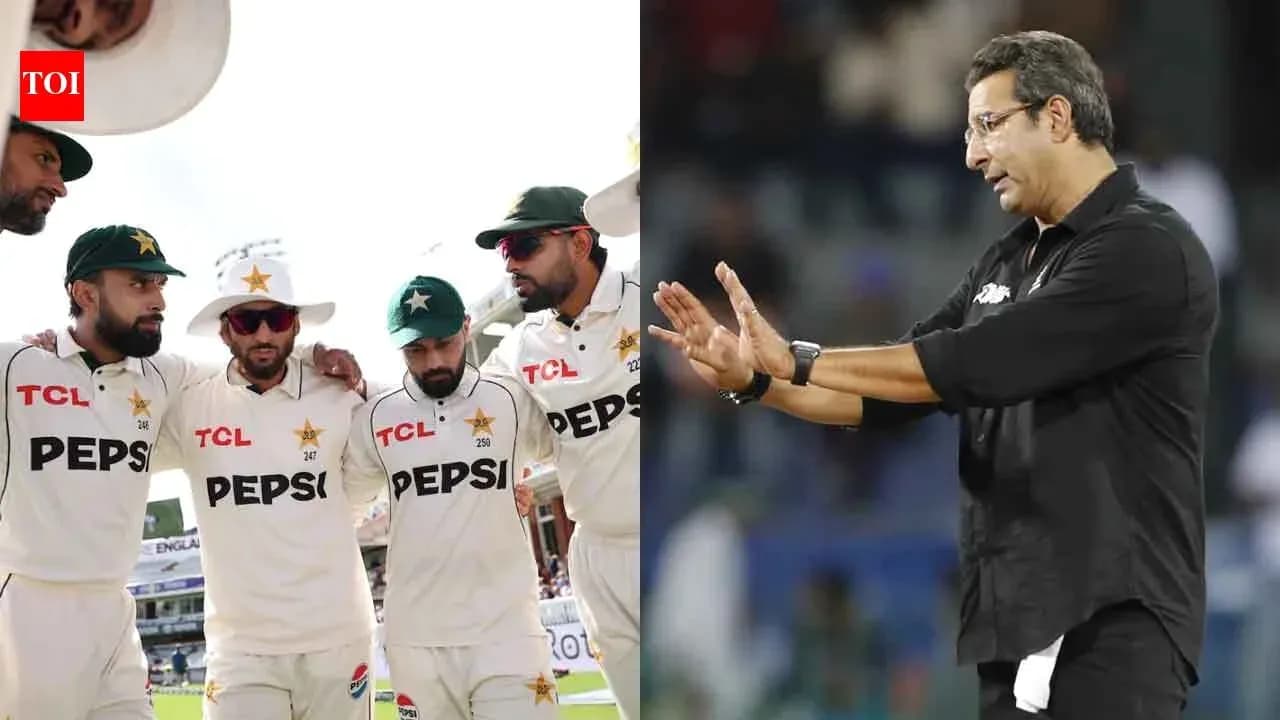
Wasim Akram saw the whitewash coming long before Pakistan walked out at Lord’s.
Sitting thousands of miles away, the former captain says he knew this England tour would end 3-0. Two Tests in, with Pakistan already 0-2 down and outplayed in every department, his warning sounds less like pessimism and more like a blunt reading of a broken system.
“I knew before the series we were going to lose 3-0 to England,” Akram told The Athletic. “Our batting is struggling, our bowling is below average and our fielding is worse. It’s not rocket science.”
This is not just any ex-player throwing stones from the sidelines. Akram was at the heart of Pakistan’s golden years in England, part of the sides that won three consecutive Test series there between 1987 and 1996, captaining in the last of those triumphs. He understands what a strong, settled Pakistan looks like on English soil. This, he believes, is nowhere close.
Turmoil on and off the field
The defeats have been heavy, but the reaction from the Pakistan Cricket Board has been even heavier. After the second Test, the PCB ripped through the touring party and backroom staff, sending seven players home and sacking head coach Sarfaraz Ahmed and his entire support team mid-series.
The shockwaves ran through the cricket world. Even by Pakistan’s volatile standards, this was dramatic.
Akram’s response carries both sympathy and frustration. He feels for the players, but he does not spare them either.
“In Pakistan we have a saying: ‘You can only clap with two hands’,” he said. The implication is clear: administrators and players share the blame.
He is repeatedly asked if he can “do something” to fix Pakistan cricket. His answer is stark. The problems, he insists, lie far deeper than any quick-fix consultancy or emotional dressing-room speech.
“These are the top players, there’s nothing else there. The systems aren’t there below that,” he said. Pakistan’s first-class structure, once a rugged breeding ground for tough cricketers, has been “all over the place” in recent years. Formats, teams, and policies have changed so often that consistency and patience – the backbone of any elite system – have evaporated.
That chaos filters down. Not just into the dressing room, but into the stands and onto social media.
“That dribbles down to the fans, too. They see the team lose and they want to rip it all up, too. We’ve done that so many times and now there is nothing really left,” Akram said.
It is a brutal assessment: a national game that has torn itself apart so often that the foundations are now threadbare.
A champion’s concern for Imran Khan
When Akram talks about Pakistan cricket, he speaks as a legend of the game. When he talks about Imran Khan, he speaks as a friend.
The former captain and ex-prime minister remains in jail, at the centre of a bitter political storm. Akram says he has not spoken to Imran for three years, but distance has not dulled his concern.
“I haven't spoken to him for three years. It's so unfortunate, politically, what's happening with him. The court of law is the court of law. But as far as his health is concerned, there can be no compromise on that,” Akram said.
There are campaigns in England and elsewhere pushing for better conditions and clarity over Imran’s situation. Within Pakistan, Akram is not convinced the same urgency exists.
“There's a movement in England and elsewhere (to improve Imran's conditions) but here (in Pakistan)? I'm not so sure,” he said. “I'm speaking from the heart as someone who is worried about him as a person. Convicted or not convicted. Jail or no jail. We need to safeguard his health. We don't know what's happening, the government are saying his health apparently is fine. But I'm worried. I miss him a lot.”
It is a rare, raw glimpse into the emotions of a man who usually speaks in the hard, precise language of elite sport.
As Pakistan stumble towards the final Test in England, with a 3-0 scoreline looming just as Akram predicted, his words hang over more than just a misfiring team. They touch a fraying cricket structure and a country wrestling with the fate of one of its most iconic figures.
The scoreboard in England will soon stop ticking. The questions Akram raises will not.