.svg&w=384&q=75 "logo")
Qinwen Zheng's Remarkable US Open Journey
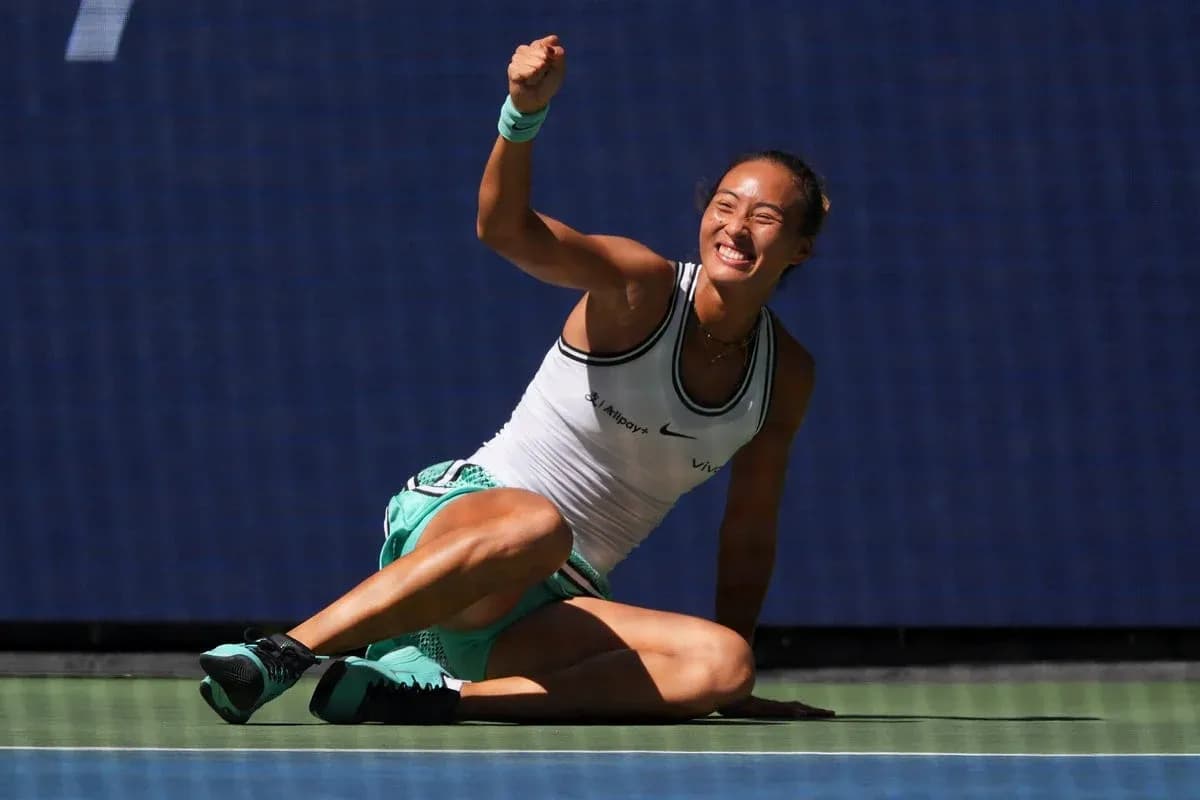
Qinwen Zheng was flat on her back in Arthur Ashe Stadium, staring at the New York night, the noise pouring down on her. It was part disbelief, part release. For the second match in a row at this US Open, she had walked to the edge of the cliff, looked over, and refused to fall.
From qualifier to quarter-finalist. From world No 121 to the woman who has just taken out Iga Swiatek in straight sets.
From 0-5 down. Again.
Two days earlier, Zheng had been a point from going home. Trailing Madison Keys 0-5 in the deciding set, facing match point against the American 22nd seed, she ripped through seven games in a row to steal it 1-6 7-6 (7-3) 7-5.
That kind of escape usually comes once in a fortnight, if at all. Zheng has done it twice in 48 hours.
Against Swiatek, the eighth seed and former US Open champion, the nightmare start came even earlier. Zheng went 0-5 down in the opening set, her timing off, her range deserting her on the biggest court in tennis. Swiatek, a six-time grand slam champion, looked settled, in control, ready to impose her authority.
The scoreline said one thing. Zheng’s body language said another. She refused to sag. She refused to rush.
“I started the match not so well,” she admitted on court. “Little by little I found my rhythm on the center court because it's been a long, long time. I just really appreciate it to be here in the Ashe Stadium.”
The shift was subtle at first. A first serve landing a little deeper. A forehand holding the baseline instead of drifting long. Then the games began to pile up. One, then two, then three. Swiatek’s clean, early dominance started to fray. Errors crept in. The Pole’s racket speed stayed high, but the margins disappeared.
At 4-5, Zheng was so locked in she later said she forgot the score. That, in its own way, told the story. She was no longer chasing the scoreboard; she was dictating the points.
Seven games in a row. From 0-5 to 7-5. The Ashe crowd, initially expectant of a routine win for a multiple major champion, now roared for the qualifier who simply refused to go away.
“I just focused point by point and little by little I start to play better tennis, I start to find my game,” Zheng said. “I guess to come back 0-5 yesterday is not lucky, that's all I can say.”
Swiatek unravels, Zheng rises
Swiatek has built her career on control – of rallies, of tempo, of herself. Here, the control slipped through her fingers. Her error count ballooned to 28, and with every misfire the tension in her shoulders grew more obvious.
For the fifth major in a row since her Wimbledon title in 2025, her campaign ended in straight sets. This one cut deep. She left Arthur Ashe Stadium in tears, the weight of another early exit heavy on her.
Zheng, by contrast, grew bolder. The second set did not have the same wild swings on the scoreboard, but it carried its own kind of pressure. One break would decide it. One moment of courage, or one lapse.
Zheng found the break she needed and never handed it back. She locked onto her serve, held her nerve, and closed out a 7-5 6-3 victory, sealing a place in the US Open quarter-finals for the third time.
When the fourth match point finally landed in her favour, she crumpled to the court. Seven wins in a row in New York, from the qualifying rounds to the last eight, after an elbow injury had cost her long stretches of the 2025 season and pushed her down the rankings.
“I'm just really happy to win this match cause it's not easy and it's been a while really,” she said. “I didn't beat any top 10 player. I just really, really appreciated this win for me, and I want to say thank you for all the fans who come to support me today.”
Two years ago in Paris, Zheng beat Swiatek in the Olympic gold medal match. That felt like a career high. This, given where she has come from in the past year, might mean even more.
Next, she faces either second seed Elena Rybakina or 13th seed Naomi Osaka, a two-time US Open champion. It will be a different kind of test, but if the last two rounds have proved anything, it is that Zheng will not be intimidated by names or numbers next to them.
Andreeva’s fight, Potapova’s heartbreak
On a different court, another comeback was unfolding.
French Open champion Mirra Andreeva dropped the first set to Anastasia Potapova, 5-7, and found herself dragged into a physical, emotional battle. The Russian teenager, already a Roland Garros winner, leaned on her resilience, turned the match around and took the second set 6-4.
At 5-3 in the third, with Andreeva closing in on her first US Open quarter-final, the match changed in an instant. Potapova, representing Austria and playing some of the sharpest tennis of her season, chased a forehand and twisted her knee badly.
She went down in obvious pain. The knee was heavily strapped, and she chose to continue, hobbling between points, trying to swing freely from a compromised base. The courage was obvious. The outcome was brutal.
Potapova did not win another point.
Andreeva closed it out 5-7 6-4 6-3, but there was no wild celebration, just a muted acknowledgement of a match that had ended in a way no player wants.
“Anastasia is a good friend, and seeing what a battle we have and then seeing her fall is not easy,” Andreeva said. “It’s not the way you want to finish the match. I just told her she is playing amazing and I’m sure she’ll come back even stronger, she’s a warrior.”
In New York, the draw tightens, the lights get harsher, and the stories sharpen. Zheng, the qualifier who keeps climbing out of impossible holes, and Andreeva, the teenager already carrying a major title, now stand a step away from the semi-finals.
The question is no longer whether they belong here. It’s who, if anyone, can stop their surge.