.svg&w=384&q=75 "logo")
Frances Tiafoe's Epic Comeback to Reach US Open Semi-Finals
Frances Tiafoe was gone. Two sets down, a break behind, the crowd murmuring rather than roaring on Arthur Ashe Stadium. Alex Michelsen, 22 years old and unseeded, had one hand on the biggest win of his life.
Then Tiafoe woke up – and New York woke up with him.
The 11th seed clawed his way back from the brink, overturning a two-set deficit and breaking when Michelsen served for the match in the third, before finally dragging himself over the line in a nerve-shredding fifth-set tie-break. After four hours and 38 minutes, Tiafoe completed a 5-7 3-6 7-5 6-3 7-6 (10-6) victory to reach his third US Open semi-final in five years.
He is 28 now, no longer the wide-eyed upstart but a hardened contender, and he will face either defending champion Carlos Alcaraz or fellow American Ben Shelton for a place in his first Flushing Meadows final.
Michelsen’s fearless start
For half the night, this was Michelsen’s stage. The world number 46 arrived without having dropped a set all tournament and played like a man who saw no reason to start now.
He went toe to toe with Tiafoe early, the pair trading breaks, but Michelsen’s backhand quickly became the sharpest weapon on court. At 6-5 in the opening set, he surged again, cracking 15 winners to Tiafoe’s four and ripping the set away from the favourite with a decisive break.
Tiafoe looked flat, his feet heavy, his timing off. Michelsen, in contrast, swung freely. He dictated from the baseline, stepped in on anything short, and owned the key points. The second set followed the same script: Michelsen in control, Tiafoe chasing shadows. Soon it was two sets to love.
The upset was no longer a possibility. It was the expectation.
On the brink – and then the turn
Michelsen broke early in the third set. The scoreboard read 5-3, with the 22-year-old serving for the match at 5-4. One more hold and Tiafoe was out.
That was the moment the tension finally gripped the younger American.
Michelsen’s arm tightened. Two double faults crept into his service game. The clean backhand that had been his anchor suddenly wavered. Tiafoe pounced, broke back for 5-5 and, with the crowd finally finding its voice, stole the set 7-5.
“I slowly started to get my rhythm. Snuck out that third set and got better and better,” Tiafoe said afterwards, fully aware that this was the hinge on which the entire night swung.
Once he had that lifeline, he refused to let go. Tiafoe raced through the first three games of the fourth set, feeding off the noise that now rolled down from the stands. Michelsen, so composed for so long, found himself scrambling, the initiative ripped from his hands.
Tiafoe closed out the fourth 6-3. What had looked like a routine upset now had the feel of a classic.
A fifth set worthy of Ashe
By the deciding set, both men were running on adrenaline and instinct. Breaks of serve flew back and forth, each swing of momentum pulling the crowd in a different direction. Every hold felt like a small victory, every error like a wound.
Michelsen, playing his first Grand Slam quarter-final, refused to fold. Even as his legs grew heavy, he kept stepping into the court, kept taking on the forehand, kept believing he could still finish what he had started.
Tiafoe, a fan favourite in New York, leaned into the chaos. He gestured to the stands, soaked up the roars, and matched them with raw, aggressive ball-striking. This is the arena where he plays his best, and once the match turned into a street fight, he looked at home.
They arrived at the 10-point tie-break with the stadium buzzing. This time, Tiafoe held his nerve. He surged ahead, tightened up his patterns, and forced Michelsen to hit from uncomfortable positions. At 10-6, it was over. Tiafoe had his fourth five-set win at a major in 2026, and one of the most dramatic of his career.
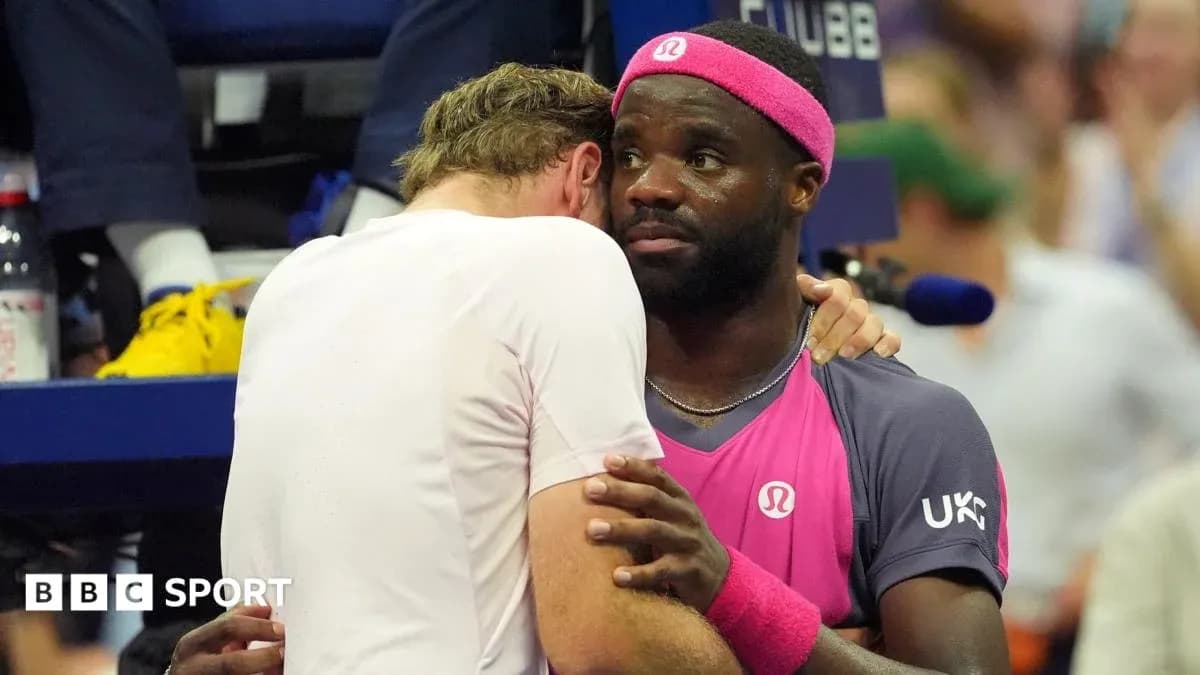
Across the net, Michelsen was in tears as they met at the net. The embrace lingered. The older American knew exactly what his opponent had poured into the night.
“He’s a hell of a player and he easily could have won today. Shout out to Alex Michelsen,” Tiafoe said, before turning to the crowd that had roared him home. “Everyone was asleep in the first couple of hours, I was too. As it went along the energy was incredible as it is always. You guys are rooting for me and I appreciate that.”
Another shot at history in New York
For Tiafoe, this run carries a familiar tension. He has been here before – deep into the second week, the city behind him, the belief building. In 2022, Carlos Alcaraz stopped him in the semi-finals. In 2024, it was Taylor Fritz who blocked his path in the last four.
Now he stands one match away again, older, battle-scarred, but still chasing the same dream: a first US Open final on the court where he has built his reputation as one of the sport’s great showmen and fighters.
He has already spent nearly five hours surviving a match he had no right to win. The question now is simple: after a comeback like this, who will really want to see Frances Tiafoe standing across the net in New York?