.svg&w=384&q=75 "logo")
Elena Rybakina Becomes First Kazakhstani Number One
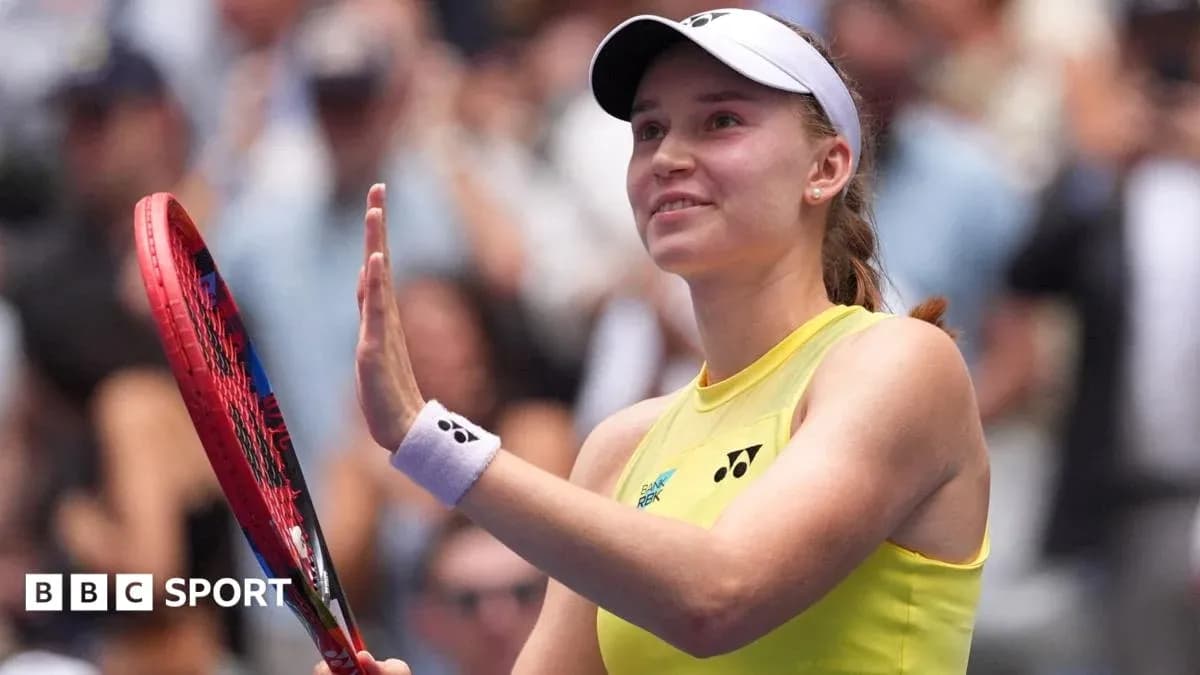
Ninety-nine weeks at the top. Then Elena Rybakina walked into Arthur Ashe Stadium and quietly rewrote the script.
Her three-set win over Zheng Qinwen in the US Open quarter-finals did more than book a place in the last four. It confirmed that on Monday, for the first time, a Kazakhstani player will sit at the summit of the singles rankings. Aryna Sabalenka’s long reign is over; Rybakina’s begins.
It did not come easily. For the first time this fortnight, Rybakina dropped a set, Zheng snatching the opener 6-3 and threatening to turn the night session into an ambush. The world number one-elect tightened, misfired, and briefly looked human.
Then she reset.
Rybakina roared through the second set 6-1, the serve snapping back into rhythm, the forehand suddenly heavier, more ruthless. The match turned from a scrap into a statement. The pressure finally told in the decider, but not without one last scare: Zheng carved out a break point, a crack in the door. Rybakina slammed it shut, held firm, and closed out a 3-6 6-1 6-4 victory that carried far more weight than a routine quarter-final.
This is the culmination of a chase that has stretched across seasons, continents and surfaces. Sabalenka’s run at number one, a 99-week stretch dating back to 21 October 2024, is the sixth-longest in WTA history. To dislodge her, someone was going to have to string together something special. Rybakina did.
She arrived in New York with the maths clear. Three women – Jessica Pegula, Coco Gauff and Rybakina – had a shot at the top spot. The equation for the Americans was brutal: win the title and hope Rybakina fell before the semi-finals. Anything less, and Sabalenka stayed where she was.
Rybakina tore up that scenario on Tuesday night.
The rankings milestone will dominate the headlines, but she refused to dress it up as the destination. “It’s just a number right now. My goal is to win the tournaments which I play,” the 27-year-old said. For her, the trophy still trumps the table. She knows how quickly points disappear, how fast the ladder can shift.
That realism comes from the road she has travelled since the end of 2025, when her push towards the summit truly began. In Wuhan last October, Sabalenka stopped her in the quarter-finals. One week later in Ningbo, Rybakina answered with a title. Then came the real turning point: the WTA Finals, where she beat Sabalenka to lift the season-ending crown and plant a flag at the very top end of the game.
She carried that edge straight into 2026. In Melbourne, the two big servers collided again, this time with a major on the line. Rybakina absorbed the power, matched the aggression and edged a tight three-set final to win the Australian Open – her second Grand Slam, almost four years on from her breakthrough at Wimbledon.
The rivalry refused to settle into a simple pattern. Sabalenka hit back in the spring, taking their Indian Wells final and their Miami Open semi-final. Rybakina answered on clay, claiming the Stuttgart title while Sabalenka’s form dipped and surged from week to week.
Not everything clicked. The climb to number one wound through some sharp setbacks: early exits at Roland Garros and Wimbledon, a near-miss in Toronto where she reached the final only to lose in straight sets to Iga Swiatek, and a painful stop in Cincinnati. There, against Swiatek again in the quarter-finals, a left ankle problem forced her to retire, the injury hampering her movement and robbing her of her usual push-off on serve.
Later, she admitted the ankle had been “bothering me for a long period of time” but insisted she had it “under control”. Even so, the build-up to New York was fractured. She could barely train for much of the week before the tournament. The preparation, by her own account, “wasn’t great”.
It hasn’t mattered. She has still ticked off the first of her two big targets in New York: the number one ranking secured, the US Open title still out there, gleaming in the distance.
Her path to that trophy now runs through either Coco Gauff or Mirra Andreeva in Thursday’s semi-finals. On the other side of the draw, Sabalenka meets Pegula. The possibility hangs in the air: a US Open final between the top two, a reprise of this year’s Australian Open showdown, another chapter in a rivalry that is fast defining this era.
Behind Rybakina’s rise sits a coaching story that has been anything but straightforward. She has worked with Stefano Vukov for almost seven years, on and off. Their first spell together ran from 2019 to 2025 before they split. Later that year, an independent investigation into his behaviour towards Rybakina led to a WTA Tour ban for breaching the code of conduct. Vukov denied wrongdoing, and Rybakina maintained she had never been mistreated by him.
She wanted him back. At the start of 2025, she pushed for his return to her team. The Croat appealed the suspension, won, and rejoined her in August. The impact was immediate. At her first event after their reunion, she reached the US Open fourth round for the first time in her career. From there, her end-of-season surge began – the one that has now carried her all the way to the top of the sport.
On Monday, the rankings will confirm what this hard, complicated, compelling stretch of months has already made clear.
Elena Rybakina is the player everyone else has to catch.