.svg&w=384&q=75 "logo")
Dilip on the Art and Science of Fielding in Cricket
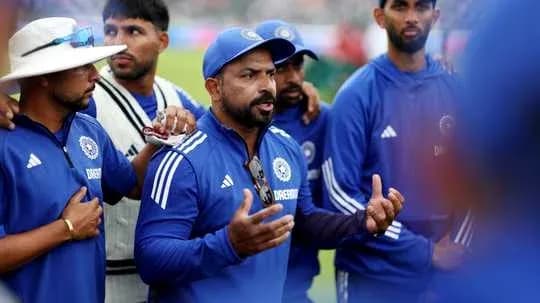
T Dilip has spent four years living in the spaces most fans barely notice – the half-step before a dive, the angle of a run, the way a head stays still under a swirling ball. For India’s former fielding coach, the game’s quiet craft is not decoration. It is the difference between winning and losing.
In the second part of his conversation with Cricbuzz, he strips fielding down to its moving parts and builds it back up into something far more serious than “support skill”.
The science in a split second
Catching, for Dilip, starts long before the ball leaves the bat.
He talks about a checklist: the fielder’s starting position, how early he picks up the ball, whether the head remains stable, how the hands move in sync with the body. Then the context kicks in. A slip catch, a towering outfield chance and a flat missile inside the ring are not cousins; they are different species.
Ground fielding begins even earlier. Before contact.
The best fielders, he says, are already balanced, already anticipating, already loading that first movement. Merely reaching the ball is not the win. Arriving under control, picking up cleanly, and flowing into the throw – that is the full act.
Throwing, in his eyes, has been misunderstood for years. It is not a javelin contest.
Power matters, but only as one piece. Speed of release, accuracy, and – crucially – decision-making sit on the same line. Who you are and where you field shapes your training. A slip catcher, an inner-ring scrambler and a boundary rider do not need a copy-paste programme. The base skills connect, but the practice must mirror the situations they live in.
Why other sports help, but don’t complete the picture
Dilip is a big believer in multi-sport childhoods. Kids who play different games, he says, learn how to solve different movement problems. That matters because fielding is chaos. The ball never behaves the same way twice – height, speed, angle, spin, surface, all shifting.
Adaptability becomes a weapon.
Yet he is clear: football or hockey alone will not turn anyone into a complete fielder. Cricket demands its own literacy – reading the bat, judging the trajectory of a cricket ball, understanding surfaces, picking up cleanly, throwing accurately. The body can be trained elsewhere. The eye and the mind still have to be trained in cricket.
IPL: the fielding revolution
On one point, Dilip does not hesitate. The IPL has changed Indian fielding.
It has altered the importance teams place on it and the standards young players see every day. A teenager can walk into an IPL dressing room and suddenly share a field with some of the world’s best fielders. He watches how they warm up, how seriously they treat every ball, how involved they remain even when they have not batted or bowled.
That proximity speeds up learning in a way no drill can.
Recent numbers have shown dips and spikes in catching efficiency. Dilip accepts that those trends deserve close study. But he rejects the idea that IPL has damaged Indian fielding. For him, it has transformed it – raised expectations, widened the pool of capable fielders, and convinced a generation that fielding can swing a result as decisively as a fifty or a four-wicket haul.
The missing numbers
Cricket’s data boom has left fielding behind. That bothers him.
Analysts can measure swing in degrees, release points in millimetres. Yet the game still has no widely available numbers for how quickly a fielder reacts, how efficiently he reaches the ball, how much ground he covers.
At the moment, catches and run-outs tell only a fraction of the story.
Dilip imagines a more complete picture: where the fielder started when the ball was struck, his reaction time, the route he took, the time from pick-up to release. For throws, not just velocity and accuracy, but whether he chose the right end.
Even catching percentage, he says, needs context. A great athlete might reach a ball very few others would touch, get a hand to it, and be marked down for a drop. A slower fielder never gets close, and the numbers stay clean. Every chance, he argues, should be graded for difficulty – reaction time, distance, ball speed, direction of movement, proximity to the boundary, all wrapped into one assessment of athletic ability.
The same logic applies to runs saved. If a shot usually brings two and a fielder claws it back to a single, that should be visible. Over a tournament, those tiny cuts add up to something enormous.
Bowlers, pride and ownership
When he looks back on his stint with India, Dilip resists the easy claim that players “improved under me”. The credit, he insists, belongs first to the players themselves, who move between national teams, state sides, IPL franchises and multiple coaches.
His biggest satisfaction lies not with one star name but with a group: the bowlers.
India’s attack, over his tenure, did not just sharpen technically as fielders. They began to own that part of the game. They took pride in saving a run, backing up a teammate, holding a tough catch after a draining spell. That shift in attitude – from obligation to identity – is what he cherishes most.
Watching fast bowlers and spinners throw themselves around with the same intensity they bring to the ball in hand, he says, was one of the most rewarding pieces of his journey.
The most overlooked moment
At the elite level, Dilip does not believe any specific fielding skill is truly underestimated. Players arrive with awareness, with experience, with a base level of respect for the craft.
Yet he keeps circling back to one phase: the preparation before the ball is struck.
It is not undervalued in theory, but it does not always get the same attention as the spectacular dive or the highlight catch. Anticipation, he stresses, is not guesswork. It grows from game awareness, knowledge of angles, and the discipline of staying locked in before every delivery.
One good first step can turn a tough stop into something routine. One poor first step can turn a reachable ball into a lost cause. That, he believes, is an area where players at every level – from school cricket to international finals – can keep finding small, meaningful gains.
T20’s double edge
Dilip refuses to paint T20 cricket as the villain.
If anything, the format has dragged fielding standards upward. Players are quicker across the turf. Boundary catching has become an art form of its own. Pick-up and release speeds have gone through the roof.
The problem lies elsewhere – in the calendar.
Modern schedules compress matches, travel and recovery into a relentless loop. Under that load, players naturally push their primary skills – batting and bowling – to the front of the queue. In franchise cricket, fielding sessions can be optional because workloads differ. On some days, a player might skip catching practice entirely.
The risk is subtle but serious. Without that volume, that feel, the first few catches in a match become de facto practice. At this level, that is a dangerous way to warm up.
The answer, Dilip says, is not marathon fielding sessions. It is a small, protected pocket of high-quality catching work, even on so-called optional days. Players must own that preparation, not just during tournaments, but in pre-season and the off-season too.
Consistent catching, in his view, comes only from consistent effort.
Touch, rhythm and the coach’s real job
Even with the best in the world, the basics do not take care of themselves.
When a team enters a new series or tournament, Dilip thinks about feel and rhythm. Catching is touch and confidence. A new venue changes the carry. Wind and lights play with the ball’s path. Fielders switch positions, bowlers change ends, angles shift.
A short burst of focused repetitions helps hands and bodies tune into those conditions. In those moments, the coach is not always there to fix a flaw. Sometimes the job is simpler and more precise – to prepare a player for the specific demands of that tournament, that ground, that week.
In a sport obsessed with numbers and narratives, Dilip’s world lives in the margins: the unseen steps, the uncounted runs, the half-chances turned into non-events. The question now is whether cricket’s systems – from academies to franchises to national teams – are ready to value those details as much as he does.