.svg&w=384&q=75 "logo")
Cricket Australia Opens Door to Big Bash League Investment
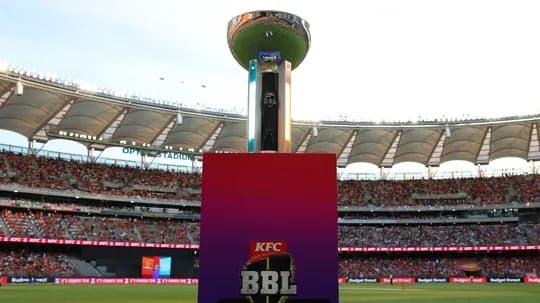
Cricket Australia dangles a Big Bash carrot in front of Indian Premier League money. The IPL looks. It runs the numbers. It studies the fine print.
It does not rush.
A billion-dollar pitch, with caveats
Cricket Australia (CA) has finally opened the door to private investment in selected Big Bash League (BBL) franchises, a structural shift it has long resisted. The move has immediately drawn interest from IPL franchise owners and other Indian investors, CA has confirmed, with the familiar heavyweights of the IPL ecosystem believed to be circling.
None of them is ready to say so publicly. Approached for confirmation, they have all stayed silent.
CA has brought in the Raine Group to run the process, the same US merchant bank that oversaw the lucrative sale of The Hundred franchises in England last year. That precedent has emboldened CA chief executive Todd Greenberg to label BBL privatisation a “billion-dollar opportunity” for Australian cricket.
On paper, it sounds irresistible. In reality, the IPL giants see a minefield of conditions.
Renegades on the block, but no built-in army
At this stage, only one team is on offer for full ownership: Melbourne Renegades. A 100 per cent acquisition, overseen directly by CA rather than Cricket Victoria, is expected to be wrapped up by Christmas.
The catch is brutal. Any buyer gets the licence, not the legacy.
The new owner will have to build a side from scratch, without inheriting an existing fan base or established squad. In a league where brand loyalty has grown slowly and unevenly, that is no small handicap for investors used to instant reach and ready-made fandom.
Next in line are expected to be Hobart Hurricanes and Perth Scorchers. But the terms tighten there. Those future sales are understood to be capped at 49 per cent, with member bodies such as the WACA still to consult their constituencies on whether they even want to sell.
That 49 per cent ceiling is the first major red flag for IPL teams.
Control without control
Across SA20, ILT20, CPL and even Major League Cricket, IPL owners enjoy full franchise ownership and, crucially, control. They are accustomed to calling the shots on cricket operations, commercial strategy, and long-term planning.
CA has no intention of handing over that level of power.
Chairman Mike Baird has been explicit: CA and its members will retain control over “the most significant aspects of Australian Cricket operations,” including international scheduling, player availability, BBL salary caps, branding proposals, licence reserve prices, and investor approvals.
In other words, investors can buy in, but they cannot run the show.
The model is not entirely without precedent. In The Hundred, the Sun Group-owned SRH holds a 100 per cent stake in Sunrisers Leeds, while Sanjiv Goenka’s RPSG Group owns 70 per cent of Manchester Super Giants. MI’s Reliance and DC’s GMR each own 49 per cent of MI London and Southern Brave, yet still wield operational control.
The difference is that CA appears determined to keep a firmer hand on the tiller than the ECB has allowed.
Old courtship, new resistance
GMR, co-owner of Delhi Capitals and also owner of Hampshire County, has long been one of the more adventurous Indian investors in overseas cricket. As Cricbuzz first reported in January 2025, GMR previously explored a deeper partnership in Australia, looking at potential investment in Sydney and Cricket New South Wales (NSW). During the fifth and final BGT Test, GMR representatives were in Sydney for talks with Cricket NSW on a possible collaboration.
Those talks have run into political resistance.
Cricket NSW is now understood to be opposed to private investment in its set-up and may not even renominate Baird to the CA chair in future. There is a clear philosophical split between Baird and Cricket NSW on the role of private money in the BBL.
IPL owners are watching that domestic power struggle, but they are far more focused on the hard fundamentals: media rights value, player availability, travel demands, tax regimes, and the influence of the Australian Cricketers Association (ACA).
Stars on paper, missing on the park
The biggest sporting concern is simple: will the best Australian players actually turn up?
The ECB carved out a clean window for The Hundred, protecting it from clashing international commitments and guaranteeing star power. CA has not offered anything similar. Historically, BBL fixtures and international cricket in Australia run side by side, leaving top Australian players either unavailable or heavily restricted.
The numbers are stark. Pat Cummins has played only seven BBL matches since 2016. Over the same period, he has appeared in 76 IPL games. In India, the Board of Control for Cricket in India (BCCI) locks in its marquee names for the IPL. MS Dhoni (149 matches), Virat Kohli (160), Rohit Sharma (153) and Jasprit Bumrah (141) have barely missed an IPL outing in that span.
The contrast is not lost on IPL owners. They are being asked to invest in a league without firm guarantees that the country’s biggest names will consistently feature.
Overseas players, tax and the lure of rival leagues
The uncertainty does not stop with Australian stars. There is also no clear framework yet on the availability of international players, another non-negotiable for IPL investors who have built global brands around high-profile overseas talent.
Australia’s tax regime looms as a problem. Player taxation there is understood to be significantly higher than in South Africa, the UAE and Bangladesh, all of which host leagues that clash with the BBL window. For many international players, the financial equation may tilt away from the BBL and towards those rival tournaments.
That means any BBL investor could be paying top dollar for a product that struggles to consistently attract and retain the global names that drive ratings and sponsorship.
Distance, cost and the tyranny of travel
Then there is the geography.
A single trip to Perth can mean a five- to six-hour flight, with all the attendant costs, fatigue and logistical complexity. In South Africa’s SA20, where IPL owners control all six franchises, the longest journey between host cities is just over two hours. Travel in England, the UAE and the Caribbean is similarly manageable.
The BBL’s vast footprint across Australia might look attractive on a map, but from a franchise operator’s perspective it brings serious operational overheads.
Locked media deal, strong players’ union
On the commercial front, the timing is awkward. CA is only three years into a seven-year media rights deal. Any new investor is stepping into a market where the biggest revenue stream is already locked in, with limited scope to renegotiate or immediately unlock fresh broadcast value.
Then there is the ACA, a powerful and vocal players’ union that has never shied away from hard bargaining with CA. IPL owners, who are used to running relatively streamlined operations in other leagues, are scrutinising the ACA’s influence and what it could mean for future negotiations on player terms, scheduling and league structure.
Profits on the board, doubts in the boardroom
For all the obstacles, there is one compelling upside: most BBL clubs are believed to be profitable. That alone sets the league apart in a crowded global T20 market where several competitions still rely heavily on central subsidies and optimistic projections.
That profitability is one reason there is no unanimous push within CA to bring in private money. For IPL groups already entrenched in almost every major franchise league outside the Pakistan Super League and, so far, the BBL, a stable, profit-generating asset in a mature cricket market carries obvious appeal.
But they want flexibility, not just a share certificate.
An IPL insider captured the mood bluntly: “The ECB was difficult; CA is five times tougher to negotiate with.”
If CA truly wants to turn the BBL into the billion-dollar opportunity it is selling to investors, it may have to decide how much control it is really prepared to give up—and how many of those red flags it is willing to lower.