.svg&w=384&q=75 "logo")
Coco Gauff Surges to Fourth Round at US Open
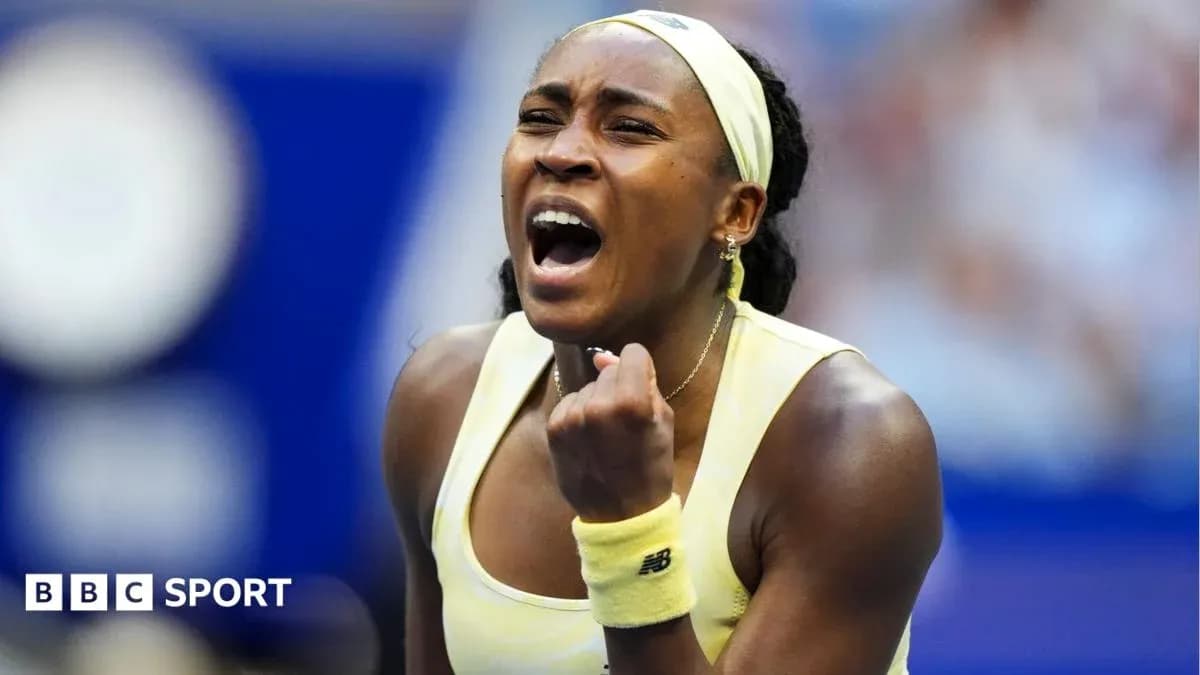
Coco Gauff steadied herself, then surged. Under the lights and the weight of expectation in New York, the defending US Open champion bent but never really cracked, brushing aside a stubborn Cristina Bucsa 6-3 6-4 to reach the fourth round once again.
It was not flawless. It did not need to be.
Gauff rides the waves, not the nerves
Bucsa jumped on Gauff early, grabbing a 3-1 lead and quieting the crowd. For a moment, it looked like one of those edgy home-soil afternoons where every missed forehand feels like a referendum on a star’s composure.
Gauff refused to let it become that.
She reeled off five straight games to snatch the opening set, leaning on her athleticism and a heavier, more assured forehand when it mattered. When she was broken to love early in the second set, any lingering doubts about last year’s nerves resurfaced in the stands. On court, they didn’t last long.
Gauff broke straight back, tightened the screws on return and never allowed Bucsa to settle again. The Spaniard probed, extended rallies, tried to drag the contest into the trenches. Gauff kept her foot on the accelerator just enough, closing in straight sets for an eighth consecutive WTA Tour-level win without dropping a set.
This is now her fifth straight year in the second week at her home major. At 22, she walks into it as the form player in the women’s game, already a US Open and French Open champion, already used to the glare.
“I feel like I'm used to getting to the second week now. I woke up today and I was like ‘oh we're already in round three’,” she said, acknowledging the familiar tension that comes with being the American face of the tournament. “There's expectations, being American, and I want to do well in front of the fans. Last year, I put so much pressure on myself. I'm enjoying the experience out here.”
Enjoyment is one thing. History is another. The fourth round has been her ceiling in each of the past two editions. This version of Gauff, though, looks more at ease with the burden than ever.
A home hope unravels: Keys’ collapse
On the adjacent storyline of the day, Madison Keys’ US Open ended not with a roar, but with a freeze.
The 2017 finalist built what should have been an unassailable lead against Olympic champion Zheng Qinwen, racing 5-0 ahead in the deciding set and earning a match point. The stadium began to sense a throwback run, a first fourth-round appearance here since 2023. It never arrived.
Zheng, the reigning Australian Open champion, refused to go away. Keys, by her own admission, could not swing freely anymore. The match flipped, then spiralled. Zheng took seven games in a row to complete a 1-6 7-6 (7-3) 7-5 comeback that stunned Arthur Ashe and left Keys visibly shaken.
“The 31-year-old said she felt as though she ‘couldn't play tennis anymore’ in the final set, the racquet suddenly feeling heavier than the moment.
“I obviously got off to a really good lead, and then I got really scared, like I couldn't swing [the racquet],” she said. “I felt like I couldn't play tennis anymore. It just felt like it was a much bigger deal than just playing a tennis match all of a sudden.”
That honesty cuts deep for a player who has long flirted with the sport’s biggest prizes without quite grabbing them. Keys reached the fourth round at all three other majors this season, but this collapse will linger. She knows it.
“I feel like I've been struggling for a while now. I'm going to have to make some sort of changes,” she added. “I just kind of keep putting it off because that's how the tennis world works. It's just to the point where I actually need to do something about it.”
Anisimova’s frustration boils over
Amanda Anisimova, last year’s runner-up in New York, also departed, and her exit carried a different kind of sting.
Beaten in last year’s final by Aryna Sabalenka, the 25-year-old never found a rhythm against Anastasia Potapova, the Russian-born Austrian 24th seed. The straight-sets defeat was laced with visible frustration: muttering between points, gestures to her box, the body language of a player unable to wrestle control of her own game.
She dropped serve twice in the first set, then four more times in a chaotic second. Every time she appeared ready to claw back, another loose game handed Potapova the initiative again. The result was a flat end to a campaign that began with genuine hopes of another deep run.
American pack still strong
For all the bruises, the home contingent remains very much alive.
Gauff leads the charge, with Jessica Pegula, Taylor Townsend and Emma Navarro already alongside her in the last 16. Iva Jovic will try to join them, raising the prospect of as many as five American women in the fourth round.
On the men’s side, the stars are aligning in similar fashion. Ben Shelton, Frances Tiafoe, Tommy Paul and Alex Michelsen are through, with Learner Tien and Michael Zheng still to come. Six of the eight men’s fourth-round matches could feature American players if results fall their way.
The narrative, though, keeps circling back to the woman who has already carried the trophy out of this stadium once.
Three years after becoming the first American teenager since Serena Williams in 1999 to win the US Open, Coco Gauff is back in the second week, older, sharper, and visibly more comfortable with the chaos that surrounds her. The fourth round has stopped her here before.
This time, it feels like she intends to treat it as a checkpoint, not a ceiling.