.svg&w=384&q=75 "logo")
Carlos Alcaraz Steps Away from Grand Slam Revenue Campaign
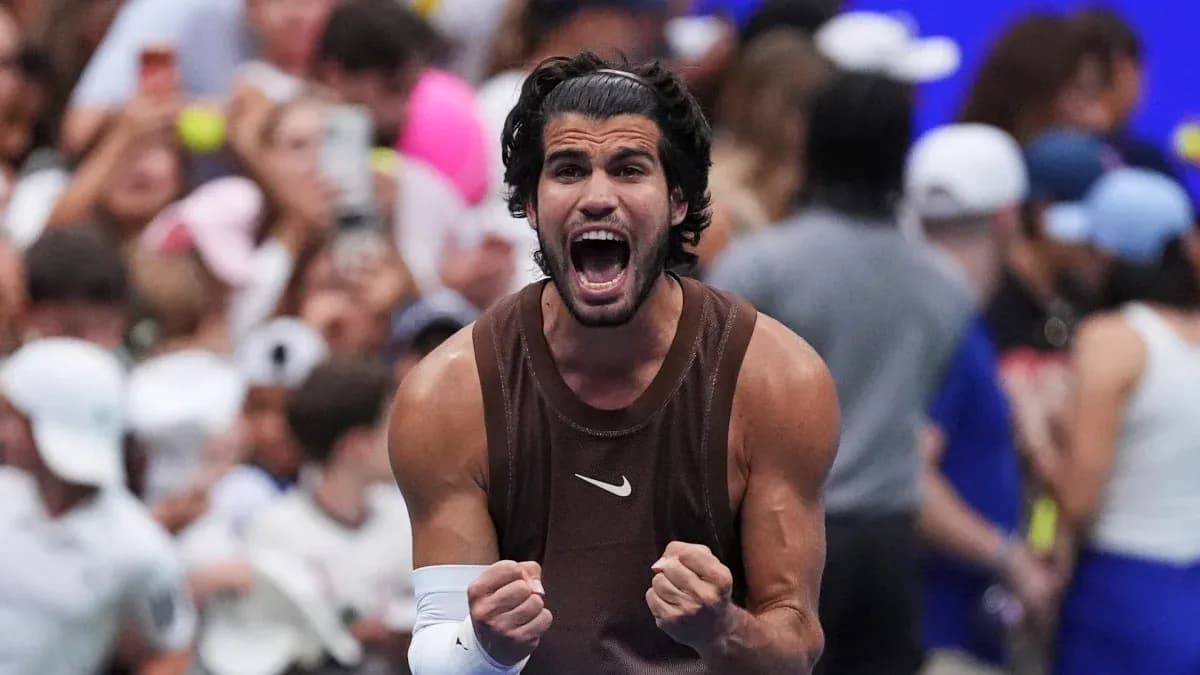
Carlos Alcaraz is back in New York doing what he does best – ripping through the draw and reminding the sport why every major feels different when he’s in it. But while his tennis looks familiar, his role in one of the game’s biggest off‑court battles has shifted dramatically.
According to The Times, Alcaraz’s long-time agent Albert Molina told the group driving the Grand Slam revenue campaign, shortly before the US Open, that the Spaniard would no longer be involved. For a movement built on the idea that the sport’s brightest stars were finally pulling in the same direction, it’s a significant loss.
A star steps away from the movement
The campaign, launched in March 2025, had been a rare show of public unity from the locker room’s elite. Aryna Sabalenka, Jannik Sinner and Coco Gauff were among the headline names pushing for a bigger slice of the sport’s richest pie: a rise in the players’ share of Grand Slam revenue to 22% by 2030, better welfare provisions and a stronger voice in how the tour is run.
It was never framed as a simple grab for prize money. Sinner spelled that out bluntly during a 2026 season when discontent began to spill into the open.
“It’s more about respect, you know?” he said. “Because I think we give much more than what we are getting back.”
Players made that point in Paris with a symbolic show of resistance, cutting back their pre-tournament media duties at Roland Garros to mirror the percentage of Grand Slam revenue they believed was actually reaching them. The gesture was small, but the message was not: this was about power, not just pay cheques.
The pressure told. Wimbledon lifted its total prize fund to £64.2 million. The US Open responded with a 20% jump in total player compensation to $108 million and introduced a $2 million Player Support Program. The four majors agreed to create a Grand Slam Player Council, a formal platform for player voices at the sport’s most powerful table.
Those gains arrived with Alcaraz publicly aligned to the cause. His reported decision to step away does not mean he suddenly opposes any of it. But it does strip the movement of one of its most magnetic figures – a 21-year-old multiple major champion whose presence had helped sell the idea of unity to the wider world.
For a campaign that leaned heavily on the optics of the game’s future standing shoulder to shoulder, losing Alcaraz is more than a footnote.
A body that finally said no
His priorities, at least for now, lie elsewhere. They have to.
Alcaraz spent almost five months off the tour with a wrist injury, long enough to miss both Roland Garros and Wimbledon, long enough to confront the limits of a schedule that chews through even the most gifted bodies. The layoff did not just stall his momentum. It seems to have reshaped his outlook.
“In the future, I’m going to take some breaks, some long breaks,” he said. “Maybe not four months, but one month, two months, missing some tournaments, because it’s impossible to play them all.”
That is not the language of a player trying to be everywhere, all the time, any more. It is the voice of someone who has stared at the calendar and decided something has to give.
The irony is obvious. While others fight for a bigger cut of the majors, Alcaraz is talking about playing less, not more. His concern is not the percentage of revenue; it is the sheer volume of weeks his body is being asked to endure.
Questions answered in New York
If anyone wondered what four and a half months away would do to his game, the first week in New York has offered a sharp reply.
Alcaraz has marched into the US Open quarterfinals with the kind of authority that makes rankings and seedings feel like background noise. Roman Safiullin, Jaime Faria, Wu Yibing and Tommy Paul all tried to test that wrist, that timing, that confidence. None got close enough to rattle him.
Paul was honest about the gap.
“It felt like he’s playing at a completely different level than me,” he admitted.
Alcaraz sounded just as sure of himself.
“So it probably doesn’t matter that I was out for four months and a half,” he said. “Every time that I come here, I play my best.”
That blend of swagger and steel is what makes him such a force at the majors. It is also what makes his absence from the revenue campaign sting. When a player of his stature speaks, people listen – whether it’s about prize money, player power or the physical cost of the modern tour.
Choosing his battles
His comeback has done more than restore his status as a title threat. It has underlined the lesson that came with those lost months: he cannot, and will not, try to play everything.
Alcaraz is still chasing the sport’s biggest trophies, still expected to anchor the next decade of men’s tennis. But he is now picking his battles, on and off the court. For the Grand Slam revenue movement, that means moving forward without one of its most compelling standard-bearers.
For Alcaraz, it means something else: protecting a career that, if managed on his terms, might define an era rather than burn out trying to conquer every week on the calendar.