.svg&w=384&q=75 "logo")
Carlos Alcaraz Dominates Tommy Paul to Reach US Open Quarter-Finals
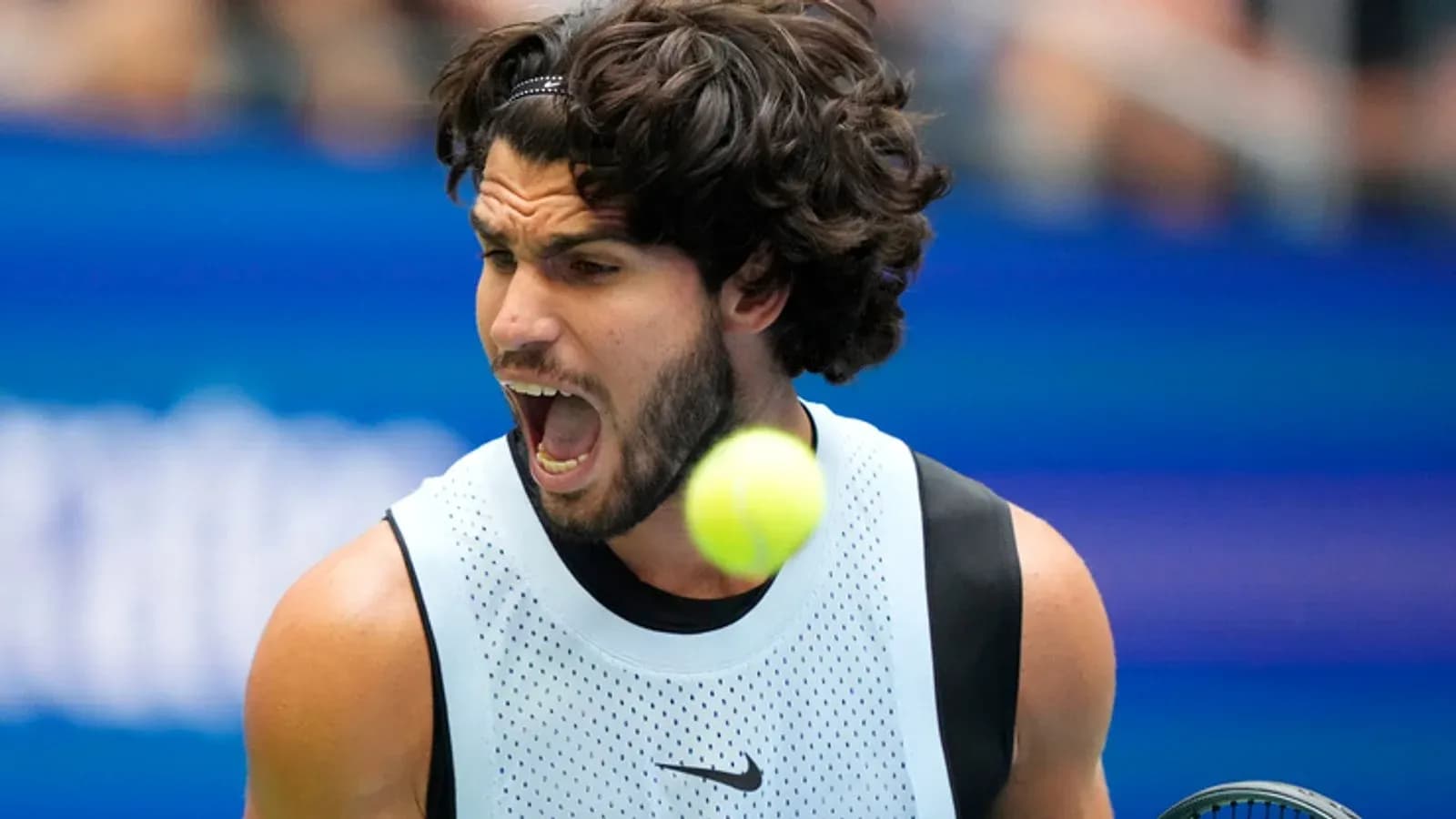
Carlos Alcaraz did not so much reach the US Open quarter-finals as storm through the gates.
On a warm New York night, with Arthur Ashe still buzzing from the holiday weekend, the defending champion dismantled Tommy Paul 6-4 6-3 6-4, a straight-sets win that felt even more one-sided than the score suggests. The supposed danger match never really materialised.
The Spaniard’s right wrist, the great pre-tournament concern after four-and-a-half months out, looked like it belonged to a different sport. No strapping, no hesitation, no compromise. Just full-blooded, violent forehands and that familiar, elastic movement that turns defence into attack in a heartbeat.
Paul, the 20th seed, had talked boldly before the match, insisting he always believes he can take down the game’s elite. Belief is one thing. Solving Alcaraz in this mood is something else entirely.
This was their sixth meeting in a row won by the 23-year-old, and the 14th consecutive set he has taken from the American. The pattern is becoming brutal. Paul can hang, he can rally, he can flash his shot-making. But when the points tighten, Alcaraz tightens the screws.
The match turned on those moments. Alcaraz broke once in each set, then guarded the advantage with icy clarity. When Paul did finally open a door at the end of the third, earning two set points, Alcaraz slammed it shut with two forehands that bordered on insult – ripped winners, struck with that easy violence Tim Henman calls the best in the sport.
“I played my game. I tried to put my style on today’s match,” Alcaraz said on court, almost underselling the authority he had just displayed. He spoke of being ready to run, ready for the battle, but the truth is he rarely had to scramble. His aggression on return pinned Paul down; the American’s serve never felt like a weapon, only a starting point for another Alcaraz assault.
“I tried to be aggressive all the time and tried not to let him stay on the court,” he added. The plan was simple. The execution was ruthless.
From the commentary box, Henman could barely hide his admiration. “It’s a pleasure to watch Alcaraz go through the gears,” he said, noting how the world No 1 has sharpened with every round. Martina Navratilova went further, describing him as being in “another stratosphere” for a player so young and so complete.
The numbers back up the feeling. Alcaraz has already become the youngest man to complete the career Grand Slam. Now, history is staring him in the face again. Having conquered Wimbledon’s grass in 2023 and 2024 and Roland Garros’ clay in 2023 and 2024, he stands two wins away from defending his US Open title and becoming the only man in the Open Era to successfully defend majors on all three surfaces.
He insists the layoff has not dulled him. “Am I back to full power? I think so,” he said, smiling. On this evidence, the field will agree.
Sabalenka survives a wild one
On the women’s side, Aryna Sabalenka’s title defence is still alive, but only after a jagged, restless win that said as much about her stubbornness as her power.
The world No 1 beat Taylor Townsend 6-4 6-3 in a match that lurched and twisted through 11 breaks of serve in 19 games on Arthur Ashe. It was not clean. It was not comfortable. It was, however, enough.
Sabalenka has now spent 99 weeks at the top of the rankings. To make it 100, she must win a third consecutive US Open and hope Elena Rybakina falls before the semi-finals. The pressure sits on every service game, every tight deuce. That weight showed against Townsend, a crowd favourite who attacked, charged the net and forced the Belarusian into some ragged patches.
Sabalenka fell behind in the second set, the kind of moment that has unhinged her in the past. This time she dug in. “I was like, ‘okay, you are down the break, just try to return the serve and put as much pressure on her as possible’,” she explained. Point by point became ball by ball, a narrowing of focus that steadied her hand.
When she finally broke back, the roar she unleashed shook the stadium. Annabel Croft called it the moment you knew she “meant business” – the instant when the showwoman turned ruthless competitor. Sabalenka’s intensity surged, her groundstrokes found their range, and Townsend’s forays to the net began to look more like last throws of the dice.
Navratilova graded the performance as “good enough”, praising Sabalenka’s returning and passing shots while noting the repeated breaks of serve. It was, in her words, a “B” performance, but a B that still produced a straight-sets win and a place in the last eight without the loss of a set all fortnight.
Next comes Linda Noskova, the Wimbledon champion, who survived a marathon of her own against Marta Kostyuk. The Czech eventually edged through 7-5 5-7 6-4 in a rematch of their SW19 semi-final, only after Kostyuk saved five match points – two at the end of the second set and three in the third.
Sabalenka will not need reminding that Noskova can absorb pace and redirect it with interest. She will also know that, for all the breaks and the nerves, she is still standing, still swinging, still dictating.
Alcaraz looks like a man chasing history. Sabalenka looks like a woman refusing to let go of what she already owns. New York is about to find out whose grip is stronger.