.svg&w=384&q=75 "logo")
Ben Shelton Makes U.S. Open History with Epic Win Over Alcaraz
NEW YORK — By the time Ben Shelton turned and roared at the few thousand believers still inside Arthur Ashe Stadium, New York was closer to breakfast than last call.
The clock read 3:33 a.m. The match, if you could still call it that, had long since morphed into something else — a late‑night prize fight dressed up as tennis, two young stars trading blows under floodlights that refused to blink.
Shelton, the 23-year-old American with the serve that sounds like a slammed car door, finally finished it with a 146 mph ace, sealing a 6-7(5), 6-1, 6-3, 1-6, 7-6(10-7) win over Carlos Alcaraz and writing his name into U.S. Open history for the latest finish the tournament has ever seen.
He ended it on his signature shot. This time, it carried him past a player whose gravity usually bends nights like this to his will.
“That was a war. Epic match. So physical,” Shelton said courtside, still buzzing. “Carlos, one of the greatest champions in our sport already at 23 years old. It’s always fun.”
Then, with a grin: “The most enjoyable match I’ve had in my career.”
A main event in the middle of the night
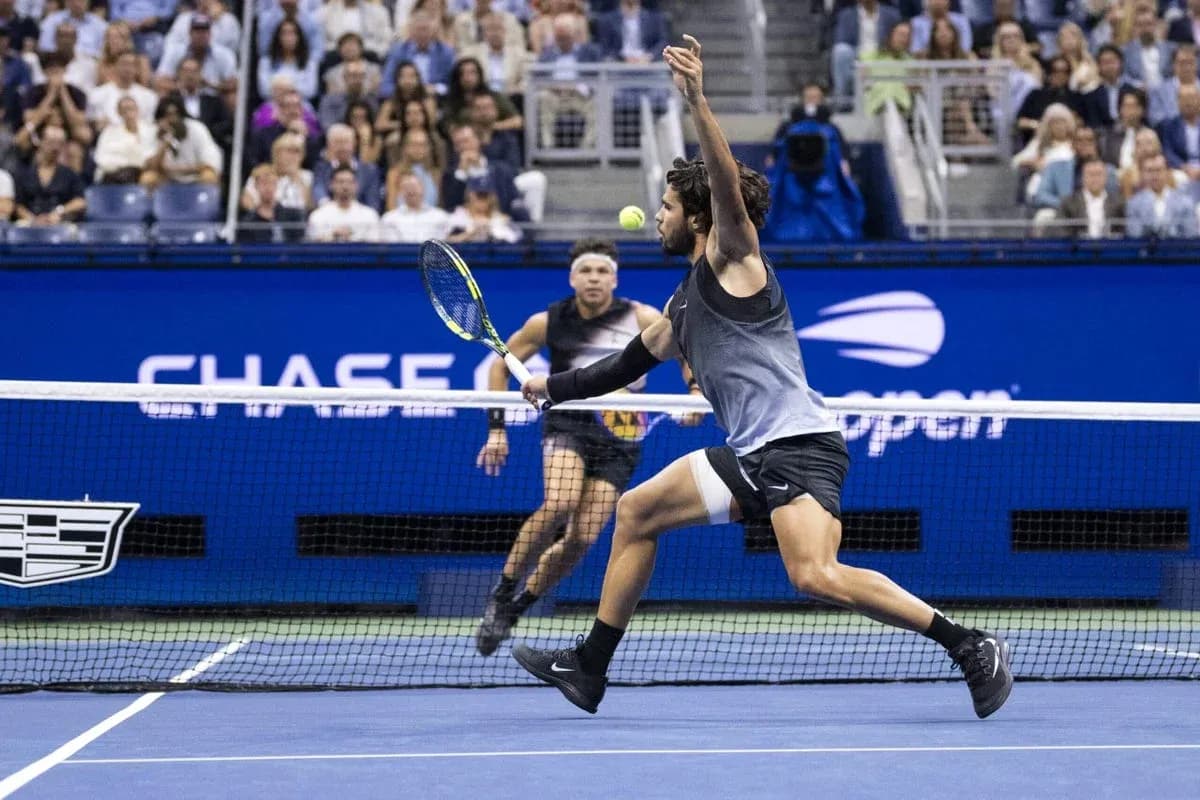
They didn’t strike a ball until 11:05 p.m. local time, a pay‑per‑view start for two box office names. Nearly 24,000 fans packed into Ashe, not to watch patterns and percentages, but to see two showmen who understand that big stages demand big theater.
From the first game, it felt less like a round-of-16 clash and more like a five‑set title bout. Styles clashed. Shelton, all spring and explosion, hurling himself into serves and forehands. Alcaraz, the seven-time Grand Slam champion, playing the sport’s sweet science, changing spins and heights, slipping in drop shots like jabs.
The opening set followed the Alcaraz script. At 5-5, Shelton matched him shot for shot, only to blink first. A couple of loose strokes, a missed first serve here, a shanked ball there, and Alcaraz had the break.
Then something rare: Shelton broke straight back, helped by two forehands from Alcaraz that flew yards off target. The Spaniard has been nursing a wrist injury and had spent nearly five months away. For most players, the rust would be expected. For Alcaraz, who had cruised through his first four matches, the wobble felt strange.
The tiebreak was chaos. Errors on both sides, then one absurd rally that had the stadium gasping — lunges, improvisation, and finally a delicate Shelton lob that left Alcaraz sliding with his back to the net. Shelton led 5-3 and had the crowd rising.
Then Alcaraz did what Alcaraz so often does.
He strung together one of those runs that make opponents feel like they’ve been dragged underwater. He rushed Shelton into a backhand miss, carved a backhand down the sideline, opened the court with a forehand, and finished the set with a wild, all‑court exchange that somehow ended with Shelton pulling off an outrageous tweener just to stay alive. It only delayed the inevitable. First set, Alcaraz.
Shelton had worked for more than an hour and had nothing to show for it. It felt like a rerun of his recent battles with Alcaraz and Jannik Sinner — big effort, thin reward.
The tide turns
What came next flipped the script.
The next 80 minutes belonged to Shelton. Or perhaps they belonged to fatigue.
Alcaraz’s level fell off a cliff. He sprayed 17 unforced errors in the second set against just eight winners. Shelton broke once. Then twice. Then a third time. The scoreline on the board looked almost disrespectful: 6-1 Shelton.
Was this really happening? It was.
Shelton’s serve, always a weapon, now felt like handcuffs on Alcaraz. The American bullied his way through service games, hammering body serves, targeting corners, forcing short replies he could feast on. The third set followed the same script. Shelton broke early, stayed on the front foot, and pushed Alcaraz around the court with heavy drives into the corners.
Only midway through that third set did Alcaraz show any real signs of life. The fist pumps appeared. The stare hardened. He tried to shake off the fog.
Serving for the set, Shelton flirted with danger. At 30-30, they produced yet another ridiculous exchange, both men sprinting in to chase down angled drop shots, Alcaraz finally ending it with a twisting forehand winner while running toward the back wall. It was the kind of point he usually rides into a surge.
Shelton knew it. He walked toward his towel, and as he did, his father and coach, Bryan Shelton, leaned over the video board and stuck out a hand. Keep going. Keep running.
Shelton slapped it. Three booming serves later, three errors from Alcaraz, and the American had the set. He was one from the finish line.
Alcaraz on the ropes, then off them
Alcaraz slumped in his chair, head between his knees. He looked spent. When he rose for the fourth set, he moved like a man dragging himself off the canvas.
Shelton had chances to end it right there. A forehand miss from Alcaraz gave him a crack at a knockout blow. Shelton sent a backhand long. Another loose Alcaraz shot into the net offered a second opening. Shelton missed with a forehand.
He didn’t panic. Alcaraz was gifting him opportunities. More would come. Except they didn’t.
Alcaraz, dazed for much of the night, suddenly found clarity. He serve-and-drop-volleyed off a blistered return, drew an error, screamed toward his box, and jolted himself awake.
Tennis turns fast. Minutes earlier, Shelton looked like he was cruising. Now, he couldn’t find the court. Alcaraz sensed the dip and went to work, dragging Shelton from sideline to sideline, grinding out rallies, and finally breaking him for the first time since late in the opening set with a classic corner‑to‑corner exchange.
By now, it was pushing 2 a.m. Maybe 10,000 fans remained, stubbornly refusing to leave. Shelton was reeling. The night, clearly, was going the distance.
Alcaraz, revived, ran away with the fourth set 6-1. The match, and the record books, were headed for a fifth.
A fifth set in no man’s land
Fifth set. 2-2. The air inside Ashe had a strange stillness, broken only by pockets of noise and the occasional yawn.
Alcaraz ripped a forehand to earn break point. It felt like the moment the champion would close his fist around the match.
Shelton refused. He hopped back, rose, and smashed an overhead so violently that Alcaraz ended up on the ground. The crowd erupted. Shelton followed with another thunderous serve, held, and turned to the stands, racket raised. He demanded noise. “U.S.A.” rolled down from the upper deck.
At 2:45 a.m., Bryan Shelton was on his feet again, watching his son fight in the strangest of hours. By 2:51, the two players had passed the previous record for the latest finish in U.S. Open history, set in 2022 when Alcaraz and Sinner played their own futuristic epic.
Once more, Alcaraz tried to escape. Shelton had three chances to earn the right to serve for the match. On one, he floated a cautious chip approach from the middle of the court instead of ripping it. The ball landed. The lights on the net posts flashed red. Out.
On the next, Alcaraz lashed a running crosscourt pass. On the third, Shelton dumped a backhand into the net. Three hours had ticked into the new day. The match refused to end.
At 3:20 a.m., with the garbage trucks already beeping outside as workers readied the Billie Jean King National Tennis Center for sunrise and another packed schedule, the two heavyweights walked to the baseline for the only thing left: a 10‑point tiebreak to decide it all.
“Let’s go Ben” echoed around the stadium. Fans clapped, shouted, and tried to keep themselves awake.
The last stand
Shelton jumped ahead 3-1 in the breaker, then faltered. Three errors in four points, plus one heavy Alcaraz forehand, flipped the script again and hushed the chants.
The Spaniard had the opening. Shelton shut the door.
Alcaraz started to leak errors of his own. “Let’s go Ben” came back, louder than before. Shelton crushed a serve. Alcaraz sent a forehand long. Shelton stood two points from the finish.
At 8-7, serving, the match sat squarely on his racket.
He went body first. Unreturnable. 9-7.
One more. He reached for his biggest weapon, threw everything he had left into the motion, and blasted an ace. Knockout. Alcaraz could only watch.
Shelton, the kid who once worked the night shift earlier in the tournament after a marathon Williams sisters doubles match pushed his start time to the edge of sanity, had outlasted one of the sport’s great closers in a match that finished closer to dawn than midnight.
An American man hasn’t lifted a Grand Slam trophy in 23 years. On Sunday, one will stand in the U.S. Open final. Shelton’s next obstacle: Frances Tiafoe, another showman, another American, another night that promises noise.
At 3:33 a.m., with the stadium half‑empty and still somehow full, it felt less like the end of a match and more like the opening bell for whatever comes next.