.svg&w=384&q=75 "logo")
Ben Shelton Stuns Carlos Alcaraz in Epic US Open Quarter-Final
Carlos Alcaraz’s reign in New York ended not with a whimper, but in a wild, breathless five-set epic that pushed the US Open into its latest finish in history.
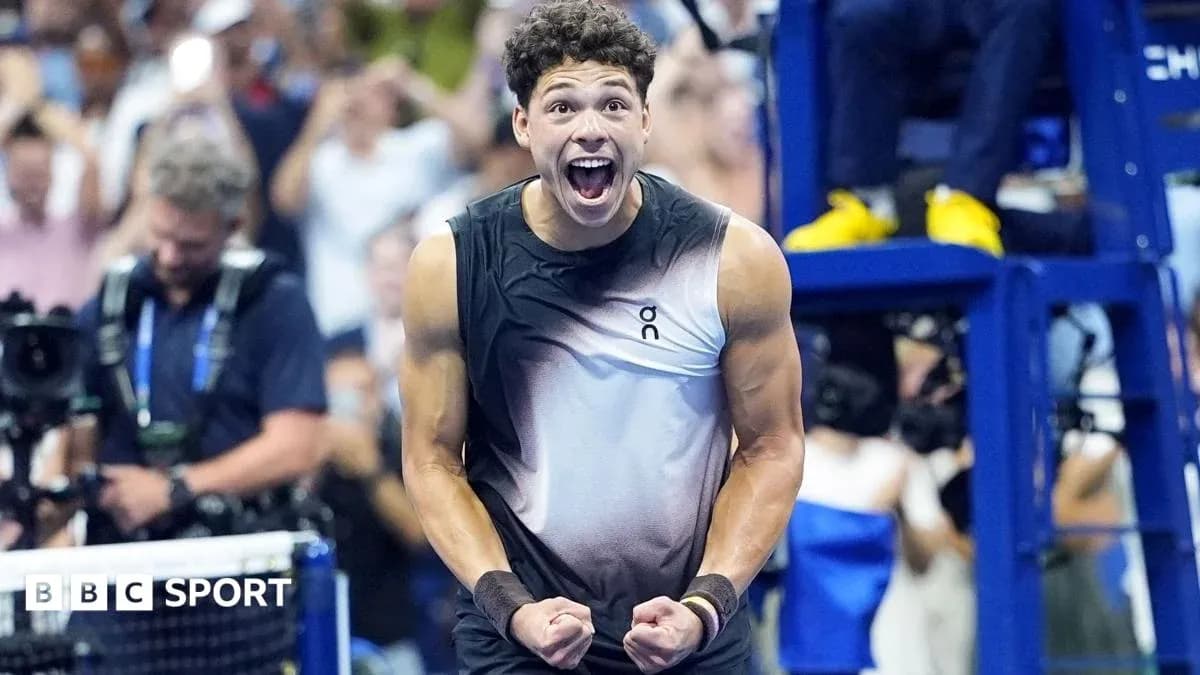
At 03:34 on Arthur Ashe Stadium, with thousands still glued to their seats and refusing to blink, Ben Shelton completed the biggest win of his young career, stunning the defending champion 6-7 (5-7) 6-1 6-3 1-6 7-6 (10-7) in a quarter-final that felt more like a prizefight than a tennis match.
The clock said the night session had started late. The atmosphere said nobody cared.
Delayed by the earlier programme, the first ball of this match wasn’t struck until around 11pm in New York. What followed over four hours and 28 minutes was a modern classic: momentum swings, shot-making on the edge of reason, and two supreme athletes refusing to yield.
When it finally ended, the eighth seed stood in the centre of Ashe, soaking up a standing ovation from a crowd that had gone from expectant to disbelieving to delirious. At 23, Shelton had just taken down a two-time US Open winner, a seven-time major champion, and a man who had owned him in three previous meetings.
Until this night, Shelton had never beaten a top-three player in 17 attempts. He chose some stage to rip up that statistic.
The stakes for American tennis were obvious. No home men’s champion has lifted the trophy here since Andy Roddick in 2003 – a year before Shelton was even born. Now, after this breakthrough, the host nation is guaranteed at least one American in Sunday’s final: Shelton will face Frances Tiafoe in an all‑home semi-final on Friday.
Alcaraz arrived in New York as a question mark wrapped in a champion’s aura. This was his first tournament back after more than four months out with a wrist injury, a lay-off long enough to dull timing and test belief. Instead, he had sliced through the draw, even dismantling 20th seed Tommy Paul in straight sets to reach the last eight, and once again looked like the sport’s irresistible force.
For long stretches against Shelton, that aura remained. The Spaniard took a tight first set in a tiebreak, his court coverage and improvisation drawing the usual gasps. Even when the American roared back, Alcaraz kept finding ways to turn defence into attack, to hang on one more ball, to ask one more question.
But the cost of that long absence finally presented its bill.
Shelton, playing at full throttle, dragged Alcaraz into a high-octane baseline war. The rallies lengthened, the sprints became more brutal, and the 23-year-old’s lack of match fitness began to show. Shelton seized the second set 6-1, then the third 6-3, riding his serve and his fearless groundstrokes as the noise inside Ashe rose with him.
Just when it looked like the champion had run dry, he found another reserve.
Alcaraz tore through the fourth set 6-1, summoning the kind of surge that has broken so many opponents before. The crowd sensed the familiar script: the great escape, the defending champion bending but not breaking, the younger challenger blinking at the finish line.
Shelton refused to blink.
The fifth set turned into a test of nerve as much as legs. Both men swung freely, both stared down break points, both leaned on every ounce of athleticism they had left. The match came down, fittingly, to a 10-point match tie-break, a final, compressed drama to decide a contest that had already given everything.
There, under the harsh glare of Ashe and the softer haze of the early hours, Shelton held his line. He struck, he attacked, he trusted his game. When the last ball from Alcaraz missed, the American dropped his shoulders, looked up, and let the roar wash over him.
The defending champion’s run ended, but not his reputation. Alcaraz had pushed his body to the limit in his first event back, defying expectations just to stand in this quarter-final, then nearly dragging himself into another semi-final on sheer will.
Shelton, though, walked off with the night, the upset, and a place in a semi-final that will carry the weight of 23 years of American longing. Now the question is simple: was this the breakthrough of a fortnight, or the moment a new US Open story truly began?