.svg&w=384&q=75 "logo")
Aryna Sabalenka Survives Against Linda Noskova at US Open Quarter-Finals
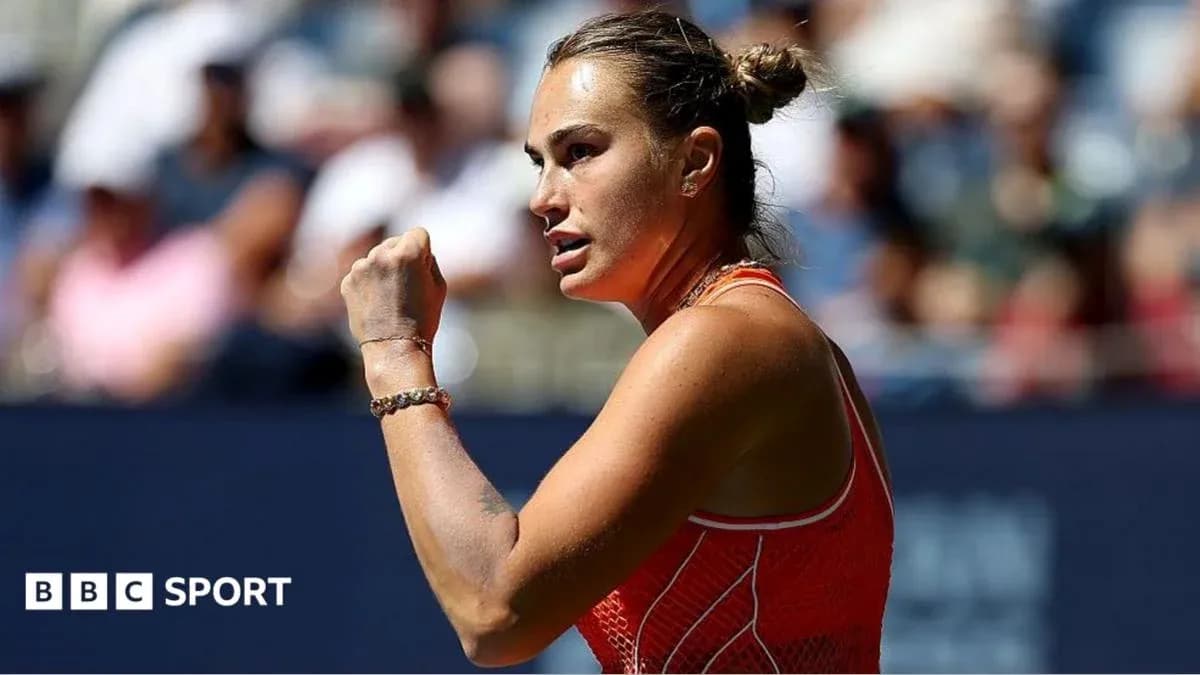
Aryna Sabalenka had already said her goodbyes in her head.
Down 4-2 in the third, then 2-0 in the match tie-break, the two-time defending US Open champion looked to be walking out of Flushing Meadows as a former ruler, not the reigning one. Linda Noskova, the new Wimbledon champion, had her on the ropes, dictating rallies, hitting more winners, making fewer errors, and staring down break points with icy calm.
And then Sabalenka did what serial champions do. She tore the script up.
The world number one dragged herself back from the brink to win 7-6 (7-1) 3-6 7-6 (10-7) in just under two and a half breathless hours, booking a sixth straight US Open semi-final and extending her winning streak in New York to 19 matches. Not since the 2023 final has she lost here. Not since Serena Williams in 2016 has any woman put together six consecutive semi-final runs at Flushing Meadows.
This was survival, not a statement win. But it might mean more than any straight-sets stroll.
A flying start, then cracks in the armour
For a set, Sabalenka looked like she might flatten Noskova.
She broke the sixth seed in her opening service game, roared to a 5-2 lead and stepped up to serve for the set with that heavy, thudding power that has bullied so many opponents off this court. Then, as has so often been the case in her more volatile moments, the serve blinked.
A double fault crept in. The rhythm went. Noskova broke back, and although Sabalenka dominated the tie-break 7-1, that lapse on serve — one of four double faults across the match — hinted at trouble ahead. So did her wastefulness on break points. Three chances slipped by early in the second set, and the pressure swung.
At 30-40 in the sixth game of that second set, the familiar demon returned. Another double fault. Another break. Noskova didn’t hesitate. She closed out the set 6-3 and, suddenly, Sabalenka was in a territory she had avoided all fortnight: a deciding set.
Noskova surges, Sabalenka teeters
The third set turned into a test of nerve.
Sabalenka’s serve, that supposed weapon, betrayed her again. Two more double faults. Broken for a third time. Noskova, calm and clinical, held to love for 4-2. The younger woman looked fresher, sharper, more precise. Her 11-match Grand Slam singles winning run had the conviction of a player who believes this is her stage now.
Sabalenka? She looked, for a moment, like the player who had unravelled from a set up in the French Open quarter-finals. Shoulders tight. Racket swings a fraction rushed. A champion wrestling not just an opponent, but herself.
And then something shifted.
She clawed back the next three games, refusing to yield ground on the baseline, ripping through her forehand with the abandon that had defined her early-season hard-court dominance in Brisbane, Indian Wells and Miami. The errors that had bled into her game steadied. The body language changed. The crowd sensed it and came with her.
Noskova still refused to fold. She kept saving break points — seven of nine across the match — kept finding lines, kept making Sabalenka hit one more ball. But the Belarusian had found a gear that lives somewhere between anger and clarity.
The match slid, inevitably, to the tie-break.
Tie-break queen
At 2-0 down in the deciding breaker, Sabalenka’s title defence hung by a thread. Noskova had the momentum, the cleaner stat sheet, and the belief of a player who had already conquered Wimbledon this summer.
The response was ruthless.
Sabalenka tightened her targets, stepped inside the baseline, and went after her shots with the freedom of someone who had already accepted defeat once and refused to do it again. Point by point, she reeled Noskova in, drawing errors at last from a racket that had been so disciplined all afternoon.
She completed the turnaround 10-7, sealing victory with a second serve that told its own story: an ace, bold and straight down the middle. No caution. No half-measures. The kind of serve you hit when you decide you’re not going anywhere.
That tie-break win was her 10th in a row at the US Open, a streak stretching back to 2021. It also underlined a simple truth about her relationship with this tournament: when the margins get tight in New York, Sabalenka usually walks away with the last word.
A corner turned?
This was only her second quarter-final victory since March. For a player who opened the year rampaging through the hard-court swing, that statistic matters. Clay and grass had not been kind. Early exits in Toronto and Cincinnati had raised questions about whether the edge had dulled.
Yet at the US Open, the old certainty seems to return. Six quarter-finals here, six wins. The surface, the stadium, the chaos — it all appears to suit her raw, emotional brand of tennis.
She has long carried a reputation for emotional volatility, the kind that can drag her to towering heights or drag her under. The French Open collapse from a set up in the quarters still lingers in the memory. But across this fortnight, and again against Noskova, there has been something different: a willingness to ride out the storm without imploding.
Against Taylor Townsend earlier in the tournament, she trailed 3-1 in the second set after four service breaks. She found a way. Against Noskova, she looked beaten more than once. She found a way again.
She admitted afterward she thought the match was gone in that third set. That sense of release, of nothing left to lose, let her swing freely. It showed.
Rankings, records and what comes next
The win keeps her, for now, on top of the world rankings. The reprieve is temporary. If Elena Rybakina beats Zheng Qinwen on Wednesday, Sabalenka will be dislodged from number one regardless of what happens from here.
On this evidence, though, the number next to her name feels less important than the steel behind it.
Next up is an all-American hurdle or a familiar face from home: either third seed Jessica Pegula or 26th seed Emma Navarro awaits in the semi-finals. Sabalenka is chasing a fourth consecutive US Open final, a run that would anchor her status as the defining hard-court force of this era.
Noskova leaves with numbers that usually win you a match at this level: more winners, fewer unforced errors, seven of nine break points saved. She also leaves with the knowledge that she pushed the defending champion to the edge of the cliff and almost tipped her over.
Sabalenka, though, is still standing. Still swinging. Still in New York, where, for now, nobody has figured out how to beat her when the stakes are highest.