.svg&w=384&q=75 "logo")
Arthur Gea's Near-Historic US Open Journey
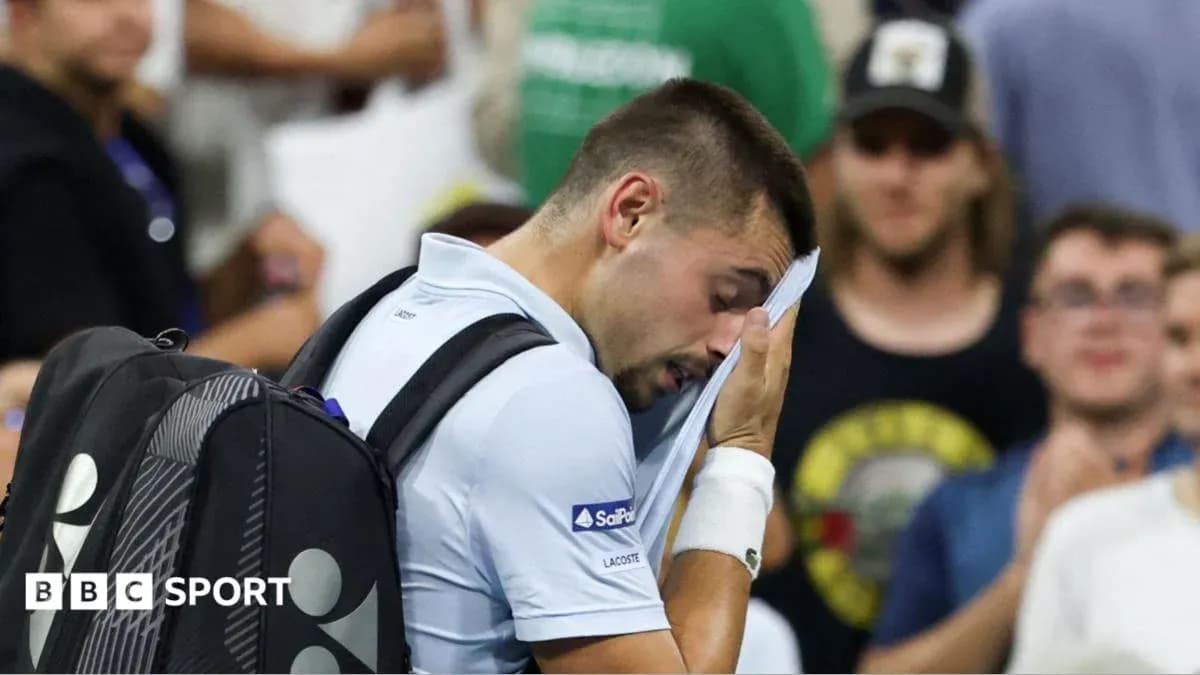
Arthur Gea stood one point from history. Three hours later, he was out of the US Open.
The 21-year-old Frenchman, a lucky loser who had already turned a second chance into a deep run, came within a single point of becoming the first lucky loser ever to reach a Grand Slam quarter-final. Instead, Botic van de Zandschulp dragged him into one of the wildest marathons Flushing Meadows has seen, then walked away with the ticket to the last eight.
The Dutchman survived, barely, winning 3-6 6-7 (0-7) 7-6 (9-7) 7-6 (7-3) 6-4 in five hours and 13 minutes – the fourth-longest match in US Open history. It was a comeback that made no sense and perfect sense at the same time.
Gea’s dream, and the point that slipped away
Gea was never meant to be here. Ranked 87 in the world when the entry list closed, he had to slog through qualifying. Seeded first, he fell at the final hurdle to American Nishesh Basavareddy and packed his bags believing his New York stint was worth $66,000 and a lesson in fine margins.
Then Casper Ruud pulled out injured on the eve of the tournament. Gea’s name slid into the main draw as a lucky loser. From there, he played like a man who refused to waste a reprieve.
He took out Juan Manuel Cerundolo, then Zachary Svajda, then Michael Zheng – two Americans beaten on home soil – to reach the last 16. Every win felt like a bonus. Suddenly, it was more than that. Against Van de Zandschulp, it was a genuine shot at history.
For two and a half sets, Gea looked ready to grab it. He outplayed the world number 70 early, taking the first set 6-3 and blitzing through a flawless second-set tie-break 7-0. In the third-set breaker, he earned a match point. One swing away.
He couldn’t land it.
Van de Zandschulp clung on, edged the tie-break 9-7, and from that moment the match turned into a test of nerve as much as legs. Gea still had chances. He served for the match in the fourth set. Again, he faltered. Again, the Dutchman refused to go away, stealing another tie-break 7-3.
By the time the fifth set rolled around, the Frenchman’s shoulders sagged. The rallies were still brutal, but the belief had shifted. Van de Zandschulp finally broke through and closed out the decider 6-4, completing what he himself called a “crazy comeback” and leaving Gea as the 13th lucky loser in history to fall in the fourth round of a Slam.
The consolation? A $480,000 payday, a huge leap from the qualifying cheque he thought he’d earned, and the knowledge that he had taken a seasoned pro to the edge in one of the epic matches of the fortnight.
Van de Zandschulp, meanwhile, gets something more tangible: a second US Open quarter-final.
Zverev finally finishes early – and wants the night back
Waiting for him is Alexander Zverev, the top seed and newly crowned French Open champion, who for once did not have to play into the early hours.
After three straight late-night finishes at 1:55am, 2:15am and 1:09am, Zverev wrapped up his fourth-round win over Luciano Darderi before midnight, beating the Italian 21st seed 6-2 6-2 7-6 (7-3).
It was sharp, efficient tennis for two sets, then a tighter third as Darderi finally found some rhythm. Zverev shut that down in the tie-break, sealing his place in the last eight without the usual New York graveyard shift.
He joked afterwards that he didn’t quite know what to do with the extra evening, tossing up between more practice and a bar. What he does know is when he wants to play next.
Zverev made it clear he will ask for another night session on Wednesday against Van de Zandschulp, quipping that he has “rented” the court from 11pm until 2am for two weeks and wants to keep it. The Dutchman has already gone the distance once. Under the lights, with Zverev’s rhythm finally in sync, the physical and mental toll of that five-hour epic could be decisive.
Blockx hangs on, Khachanov digs in
Earlier on Monday, another young player pushed through pain to keep his tournament alive.
Belgium’s Alexander Blockx, seeded 28th, admitted he came close to quitting against Francisco Cerundolo as rib pain worsened throughout the match. Instead of stopping, he endured – and walked off Arthur Ashe Stadium as the first Belgian man ever to reach a US Open quarter-final.
Blockx beat the Argentine 6-3 4-6 7-5 7-5, grinding through his service games while visibly struggling. He said he had been in trouble from the start, especially on serve, and that had he lost the third set he would likely have retired. He didn’t lose it. He hung on, then found just enough in the fourth to finish the job.
Now comes a different kind of battle. If his body holds up, Blockx will face Karen Khachanov on Wednesday, a man who knows all about long, bruising matches at majors.
Khachanov, the world number 50, had to climb out of his own hole to make it. He trailed 14th seed Learner Tien after three sets but surged back to win 7-5 4-6 6-7 (6-8) 6-1 6-4, ending the American’s attempt to help deliver four home players in the US Open men’s quarter-finals for the first time since 1995.
Tien had the crowd, the momentum, and a two-sets-to-one lead. Khachanov had experience. He tightened his game, dominated the fourth set, and kept his nerve in the fifth to quiet the home hopes.
So the quarter-final line-up takes shape: a lucky loser who almost rewrote history is gone, a resurgent Dutchman is still swinging, the top seed is finally in sync with New York time, and a battered Belgian steps into the biggest match of his life.
At this stage of the US Open, the margins are thin, the bodies sore, and the stakes obvious. The question now is simple: who still has enough left to survive another night in New York?