.svg&w=384&q=75 "logo")
Ajit Agarkar's Future Uncertain as BCCI AGM Raises Questions
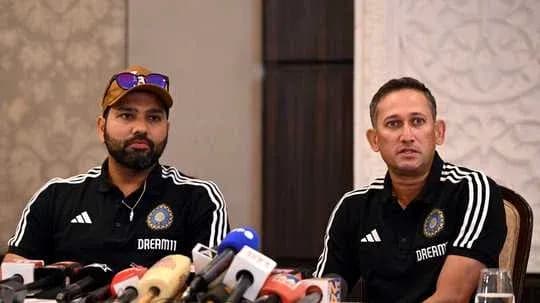
The BCCI’s Annual General Meeting in Mumbai ended with more questions than answers over one of Indian cricket’s most influential positions. Ajit Agarkar remains chairman of selectors – for now – but the board stopped short of offering any firm clarity on his long‑term future.
What did emerge was a subtle but important shift. The office bearers have been formally empowered to take a call on the senior men’s selection committee. In other words, the decision has been pushed upstairs, away from the AGM floor and into the corridors where real power is usually exercised.
Cloud over the chairman
Agarkar’s position has been under the scanner for weeks. His absence from a recent review meeting on India’s UK tour, which the BCCI tried to downplay, only intensified the chatter.
The flashpoint came around the Rohit Sharma episode before the Lord’s ODI. Selectors had reportedly conveyed to the former captain that he did not feature in the team’s plans. The board then stepped in. That intervention has lingered in the background, fuelling doubts over just how much autonomy the selection committee truly enjoys and where exactly Agarkar stands in that power matrix.
Appointed in July 2023, the former India pacer is understood to have a contract running until October 2026. On paper, that suggests stability. The mood around the position suggests anything but.
Yet, inside the selection room this week, it was business as usual. The committee met to pick squads for the West Indies ODIs, the Irani Cup and the India A teams. Those aware of the discussions described a normal working day: no delays, no visible disruption, no sign that the chair was wobbling.
No quick fix if Agarkar goes
If the axe does fall, the BCCI cannot simply anoint a new chairman overnight. The board must go through its formal process – issue an advertisement, invite applications, conduct interviews, and then finalise the panel.
That takes time, and the calendar does not stop. Tours roll on, teams need picking, and the selection pipeline has to keep moving. Any break at the top could leave the system leaning heavily on interim arrangements.
One name has already surfaced in the background noise. Former India wicketkeeper-batter Parthiv Patel is understood to be a potential contender if there is a change at the top. For now, it is just that: potential. No offer, no appointment, only a possibility waiting on a trigger.
Junior selection puzzle still open
The uncertainty is not confined to the senior setup. The junior selection committee remains incomplete as well.
The BCCI advertised for five junior selector positions on August 24, setting expectations that a new committee might be in place by the time the AGM wrapped up. That has not happened. Interviews are still pending, and the process is now expected to stretch to the end of the month.
With age‑group cricket central to India’s talent pipeline, the delay keeps another key piece of the structure in limbo at a time when the board is trying to project continuity and control.
Ranchi holds its ground in BGT schedule
Away from the selection intrigue, one storyline was firmly shut down. Reports that Ranchi could lose its Test in next year’s Border Gavaskar Trophy have been dismissed by the Jharkhand State Cricket Association.
Saurabh Tiwary, JSCA secretary, moved quickly to end the speculation, insisting there has been no change to the schedule and no communication from his end suggesting otherwise.
The five‑Test series against Australia is set to open in Nagpur on January 21. Chennai, Guwahati, Ranchi and Ahmedabad will host the remaining four Tests, in that order. For Ranchi, still growing its profile as a major Test venue, holding on to that fixture is a significant win.
Governance storm on the horizon
Inside the AGM, another issue loomed that could shape the board’s long‑term relationship with the Indian sporting ecosystem: the National Sports Governance Act.
The Supreme Court has asked the BCCI to clarify its stance on the legislation, effectively forcing the board to put its position on record. That clarification will not just be a legal formality; it will be a statement of how far cricket is willing to align with, or stand apart from, the wider regulatory framework governing sport in India.
So far, including in the Odisha Cricket Association case, the BCCI has held firm to one line – that cricket cannot be treated as a “designated sport” under the Act. That position now faces closer scrutiny.
For the moment, the board leaves its selectors under a cloud, its junior committee incomplete, and its legal stance under the Supreme Court’s gaze. The next move belongs to the office bearers. How quickly, and how decisively, they act will say plenty about who truly runs Indian cricket – and how.