.svg&w=384&q=75 "logo")
Younes Ibrahim's Journey from Academy to First Team at Brighton
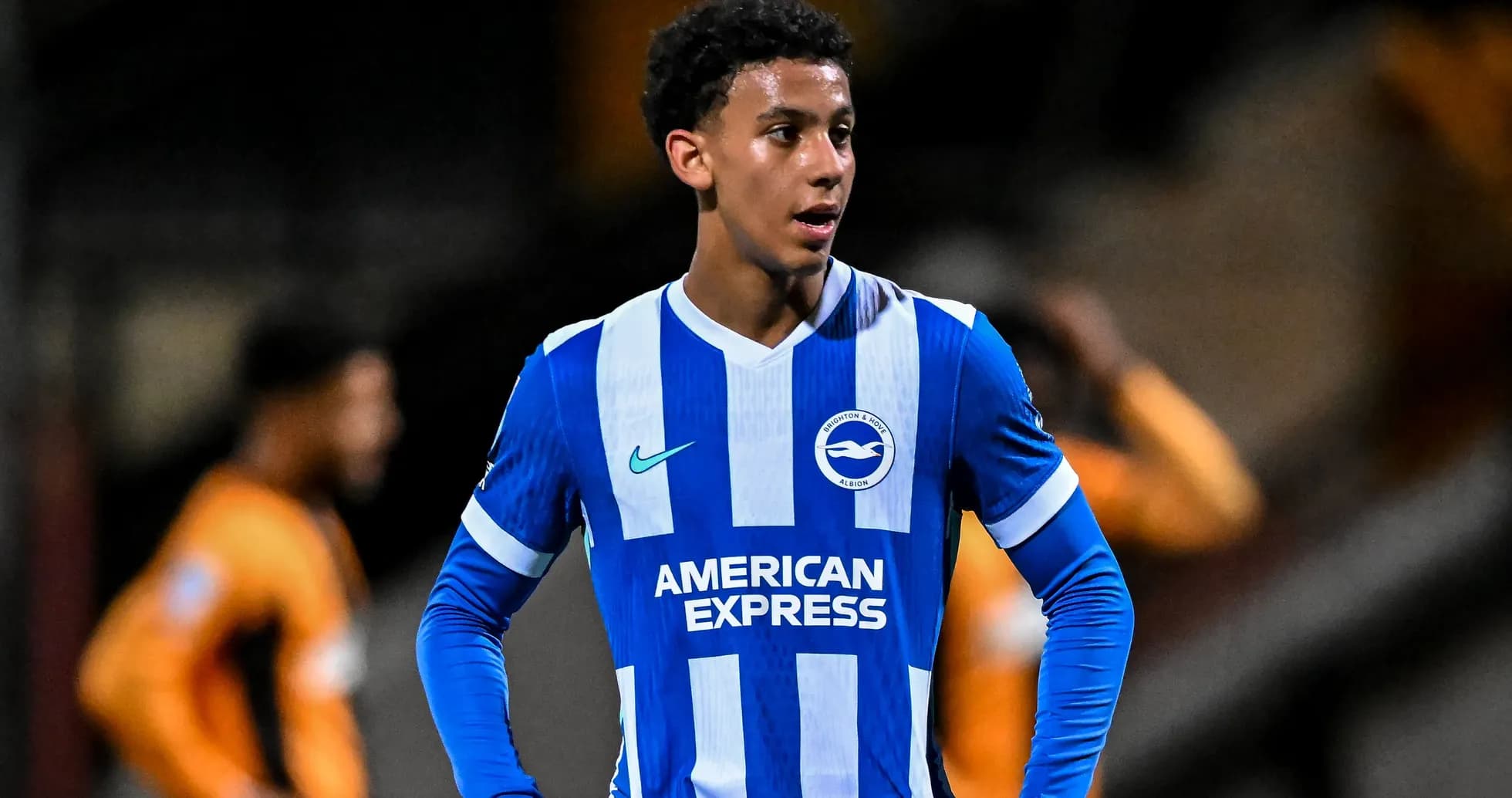
Last Sunday did not feel like academy football.
Forty-eight hours earlier, Younes Ibrahim had been just that: an under-21 standout, fresh from a superb goal that lit up Brighton’s youth channels and pinged around fan accounts. Then his phone rang.
You’re with the first team tomorrow.
No ceremonial pat on the head. No token place to make up the numbers. Not at Brighton.
This is the club that sold Moisés Caicedo for £115 million, that moved on Alexis Mac Allister and Marc Cucurella at precisely the right moment, that has turned talent identification into a business model and a footballing philosophy. If you sit on Brighton’s bench in an official match, you are not there for decoration. You are there because the club thinks you are close.
Very close.
A Numbers Game With Real Weight
The numbers behind that decision are modest on paper, but they carry weight in context.
This 2026–27 season, Ibrahim has appeared in three games across Brighton’s youth sides, with two direct goal contributions: one scored, one created. Decent returns, but not the full story.
The real surge came last season. Nine goals. Five assists. Across the campaign he grew into one of the academy’s most influential figures, not just as a finisher but as a problem for defenders between the lines. He drifted wide to play as a winger, dropped in as a false nine, and stitched moves together with the timing of a player who sees the pitch half a second quicker than those around him.
That kind of versatility is catnip to a club like Brighton. It is also not the product of a one-season wonder.
From Luton to London to the South Coast
Ibrahim’s rise has not followed the viral wonderkid script. No overnight sensation. No YouTube compilation that suddenly turns him into a phenomenon.
He started at Luton Town’s academy, a modest setting but a serious school in the basics: discipline, work rate, the realities of English football away from the glamour. From there came the leap to Chelsea’s academy, one of Europe’s most competitive talent factories, where every training session feels like a trial and the game moves at a relentless tempo.
At Chelsea he brushed up against different styles, different backgrounds, different expectations. The pressure sharpened him.
Then came the decision that raised eyebrows.
He left Chelsea for Brighton, joining the under-15s. To some, that looked like a step down. Less spotlight, fewer headlines, a smaller badge.
It was anything but.
Brighton have built a reputation as the only club in England that can look an academy player in the eye and show a clear, believable pathway to the first team. No vague promises. Concrete examples. Under-15, under-18, under-21, and then, if you keep climbing, the Amex.
Ibrahim walked that path. Each step up, he didn’t just survive the jump in intensity; he grew with it. Physically, he filled out. Mentally, he adapted. His game became more rounded, his decisions cleaner.
Last July, the club made it official. His first professional contract.
Brighton academy director Ian Buckman framed it as a milestone not just for the player but for the people around him: “It is an exciting moment for the players and their families alike.” A line that fits the club’s ethos, where development is treated as a shared project, not an individual lottery win.
Buckman went further, underlining what that signature really meant. Recognition of the work already done, and a challenge to seize the chances now in front of him, to keep learning and progressing, just as he has up to this point.
Brighton do not hand out professional deals to tick boxes. They hand them out because they expect a return.
Four Nations, One Decision
What turns Ibrahim’s story from a promising academy tale into something far bigger is his passport.
Or, more accurately, passports.
Born in Australia, he is eligible for the Socceroos. Eight years in England make him a candidate for the Three Lions. Egyptian and Moroccan heritage opens the door to the Pharaohs and the Atlas Lions.
Four national teams. Four different footballing cultures. One emerging forward.
Australia are searching hard for their next long-term striker, a focal point for a new generation. England leave no Premier League talent unscouted, especially those coming through a system as respected as Brighton’s. Egypt and Morocco have both made it a strategic priority to convince dual-nationality players in Europe to commit early, to fold them into ambitious national projects.
For now, Ibrahim is keeping his options open. That is not fence-sitting; it is good career management. At 18, the real battle is not between four flags. It is for minutes at Brighton.
First, turn a place on the bench into a debut. Then turn that debut into a role. Then turn that role into a first Premier League goal.
When that happens, the dynamic changes. The calls come to him. The pitches are made to him. He will choose, not chase.
A Bench That Meant More
So that afternoon against Coventry, when his name appeared among the substitutes, it was not just a line on a teamsheet. It was a statement.
Brighton had decided that the project was ready for its next phase.
From Sydney’s early steps, to the grind of Luton, to the sharp edges of Chelsea, to the calculated move to the south coast, Ibrahim’s journey has been about more than survival in elite environments. It has been about positioning himself for the moment when the door finally opens.
On Sunday, he stood in the doorway.
Now the question is not whether he belongs in that space, but how quickly he can turn that first glimpse of the Premier League into a permanent view.