.svg&w=384&q=75 "logo")
Williams Sisters Shine in Emotional U.S. Open Return
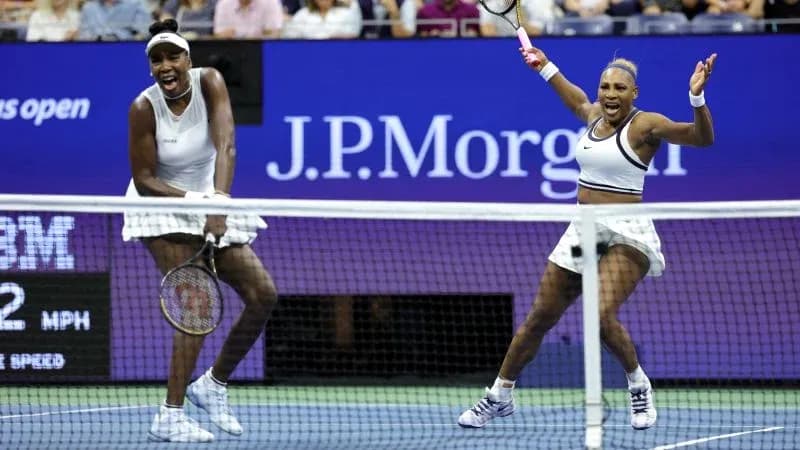
On a sticky New York night, with the city’s noise pressed up against the walls of Arthur Ashe Stadium, the Williams sisters walked back into the kind of spotlight they practically invented.
Serena at 44. Venus at 46. Under the lights. In a first‑round doubles match that was treated like a final.
Carlos Alcaraz had already done his work for the day, a brisk win in straight sets, and made his plans clear.
“I think there is no better plan (than) to watch the doubles, the Williamses once again, while getting a treatment,” the defending men’s champion said. “I’m going to be ready for that.”
He wasn’t alone. Ashe filled for them the way it once did for their title runs, the way it did for Serena’s supposed farewell in 2022. This was their first U.S. Open appearance since then, their first Grand Slam doubles match together since that emotional exit. The U.S. Open schedulers gave them the night session on the main stadium – almost unheard of for first‑round doubles – and the sisters repaid the gesture with a match that swung wildly between nostalgia and heartbreak.
They lost. 6-3, 6-7 (6), 7-6 (10-7) to Hao-Ching Chan and Maya Joint, a thriller that ended with a 10‑point match tiebreak in which the Williamses led 5-0 and still couldn’t close.
For a few minutes, it felt like old times. Then it felt like time itself.
Chan and Joint had already seen the script once this summer. Joint, the Australian, beat Serena in three sets at Wimbledon in the American’s return to singles, and the sisters then withdrew from their doubles match there after Serena hurt her knee. That setback pushed their return to the Grand Slam stage back to New York, the place where they first won this title in 1999, then again in 2009, and built a 27-8 record in 10 doubles appearances.
On Friday night, they had to fight just to give themselves a chance to win it again.
Chan and Joint took the opening set 6-3 and jumped out 4-1 in the third. The stadium grew quiet. It has seen too many comebacks from these two to ever fully give up, but the tension changed. The points stretched. The legs looked heavier.
Then the old defiance kicked in.
They clawed back from that 4-1 deficit to level the set, igniting Ashe the way only they can. Returns started to bite. Volleys tightened. The crowd rose with every hold, every break, every glance between the sisters that said: one more time.
They forced the match tiebreak and then sprinted out to 5-0. At that moment, with the noise rattling around the stadium, it felt like the sport’s natural order had been restored.
And then it slipped.
Perhaps it was the age. Perhaps the rust from Serena’s long layoff. Perhaps just nerves. Whatever the cause, both sisters double‑faulted in the breaker after playing some of their sharpest tennis late in the third set and in the opening points of the decider. Chan and Joint, to their credit, didn’t flinch. They reeled them in, point by point, and shut the door 10-7.
The U.S. Tennis Association said the sisters would not be available for comment. The silence only added to the sense that this hurt.
It was their second loss in a match tiebreak together this summer after a similar defeat at the Cincinnati Open. For Serena, it was also a second painful chapter against Joint in a matter of months. For Venus, who had already gone out in the first round of singles, it was another reminder of how unforgiving the tour can be to legends who insist on writing their own endings.
Once, the Williams sisters owned this format. Fourteen Grand Slam doubles titles together. Olympic gold medals in 2000, 2008 and 2012. A shared run as the No. 1 team in the world. For years, they turned doubles into a showcase of raw power and intimidation.
On this night, they were still the main attraction. They just weren’t the ones advancing.
Around them, the tournament kept moving, the next generation carrying the draw forward.
Alcaraz, back at the U.S. Open after four months out with a right wrist injury, brushed aside Wu Yibing 6-3, 6-4, 6-1 to reach the round of 16 again. The two‑time champion looked sharp, aggressive, and maybe a little ahead of schedule.
“To be honest I’m better than I thought,” he said afterward, a warning as much as an admission.
His next test comes against No. 20 seed Tommy Paul, who edged No. 15 Alexander Bublik in five sets in a very different kind of grind.
On the women’s side, Aryna Sabalenka finally had to sweat. The two‑time defending champion had cruised through her early rounds, but Kamilla Rakhimova pushed her into a second set that lasted 54 minutes – one minute longer than Sabalenka’s entire previous match.
Sabalenka won 6-3, 6-4, handling both her opponent and an unwelcome distraction: the smell of marijuana drifting through the court. The No. 1 seed kept her focus, kept swinging, and kept her bid alive to become the first player since Serena Williams from 2012-14 to win three straight U.S. Open titles. Taylor Townsend awaits her in the round of 16, a different type of challenge with a very different rhythm.
The sport moves quickly. New champions arrive. Old ones refuse to leave quietly.
On Friday night in New York, Serena and Venus Williams walked back into the arena they helped define and showed, for long stretches, that their tennis still belongs on its biggest stage. The result will sting. The performance will linger.
How many more nights like this they have left is unclear. What is clear is that, even now, when the schedule-makers want to remind the world what this tournament feels like at full volume, they still turn to the Williams sisters.