.svg&w=384&q=75 "logo")
Varun Aaron's Journey from Fast Bowler to Coach: A New Calling
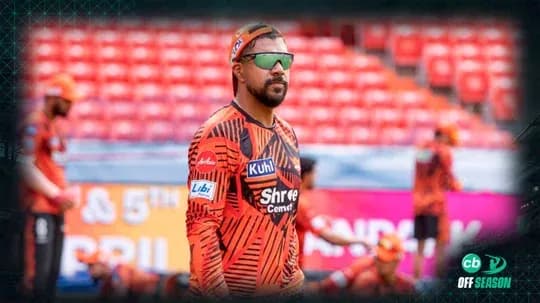
Daniel Vettori’s phone call found Varun Aaron in a rare place: at peace.
The former India quick had walked away from professional cricket earlier in 2025 at 35, content with a career carved up by pace and punctured by injuries. He had slipped neatly into broadcasting, talking fast bowling instead of living it, and for once his body wasn’t screaming back at him. Coaching? That was never part of the grand plan. Mainly because there was no grand plan.
"I really was not setting out any targets," he says. No five-year roadmap, no checklist. Just a man who’d survived three stress fractures, multiple comebacks and the unforgiving speed gun, finally allowing himself to breathe.
And then Vettori rang. Would he be interested in coaching Sunrisers?
The Accidental Coach
The thing is, Aaron had been coaching long before anyone gave him a title.
At Jharkhand, teammates drifted towards him with questions about their actions, their rhythm, their bodies. Years of injury had forced him into an obsessive study of his own mechanics. He had become his own guinea pig, his own physio, his own bowling coach.
"I think I've coached myself quite a bit because of the amount of injuries I've had," he reflects. The process hardened into a habit. Friends asked, he answered. Bowlers tinkered, he guided. The satisfaction of seeing someone else get better lodged itself quietly in his system.
There was structure too. The new MRF Pace Foundation High Performance Center was, in many ways, his blueprint. Aaron didn’t just show up as a guest coach; he helped design the facility, the protocols, the programme, even the redevelopment of the ground and gym. It was his way of paying back an academy that had shaped him, this time with planning rather than yorkers.
He later worked as a bowling consultant with the Jharkhand State Cricket Association. The seeds were there. He just never labelled them as a career.
Sunrisers, Auctions and a Free Hand
Vettori’s offer changed that. Sunrisers didn’t just want a bowling coach; they wanted him involved in building a bowling group from the ground up.
In his first season, Aaron found himself at the auction table, not just the practice nets. He was given a say, and he used it. Among the names he circled were two relatively unknown quicks: Praful Hinge and Sakib Hussain.
"What I saw was not what they were doing, but what they could do," Aaron says. He wasn’t chasing present numbers; he was betting on ceiling. On potential that hadn’t yet been dragged into the spotlight.
The bet paid off fast. Hinge and Sakib ripped through Rajasthan Royals in their first IPL game, each taking four-wicket hauls and announcing themselves with the kind of debut that makes franchises look very smart, very quickly.
Those spells didn’t happen by accident. Aaron had been working with them in the lead-up to the tournament, even as he juggled another job. He was on commentary duty for the T20 World Cup, which meant days split in two: broadcasting in the morning, coaching in the evening in Mumbai, or the other way around. Studio lights, then training cones. Analysis on air, then analysis in the nets.
When the World Cup schedule tightened and his travel spiked, he didn’t simply hope the work would continue. He sent Hinge and Sakib to the Rao Cricket Academy, to a man he trusted implicitly: SS Rao, his former Jharkhand captain.
"Me and SS Rao have a brotherly relationship," Aaron says. He handed Rao a clear set of instructions, and Rao followed them to the letter, adding his own presence and energy to the mix. The method stayed intact; the voices multiplied.
The Sunrisers scouting didn’t stop at two names. Aaron raves about Shivang Kumar. He mentions Onkar Tarmale, who picked up an injury at the wrong time and slipped under the public radar, but who, Aaron insists, can crank it up to 145 kph. These were not random punts. They were targeted, specific picks.
And crucially, he was allowed to make them.
"When you're empowered by the head coach and the team owner in that fashion, I really feel your job becomes all that much easier," he says. In year one, he got something coaches often wait seasons for: a near free hand. That freedom, he says, let him be "creative" with his work. It made the job fun.
The Art of Keeping It Simple
For all the technology, data and biomechanics that now swirl around fast bowling, Aaron’s philosophy boils down to one word: simplicity.
"Fast bowling is really simple, but I think as a player you complicate it a lot," he says. Young quicks chase new tricks, new angles, new grips, but his experience has taught him that the craft rests on a handful of basic principles. Get those right, and everything else becomes less chaotic.
But simplicity doesn’t mean uniformity.
"There's no set method to coaching. It completely depends on the individual," he insists. He looks first for what makes a bowler unique, then tries to amplify it. Shortcomings aren’t reasons to tear down an action; they’re prompts to make it more efficient.
Some bowlers turn up with textbook actions and bodies that cooperate. Others carry scars, awkward angles, fragile backs. Those are the ones who require more work, more tailoring. Different musculature. Different coordination. Different biomechanics. To Aaron, that’s where modern coaching has to go: away from templates, towards true individuality.
He applies the same nuance to performance. He refuses to lazily brand spells as simply "good" or "bad". For him, every outing needs a reason attached.
If a bowler performs well, he wants them to understand exactly why. If they struggle, he wants them to leave with something learned, not just a bad day on the figures column. The danger, he warns, is drifting: bowl, go home, repeat. No reflection. No growth.
Timing, Not Just Speed
For a man once defined by the speed gun, Aaron’s view on pace is striking.
His own career burst into national conversation when he hit 153 kph in the 2010/11 Vijay Hazare Trophy final, at a time when India didn’t produce many genuine quicks. Young bowlers still approach him with one obsession: how to bowl faster.
His answer cuts against the grain.
"Fast bowling is all about timing," he says. He compares it to batting: get your initial movement right, stay balanced, keep your head still, and you give yourself time. In bowling, it’s the timing and sequencing of the action before release that decides everything.
If those are right, he argues, you’ve "won the battle." You’ll bowl as fast as your body allows, you’ll hit your areas, and you’ll stay on the park. That last part is crucial. You can’t bowl faster than your body’s limit. He tried. His back made sure he remembered.
Three stress fractures after his Ranji debut in 2008/09. A Test debut in 2011, then almost three years before his second appearance in 2014 because his back broke down again. His career became a constant negotiation between what his mind wanted and what his spine could tolerate.
Now, as a coach, he manages that same tension in others.
Life Between Commentary Boxes and Nets
Aaron’s calendar is brutal. Coaching assignments, franchise work, broadcast gigs, travel that blurs time zones. He jokes that his girlfriend is "not the happiest customer" because he’s rarely at home. He’s trying to carve out more time for her and his family. The reality, though, is that the game still has him firmly in its grip.
The double life has its advantages.
Coaching gives him access to the inner workings of players’ minds. He sees how they think under pressure, what their go-to deliveries are, how they set fields for specific balls. That knowledge feeds directly into his commentary. He’s not guessing what a bowler might do; he’s often seen it rehearsed in training.
And the reverse is true. Broadcasting lets him watch players across tournaments, formats and conditions. It keeps his information current, his eye sharp. Those observations loop back into his coaching, sharpening his assessments and plans.
The Unexpected Calling
For someone who never plotted a path into coaching, Aaron sounds like a man who has found his next calling.
"What it has taught me about myself is that coaching gives me immense happiness," he says. The joy isn’t in the title, the franchise, or even the wins. It’s in the quiet conversations after a session, when a bowler walks away having hit every target they set for that day.
For a fast bowler who once chased numbers on a speed gun, the measure of success has shifted. Now it’s in the click of timing, the light in a young quick’s eyes, and the knowledge that somewhere, in the middle of another long day, something has finally fallen into place.