.svg&w=384&q=75 "logo")
Test Cricket's Shift: From Five Days to Two
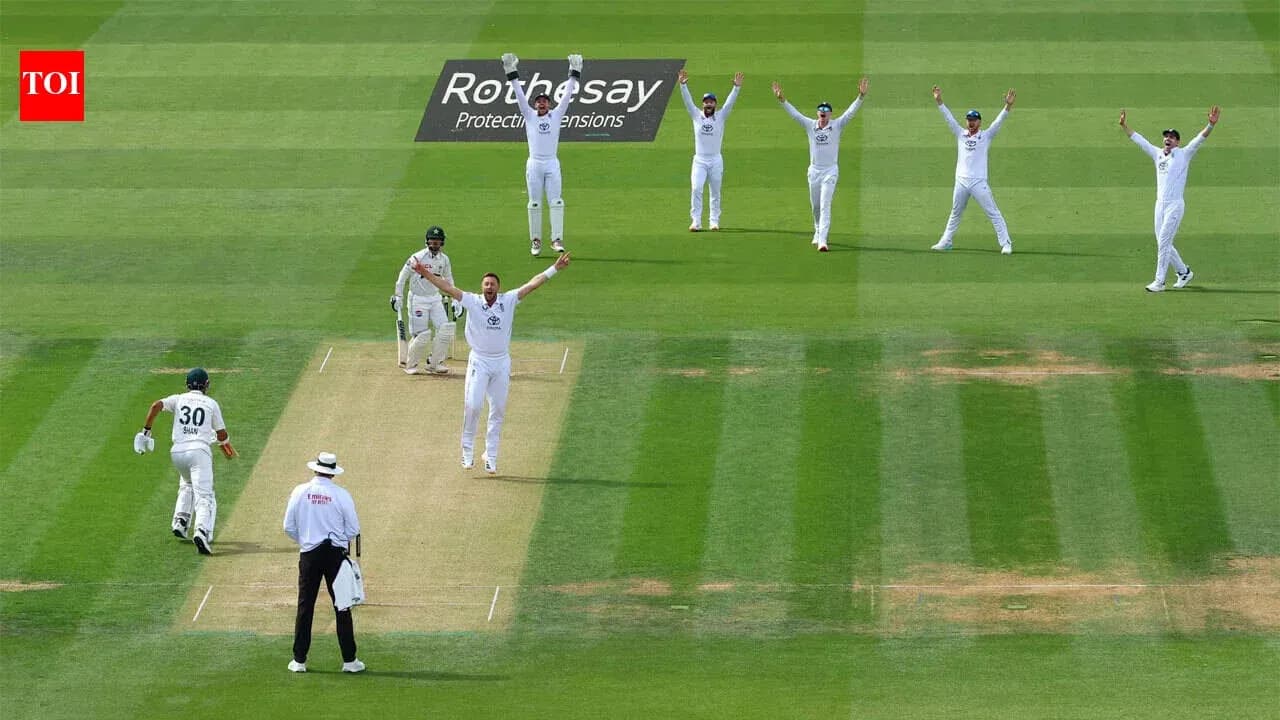
Test cricket used to promise five days of slow-burn drama. Increasingly, it is serving up a result in three – sometimes two – and sending everyone home early.
On a damp, stop-start morning at the second Test between England and Pakistan, with covers on and players waiting, Michael Atherton used the lull to explain why. The former England captain has lived the format from the inside; now, from the Sky Sports commentary box, he is watching it accelerate.
The numbers are stark. The reasons, he argues, are even clearer.
A faster, riskier game
Atherton began with the obvious shift: how batters play.
The rise of T20 has rewired instincts. Footwork is sharper, scoring options wider, but the tolerance for quiet periods has shrunk. Test batters now carry white-ball muscle memory into the longest format, and with it, a higher appetite for risk.
“Batting is higher risk now because of T20 cricket. If you take more risk, you have more chance of getting out,” Atherton said on air, distilling a decade of change into a single line.
That change has not happened in isolation. It has collided with a generation of fast bowlers who can exploit any hint of aggression. Around the world, there is a “good crop of fast bowlers,” as Atherton put it, capable of sustaining high pace and hostility across long spells. Shorter matches are not just about reckless shots; they are also about relentless, skilful bowling.
DRS and the umpires’ finger
Then there is the Decision Review System.
Before DRS, umpires tended to give the benefit of the doubt to batters, especially on lbw appeals. With technology backing them up, that balance has shifted. Atherton believes it has quietly but decisively tilted the game towards the bowlers.
“DRS has had an impact; umpires are more likely to give LBWs,” he noted. Marginal calls that once went the batter’s way now end in a raised finger and a long walk back. It all adds up: more dismissals, quicker collapses, shorter Tests.
Pitches with an edge
The surface underfoot has changed too.
Atherton linked the trend directly to the World Test Championship. With points at stake and home advantage more valuable than ever, teams have become bolder – and more ruthless – in how they prepare pitches.
“Pitches have become more advantageous since the advent of the World Test Championship; teams are generally looking to get home advantage more,” he said. In India, that often means sharp turn. In England, green seams and live grass. Elsewhere, conditions are nudged to suit local strengths.
The result? More bowler-friendly tracks, less time for batters to dig in, and matches that rarely meander to a fifth-day stalemate.
The numbers don’t lie
Sky Sports backed Atherton’s observations with data during the rain delay, and the shift is dramatic.
Only 41.43% of Tests in the 2020s have gone the full five days. In the 1970s, that figure was 77.65%. Even in the 2010s, more than half – 54.76% – lasted to the final day.
At the other end of the scale, the spike in two- and three-day finishes is even more striking. In the 1970s, just 2.79% of Tests wrapped up inside three days. In the 2020s, that figure has leapt to 23%. Almost one in four.
The recent Australia–Bangladesh Test in Mackay, done and dusted inside two days, was not an outlier. It was the latest entry on a growing list.
Atherton’s era vs now
Atherton, who played through the 1990s, knows what a grinding Test looks like. For him, the comparison with his own era is telling.
“When Nas (Nasser Hussain) and I were playing in the 1990s, the number of games finished in three days or less was around about 7 per cent (6.98 per cent). And that is now 20 per cent, so that is a big difference,” he said.
One in five Tests now ends inside three days. That is not a quirk of scheduling or weather; it is a structural shift in how the game is being played and prepared.
He highlighted one more statistic that underlines just how far the format has moved. “In the last decade (from 2017-current), there have been nine occasions where Test matches have finished in two days, and there wasn't a single two-day Test between 1946 and 2000. The Test matches are going quicker,” Atherton said.
Nine two-day finishes in less than a decade, none in more than half a century before that. For a format once built on endurance, it is a remarkable transformation.
The question now is not whether Test cricket is speeding up. It clearly is. The question is how much further this trend can go before the five-day canvas that defined the format for more than a century becomes the exception, not the rule.