.svg&w=384&q=75 "logo")
Team USA Dominates in FIBA Women’s World Cup Quarterfinals
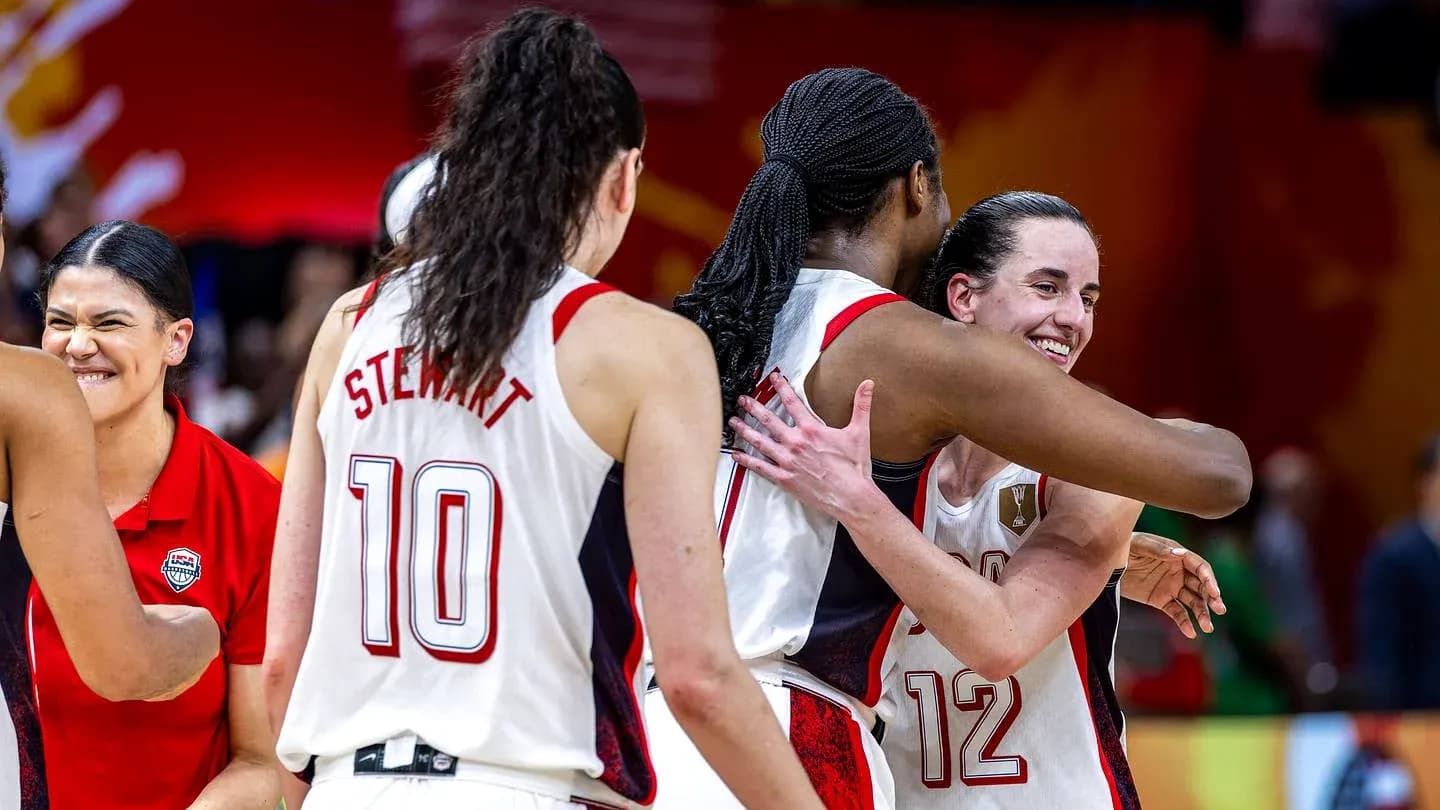
Team USA rolls into the FIBA Women’s World Cup quarterfinals not just unbeaten, but untouched.
Three games, three wins, three statements.
Their latest came on Monday in Berlin, a 105-64 demolition of Czechia that sealed a perfect 3-0 record in Group D and stretched the Americans’ World Cup winning streak to a staggering 33 games, a run that began back in 2006. This is not a team easing its way into a tournament. This is a program intent on reminding everyone who owns this stage.
A machine with many gears
The numbers from pool play tell the story of a roster stacked with stars and still finding new ways to dominate.
Breanna Stewart, in her fourth World Cup, is the quiet engine. She’s averaging 10.3 points and 8.3 rebounds, controlling games without needing to chase box-score headlines. Jackie Young has emerged as the leading scorer at 11.3 points per game, a steady, reliable option who keeps defenses honest.
The backcourt, though, is where this team’s personality crackles.
Caitlin Clark sits atop the assist chart at 6.3 per game, already dictating tempo in her first World Cup. Her 11-assist, zero-turnover opener set the tone for how she would run the team when given the ball. Coach Kara Lawson made it plain: when Clark is at the point, the offense runs through her, and the team expects her to orchestrate.
Paige Bueckers has added rim protection from the perimeter, leading the squad with 1.3 blocks per game. Rhyne Howard has become the spear at the top of the defense, averaging 1.7 steals and turning pressure into transition.
It’s a group that doesn’t rely on one superstar eruption. It overwhelms in waves.
Young core, steep learning curve
Lawson knows this is a World Cup of firsts for several of her key guards. Clark, in particular, is navigating her debut on this stage while still being asked to steer the offense and absorb responsibility late in games.
She’s “feeling her way through her first World Cup,” as Lawson put it, but she’s doing it with clear intent: to help this team win now and to grow into the kind of player who can anchor future runs. Those early pool games weren’t just tune-ups; they were live-fire reps for a young core that will be asked to deliver when the margins tighten.
The confidence from three dominant group wins now becomes currency. The knockout rounds demand it.
Bracket set, pressure rising
The Americans have earned a brief pause before the real tension begins. They’ll return to action on Sept. 10 in the quarterfinals, facing the winner of Hungary vs. Japan.
The rest of the bracket has taken shape around them.
- From Group A, Japan, Spain and Germany advanced.
- Group B sent Hungary, South Korea and France.
- Group C produced Belgium, Australia and Puerto Rico.
- Joining the USA out of Group D are Italy and China.
Before Team USA steps back on the floor, the tournament will carve itself down from 12 to 8:
Tuesday, Sept. 8 – Qualification for quarterfinals
- Hungary vs. Japan, 11:45 a.m. ET (winner faces the United States)
- Germany vs. South Korea, 2:45 p.m. ET (winner faces Belgium)
Wednesday, Sept. 9 – Qualification for quarterfinals
- Puerto Rico vs. China, 11:45 a.m. ET (winner faces France)
- Italy vs. Australia, 2:45 p.m. ET (winner faces Spain)
From there, the path is brutally simple.
Sept. 10 – Quarterfinals
Sept. 12 – Semifinals
Sept. 13 – Championship and third-place game
Lose once, and the dream ends. Win three more, and the United States extends its dynasty with another world title.
Everyone chasing the same giant
The betting markets reflect what the court has already suggested.
At BetMGM, Team USA stands as the clear favorite to lift the 2026 FIBA Women’s World Cup trophy, listed at -500. No one else is close. France is next at +600, with Belgium at +1400, Spain at +2000 and Australia at +2800 forming the chasing pack.
China, Germany and Italy sit at +6600, long shots with enough talent to cause problems but a mountain to climb to the top. Japan, South Korea, Puerto Rico and Hungary are all pegged at +20000, dangerous on their day yet still viewed as outsiders in a field dominated by the red, white and blue.
The message is blunt: everyone is playing for the right to upset the standard.
Berlin at the center of the women’s game
All of it unfolds in Berlin, the heartbeat of this World Cup.
The tournament is split between two venues: Berlin Arena and Max-Schmeling-Halle. Both buildings have hosted the group-stage action, but once the bracket tightens and the stakes rise, Berlin Arena becomes the exclusive stage for the knockout rounds.
That’s where the Americans will try to extend their 33-game World Cup winning streak. That’s where a new champion will be crowned, or an old one will tighten its grip.
Team USA has a couple of days to rest, reset and study Hungary and Japan. Then the margin for error disappears. The streak, the expectations, the target on their backs — all of it walks onto the floor with them.
The question now isn’t whether they’re favorites. It’s whether anyone in Berlin can actually stop them.