.svg&w=384&q=75 "logo")
Sonal Dinusha: Rising Star of Sri Lankan Cricket
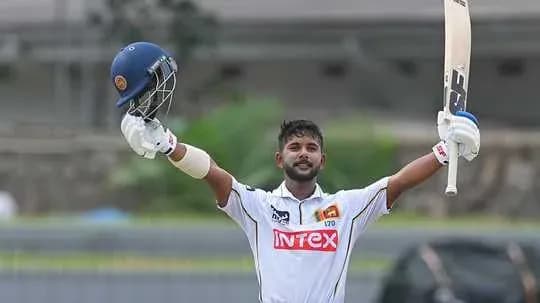
Sonal Dinusha was drowning in bouncers.
Darwin, July 2025. Sri Lanka A against Australia A. A tall, hostile pace unit – Mitchell Perry, Liam Scott, Henry Thornton – all over six feet, all happy to dig it in. Ball after ball whistled past his nose. The diminutive left-hander looked stuck, short of answers and short of breath.
On the sidelines, Avishka Gunawardene watched his young batter flinch and fend, then stepped in.
“They were bowling bouncers, he was kind of struggling. So we just went, threw a few balls, had a chat with him, just sorted out what he was going to do, the tactical part of it. And then he went on,” the then Sri Lanka A coach told Cricbuzz.
The response was immediate and ruthless. A 145-ball 105 in the first unofficial Test. A 191-ball 88 in the second. First time batting in Australia, first time facing that kind of sustained short-pitched barrage. Same result: problem identified, solution built, game moved on.
That is the Sonal Dinusha blueprint.
Built in the schoolyards
Dinusha is not a miracle out of nowhere. He is a product of Sri Lanka’s most reliable factory line: school cricket.
He started at De La Salle College in Colombo, a modest launchpad, before shifting to the more storied Mahanama College, where his current Test captain Dhananjaya de Silva once walked the same corridors. At both institutions, he found the same guiding voice – and almost the same name.
Sonal Dulshan Elwalage, an SLC Level 2 coach just eight years older than his charge, had seen his own playing career stall under family pressures. Coaching became his way to stay in the game. Dinusha became his project.
“Dinusha began playing cricket there [De La Salle College] at the age of 12, and I worked with him from that time onwards. I was drawn to the enthusiasm he showed at such a young age,” Dulshan recalled.
That enthusiasm hardened into obsession. Dulshan’s ambition to push Dinusha to the highest level turned into a second career for both of them – one as player, one as mentor, each feeding the other’s drive.
The innings that lives loudest in Dulshan’s memory came in February 2020. Under-19 Division 1, Mahanama College against Richmond College, Galle. Two-day cricket, real pressure. Mahanama 20 for 3 in the eighth over. A 19-year-old Dinusha walked in and simply refused to leave.
He batted through the innings for an unbeaten 159 off 227 balls, laced with 15 fours and four sixes. He carried his side to a first-innings win in the 82nd over, exactly the kind of long, stubborn vigil Sri Lanka fans have watched over the last fortnight at Test level.
He did more than just survive. With the No.11 at the other end, he managed the chase like a seasoned pro, farming the strike, shielding his partner, stretching the last-wicket stand for 7.3 overs. Colombo Cricket Club’s Nisal Akash faced only 11 balls in that time. Dinusha did the rest.
The skill to bat time. The calm to run a chase with a tailender. The awareness of who should face which bowler. Those habits were already there, long before the TV cameras arrived.
Learning the craft, one level at a time
While still at Mahanama, Dinusha stepped into first-class cricket with Colombo Cricket Club in 2018. It was a big jump, but he treated it like everything else: another problem to solve.
Ashan Priyanjan, long associated with CCC as player, captain and coach, still goes back to Dinusha’s very first game for the club.
“I still remember he batted out of position at No.3. He’s a No.6 batter but for the team’s balance he batted at No.3 and got a half-century against a good bowling attack,” Priyanjan said.
Out of position, under pressure, and still he found a way. That adaptability has become a theme.
Across his rise, Dinusha has collected coaches the way some players collect hundreds: Kalum Gangodawila, Felix Dias, Alan Rodrigo, Tharanga Dhamika. Different voices, different stages, one common verdict.
His career, they say, is built as much on work ethic as on talent. The runs, wickets, and diving stops are the visible part. The real foundation lies in how he trains.
Gunawardene saw it up close.
“The main thing that I saw in him was he was a very organised cricketer. He was very methodical. He works hard, he knows exactly what he wants. He knows what areas he needs to work on. If there’s any doubt, then he’d come and ask me. But if not, he knows exactly what he needs to do in training. He’s a very smart cricketer.”
That intelligence shows up most clearly in one shot.
The sweep that won a series
Across two Tests against India, Dinusha scored 173 runs off one stroke: the sweep. Conventional, slog, paddle – all of it. India kept feeding him spin; he kept dropping to one knee and emptying their plans.
Asked about this after Day 4, he barely bothered with a flourish. “I am good at sweep shot, so I play it. That’s all.”
The simplicity of the answer hides the work behind it.
Priyanjan remembers the hours.
“He loved playing the sweep shot. He’d train separately in the nets for it. He would finish batting and then take throwdowns just to play the sweep shot.”
Not a party trick. A weapon. One he forged on quiet afternoons when nobody was watching, then unsheathed when the stakes were highest.
That mindset – find a strength, sharpen it relentlessly, then trust it under fire – runs through his game. It is why Gary Kirsten, not a man easily impressed, marked Dinusha down early.
Winning over the head coach
Sri Lanka’s current head coach first really locked in on Dinusha in the Caribbean.
“The first time I really watched him bat properly was in the first innings in the West Indies. He came in at seven and we were 110 for five. And he put on a hundred (99) with the captain. And I thought, ‘jeez, this guy can play.’ And then in the second match he got 92,” Kirsten said.
Those knocks told Kirsten the kid had game. What followed against India convinced him Dinusha had something more.
“I love the way he plays Test cricket. He thinks about it. He plays to his strengths. And he is a smart cricketer. So he understands what the bowlers are trying to do to him. And then he uses his skillsets to communicate that. I think this innings (133 off 264)... what he was able to achieve, I would say would go down in Sri Lankan Test cricket history as one of the great saves.”
From Darwin bouncers to West Indies rescue acts to a monumental 133 against India, the pattern holds: crisis arrives, Dinusha thinks, adjusts, and digs in.
No time for laurels
The temptation, after three centuries in four Test innings and a series that has tilted his career trajectory, would be to bask in it. Enjoy the headlines, soak in the praise, replay the highlights.
Dinusha’s mind has already moved on.
Even before he completed that third hundred, he was talking about the next tournament. The next practice session. The next block of work.
Sri Lanka Cricket knows what it has now. A gem, yes, but not a fragile one. A cricketer with precocious talent, backed by a relentless appetite for the unglamorous grind that turns promise into permanence.
The country’s school system, club structure and A-team pathways have done their job. They have produced a batter who can think through a spell, bat through a day, and train through the noise.
The question is no longer whether Sonal Dinusha belongs at this level.
It is whether Sri Lanka will give him the space, the backing and the time to see just how high that methodical, hungry mind can take him.