.svg&w=384&q=75 "logo")
Sonal Dinusha's Dominance in India Series: A Test of Skill
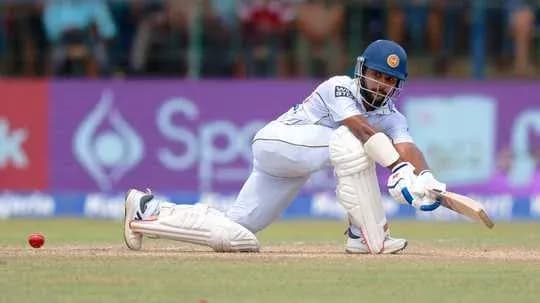
Sonal Dinusha walked into this India series with only three Tests behind him and no safety net. Four innings, four crises. Each time he arrived, the game was already snarling at him.
He left the series with 420 runs, three centuries, and something far more valuable than numbers: proof that he can live in the heat.
Sri Lanka did not win. They were outgunned by India’s superior spin attack, a unit with more bite, more variation, and far greater control. Most home batters were exposed on pitches where the 3-5m zone is a spinner’s playground and a batter’s examination hall. Dinusha turned that examination into a personal statement.
Owning the good length
Against spin, the good length is where careers stall. Dinusha turned it into a scoring area.
He took 182 runs off good-length balls from the spinners, averaging 91 at a strike rate of 58.89. The series baseline for that length? An average of 26.42 and a strike rate of 45.36. He wasn’t just ahead of the curve; he was bending it.
No one in the series scored more runs off that band. Only Niroshan Dickwella, in a much smaller sample, went quicker. Even Devdutt Padikkal, the Player of the Series, sat behind Dinusha in that zone, averaging 69.50 and scoring at 49.82.
The difference lay in where Dinusha chose to meet the ball.
His average interception point against good-length spin was 2.64m from the stumps – comfortably the furthest of any batter in the series. Padikkal, far more inclined to play from the crease, was back at 2.02m. Dinusha kept dragging the contest forward, literally.
Only 43.4% of the good-length deliveries he faced were met in the so-called danger zone – that 1.5m to 3.5m corridor between pitch and interception where batters are most vulnerable. Among Sri Lankans, no one did better. Across both teams, only Padikkal, Rishabh Pant and Ravindra Jadeja had a lower share.
He refused to let the ball dictate terms.
Front-foot intent, small-frame ingenuity
Among batters who faced at least ten overs of spin, Dinusha played 73.6% of balls from the front foot, including his advances down the pitch. Only Shubman Gill, at 77.3%, went forward more often.
Gill has height and reach. Dinusha, listed at just five-foot-six, had to manufacture his own range. He did it with two weapons: the charge and the sweep.
He advanced to 12% of the balls he faced – second only to Pant’s 13.3%. His sweep frequency was even more extreme: 21.6% of his deliveries faced ended in some form of sweep, the highest in the series.
That wasn’t a flourish. It was a plan.
Dinusha attempted 120 sweeps – including reverse and slog-sweeps – and scored 173 runs from them. Both figures are now the highest ever recorded in a Test series of any length, eclipsing Joe Root’s famous sweep-heavy campaign in Sri Lanka in 2021. Against all four of India’s frontline spinners, he scored at better than a run a ball through that one family of shots.
The pressure finally told – not on him, but on the bowlers. Every time he went down, across, or under the ball, he forced India’s spinners to keep recalibrating their length.
Mastering the toughest band
The 4-5m length was the series’ real trouble spot. It produced 27 wickets at an average of 21.14. Most batters were trapped there, neither fully forward nor safely back.
Dinusha faced 212 balls in that band. He scored 125 runs and fell only once.
He didn’t retreat into safety. He doubled down on his methods. Against that length, he swept 53 times for 87 runs and advanced down the pitch to 32 deliveries. It was a mix that prevented the bowlers from locking him into any one pattern.
Doing that to Ravindra Jadeja, in particular, stood out. Jadeja’s pace, angle and trajectory usually crush risky methods. Dinusha didn’t blink.
He attempted 34 sweeps against Jadeja – the most any batter has ever played off him in a subcontinental series. He also came down the track to 36 of Jadeja’s deliveries, a figure that sits just two short of Michael Clarke’s tally across five innings in the 2013 four-Test series in India.
This wasn’t slogging. It was calculated defiance.
Not just boundaries, but control
Dinusha’s innings were not built on relentless fours and sixes. Only 4.98% of the balls he faced went to the boundary, the second-lowest rate among specialist batters with substantial time at the crease, ahead of only Jadeja.
He didn’t need constant fireworks. Once he had bent the field and forced the bowlers to search for new lengths, he went to work. He nudged, pushed, swept and worked the ball into gaps for singles and twos. Scoreboard pressure came not from chaos, but from a drip-feed of runs.
Even within his boundary play, the method was clear. Eighteen of his 30 boundaries against spin came through sweeps or their variants, almost all in front of square on the leg side. He layered in paddle sweeps and reverse sweeps, and on four separate occasions he opened a new session with a slog sweep to the midwicket rope.
Those shots did more than decorate the scorebook. They reset the battle, ball after ball, session after session.
And then there was the shot he chose not to play.
Across pace and spin, Dinusha did not hit a single boundary through the front-of-square off side. The drive in that region – a glamour stroke for many – never appeared. He effectively removed one of the riskiest options from his game in these conditions.
For a young batter in only his fourth Test, that kind of restraint, stitched to such boldness in other areas, tells its own story.
Sri Lanka did not find a way past India’s superior attack. But in the middle of those defeats, they may have found something just as important: a batter who already understands that survival in Test cricket is not about how pretty you look when it’s easy, but how clear you stay when it’s anything but.