.svg&w=384&q=75 "logo")
Shubman Gill's Challenge on Day 5 in Colombo
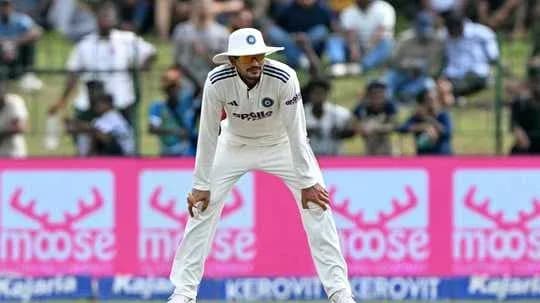
Shubman Gill stood alone at the pitch, eyes fixed on the cracks as if they might answer back. Day 5 in Colombo was barely an hour old, the first drinks break had just arrived, but the Indian captain looked miles away from the cordial ritual of sips and stretches. His team didn’t need fluids. They needed a wicket.
India were trapped in that familiar, suffocating corner that only Test cricket can paint: a fragile game state, a stubborn stand, and a clock that suddenly felt louder than the crowd.
A Different Kind of Day 5
This was Galle all over again, but with a cruel twist.
Back there, Dhananjaya de Silva and Sonal Dinusha had defied India for 90 minutes before the inevitable crack appeared. The equation was simple: take wickets, win the Test. In Colombo, the script had more layers. India still needed wickets, but now every run added to Sri Lanka’s total was also stealing time from the chase. And rain lurked as the uninvited third party.
Attack too hard, and Sri Lanka’s lead swells. Go defensive, and the overs bleed away. Somewhere between those two extremes, Gill had to live.
Sri Lanka, effectively 16 for 6, walked out with a single mission: survive. Over by over, hour by hour. Dinusha was the heartbeat of that resistance, batting with the intensity of a man who understood that his innings was the last thread holding his side together.
Gill’s Busy Morning
Gill threw the entire Test-match manual at the problem.
Spinners were used in short, sharp bursts to keep their fingers fresh and the ball fizzing. The quicks were told to bang it in, with a short leg and leg gully prowling for any miscued fend. Between deliveries, Gill was in constant motion, striding to his bowlers, shifting men a few metres this way, a few metres that way, searching for that one angle, that one plan, that might break the stand.
Early on, he looked animated, plugged in, convinced that pressure would tell.
But as the session wore on and Sri Lanka refused to budge, his shoulders began to sag. His movements slowed. The field tweaks became smaller, the conversations shorter. The more Dinusha and his partners batted, the more India’s control seemed to seep away.
The Door Opens… Just a Little
Test cricket rarely lets you off the hook easily, but it also rarely stops offering chances.
Right after Lunch, Manav Suthar finally found one. Nuwantha edged to Dhruv Jurel at second slip, and India had the opening they had been craving. Briefly, it felt like the game had shifted.
What followed was a long, grinding stalemate.
For more than two hours until Tea, India and Dinusha played out a tactical duel. India understood the equation clearly by then: Dinusha was the anchor; the path to victory lay at the other end. Every plan, every field, every spell was calibrated to expose Prabath Jayasuriya.
Fielders were shuffled dramatically to trap the No.8. Bowlers manipulated the strike, sometimes even bowling outside leg stump to Dinusha when he faced the sixth ball, just to make sure Jayasuriya took the next over. It became a quiet, ruthless game of strike rotation, and for the most part, Dinusha won it.
India did not relent. Suthar even went experimental, coming over the wicket from a diagonal angle, running between the umpire and the stumps to deliver from an awkward, almost disorienting line. It looked odd, inventive, even desperate. It did not work.
Soon, the contest slipped into that strange, superstitious zone that only long, draining days in the field can produce. Mohammed Siraj performed the now-familiar bail switch mid-over, a tiny ritual to tempt fate into changing sides.
Fate stayed put.
Dinusha and the Tail Shut the Door
Sri Lanka survived on more than just grit. They had a slice of fortune, too.
The ball was turning sharply, but Jayasuriya and Lahiru Kumara somehow kept their outside edges just out of reach. Jayasuriya lasted 28 balls, doing just enough to frustrate. Kumara went further, digging in for 90 deliveries alongside Dinusha, a partnership that slowly eroded India’s belief.
The surface, by then, was offering turn but not pace. That mattered. The slow spin allowed Dinusha to premeditate his sweeps with confidence, knowing the ball wouldn’t rush him. The tailenders could lean forward with relative security, trusting the lack of zip off the pitch.
From India’s perspective, it was the worst combination: the ball was doing enough to tease, not enough to finish.
A Captain’s Doubt, and a Nod of Respect
When it was over, Gill did not hide from the mental toll of the day, or from the questions that inevitably follow a drawn-out final act.
"It gets very frustrating," he admitted, reflecting on how the day had tested him as a captain. "Then you start questioning, was follow-on the best decision? Was it not? But then you kind of have to go back in the moment and see, what can I do? Did I take the best decision in that moment? Yes, I did. Then you can't do anything about it, you have to keep trying your best and I think we did that. We tried all that we could."
This wasn’t a collapse in discipline or a misread pitch alone. It wasn’t just about immaculate batting or benign conditions either. The truth, as it often does in Test cricket, sat somewhere in between.
For every Oval or Galle, where the script runs clean and the final day bends to the dominant side’s will, there will be a Colombo. A day when one batter reads the surface better than anyone else, when the tail hangs on just long enough, when the captain’s plans are sound but the game refuses to move.
Those are the days that strip away ego. The days when a captain has to accept that he did almost everything right, and it still wasn’t enough.
Gill did that. He swallowed the frustration, acknowledged the resistance, and tipped his hat to Dinusha.
The next time he pauses at the pitch on a tense fifth morning, the memory of Colombo will be there with him. The question is whether it hardens him, or haunts him, in the next tight finish.