.svg&w=384&q=75 "logo")
Rodrigo De Paul: From Argentina to MLS Star
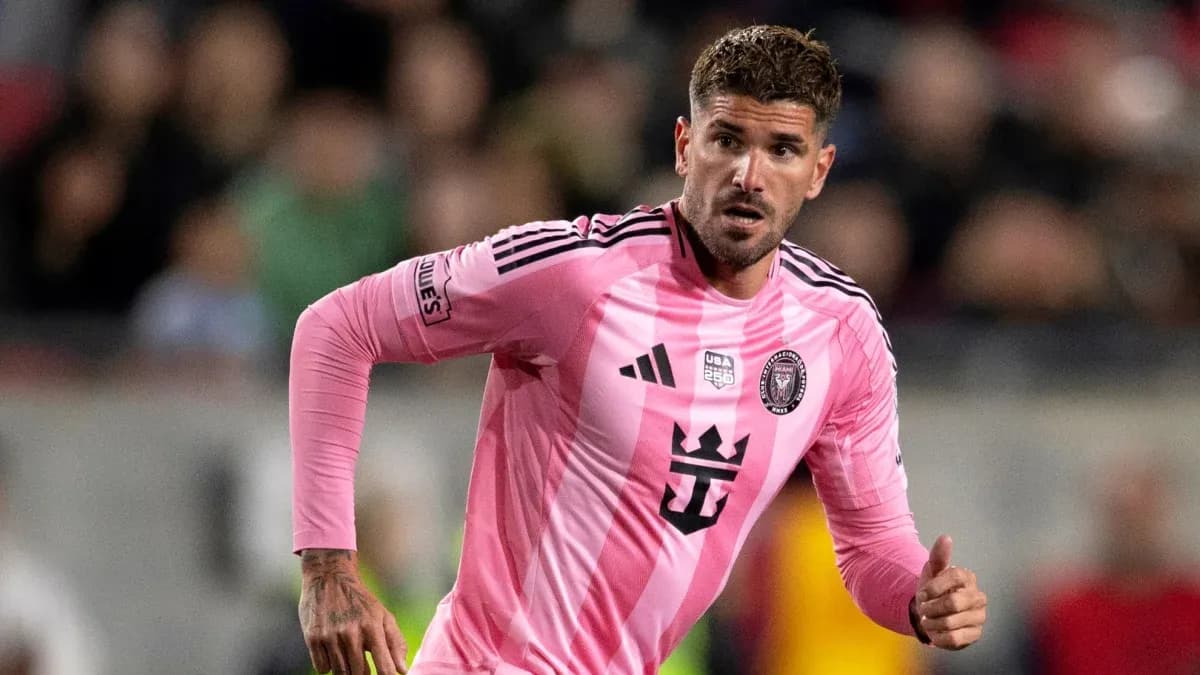
The final whistle had already gone. The scoreline, 1-1 between Inter Miami and the Chicago Fire, felt like a stalemate ready to drift into the background of a long MLS season. Then tempers snapped.
Robert Lewandowski and Ian Fray tangled, a routine late-game flare-up that usually dissolves with a few shoves and a referee’s whistle. Not this time. Rodrigo De Paul saw the push on his teammate and charged in, eyes locked on the Polish striker, body language leaving no doubt: this was personal.
The scene turned raw in an instant. De Paul went straight at Lewandowski, confronting one of Europe’s great goalscorers with the same ferocity he once reserved for Champions League nights and World Cup battles. It was a flash of the edge that has defined his career: a midfielder who runs, bites, argues, and, above all, protects.
That brief clash did more than heat up a draw in MLS. It pulled the curtain back on the journey that brought De Paul here, from Racing Club to Valencia, from Udinese to Atlético Madrid, and now to Inter Miami alongside Lionel Messi. Eleven years in European football hardened him. MLS is where that steel is now on full display.
From Avellaneda to Miami money
De Paul’s story is not the overnight riches of a viral star. It is the slow, relentless climb of a player who refused to disappear.
He started at Racing Club in Argentina, the kind of academy where talent is abundant but guarantees are not. Valencia took him to Europe in 2014. The move did not make him a superstar, but it kept him in the conversation. The real turning point came at Udinese, where five seasons in Serie A reshaped his reputation from promising attacker to all-action midfielder.
That reinvention had a price tag. Atlético Madrid paid around €35 million to sign him in 2021, a figure that underlined his rise. Four years later, Inter Miami spent roughly €14.5 million to bring him to MLS on a permanent deal. Those transfer fees went to the clubs, not to De Paul’s bank account, but the trajectory is clear: each move raised his market value, and with it his leverage at the negotiating table.
Today, that leverage is stamped all over his contract in Miami. According to MLS Players Association figures, De Paul earns a base salary of $7.57 million, with approximately $9.69 million in guaranteed annual compensation for 2026. Only two players in the league make more: Lionel Messi and Son Heung-min. In a competition increasingly defined by star power, De Paul sits firmly in the elite bracket.
Celebrity Net Worth estimates his overall net worth at $25 million. It is not an official accounting, but it fits the arc of a career built across four countries and more than a decade of top-level football, with salaries, bonuses, and endorsements layered on top of one another from Argentina to Spain, Italy to the United States.
Capology’s projections add another dimension: nearly $29.9 million in gross base salary alone over his career, before bonuses, image rights, or commercial deals are even considered. The headline numbers only tell part of the story; the grind behind them is what gives them weight.
The Messi years and the weight of a medal
De Paul’s fortune is not just financial. His footballing legacy is tied to a golden era for Argentina.
While Lewandowski has stacked up club trophies – Champions League titles, Bundesliga dominance, years of scoring at a rate that bent record books – his national team résumé with Poland lacks that defining major trophy. De Paul’s pride comes from the opposite direction.
He became the relentless engine at Messi’s side, the midfielder who ran himself to the edge of exhaustion, who filled gaps, broke lines, and never stopped snarling at opponents. That role delivered two Copa América titles, in 2021 and 2024, and the crown jewel: the 2022 World Cup.
FIFA paid the Argentine federation $42 million for that World Cup triumph. The governing body never revealed how much each player took home, and there are no verified numbers for De Paul’s individual bonuses from the Copa América wins either. The exact sums remain locked away, but the impact on his status – and his earning power – is obvious.
He carries that night in Qatar on his skin. The date of Argentina’s World Cup victory is tattooed on his neck, a permanent reminder of the moment that changed his life and cemented his place in the country’s football history.
Family, fame, and the life around the game
Away from the pitch, De Paul’s life has been just as closely watched, especially in Argentina.
He is the youngest of three sons born to Mónica Ferrarotti and Roberto De Paul. He has two children, Francesca and Bautista, from his former relationship with Camila Homs. Their family story, break-up and all, has often shared front-page space with his performances, the kind of scrutiny reserved for players who move beyond the sports pages and into celebrity culture.
His years in Europe – roughly 11 in total, from his arrival at Valencia in 2014 to his departure from Atlético Madrid in 2025 – also shaped his identity off the field. He developed a sharp interest in fashion, curated his look, and turned his body into a canvas of tattoos. The ink tells his story: the battles, the milestones, the people and moments he refuses to forget.
Now, in Miami, all those threads meet. The European-hardened midfielder. The World Cup winner. The high-earner in a league still finding its place in the global hierarchy. The father, the fashion devotee, the man whose private life has played out in public.
So when Lewandowski shoved Ian Fray and De Paul sprinted into the frame, it was not just a teammate stepping in. It was the embodiment of a career built on loyalty and confrontation, on running toward the fight rather than away from it.
The money, the medals, the tattoos – they tell one version of Rodrigo De Paul. That flash of fury in a 1-1 draw told another: in Miami, as in Qatar and Buenos Aires and Madrid, he still measures himself by how fiercely he defends the people beside him.