.svg&w=384&q=75 "logo")
Real Madrid’s Complicated Gesture of Support for Ceuta
Real Madrid’s trip to Elche was supposed to be a straightforward league assignment. It turned into something far more complicated before a ball had even been kicked.
A divided message
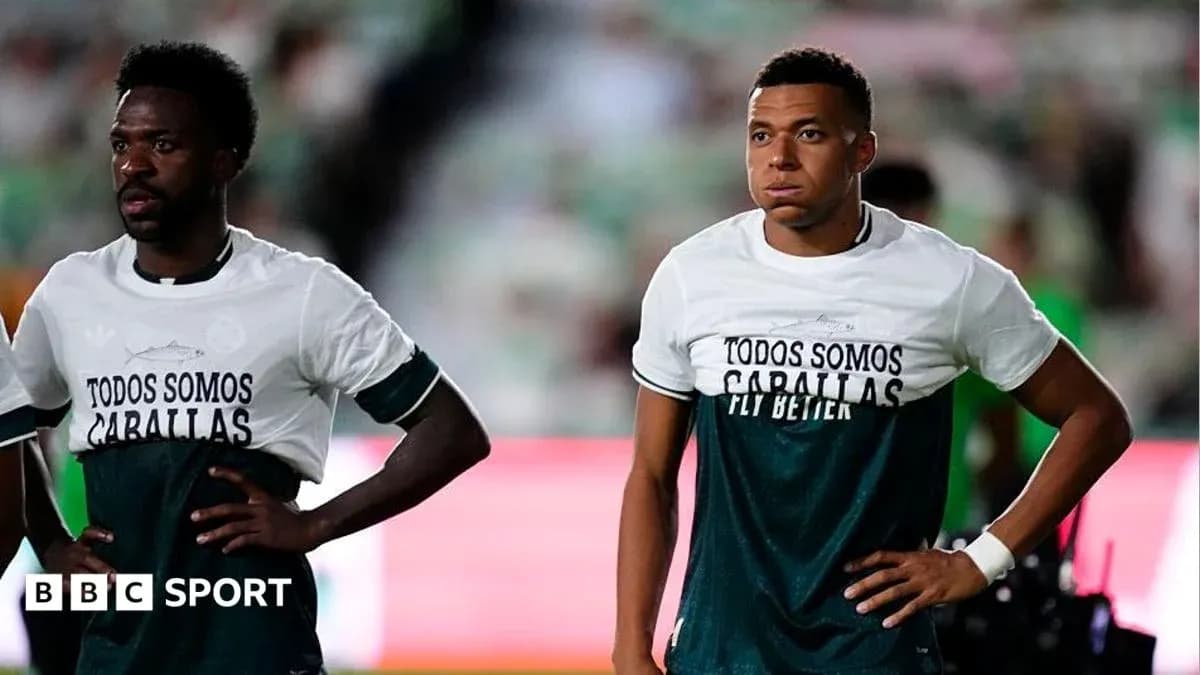
As the players emerged from the tunnel at the Martínez Valero, both teams wore white T-shirts over their kits. Across the front: “Todos somos caballas” – “We are all Ceutans” – alongside references to the Spanish autonomous city of Ceuta, perched on the North African coast opposite the Iberian Peninsula.
The idea was clear: a collective gesture of support after a severe migration crisis that has shaken the enclave. At least 72,000 migrants crossed from Morocco into Ceuta on 30 and 31 July, many of them swimming around a border fence. According to the city’s mayor, around 100 people died making that journey. Thousands more remain in makeshift camps, on streets and beaches, tensions rising as locals complain of insecurity and, in some cases, destroy shelters and block aid.
On Tuesday night, football stepped in to show solidarity. Or at least, that was the plan.
While most players wore the shirts as intended, Kylian Mbappe, Vinicius Junior and Ibrahima Konate made a different choice. All three rolled their T-shirts up to around chest height, cutting off part of the slogan and partially obscuring the campaign’s message.
Then Mbappe and Vinicius went a step further, removing the shirts altogether before the traditional pre-match handshake. Konate kept his on a little longer, still rolled, as team-mates and Elche players continued through the formalities with the message fully visible.
It was a small act in physical terms – a tug at the hem, a shirt slipped off – but in a hyper-scrutinised arena, it carried weight. The images of three of Real Madrid’s most high-profile players distancing themselves, visually at least, from a club-backed initiative were always going to travel fast.
Representatives of the players have been asked for comment. For now, the silence only sharpens the contrast between the intended unity of the gesture and the reality on the pitch.
Ceuta, crisis and the Bernabéu backdrop
This was not Real Madrid’s first public show of support for Ceuta. On 8 September, before a Champions League tie against Inter Milan at the Santiago Bernabéu, the south stand held up cards forming the city’s coat of arms. The rest of the stadium joined in with a round of applause, a coordinated display woven into a wider campaign to highlight Ceuta’s plight.
The context is grim. Although most of the tens of thousands who crossed from Morocco have since returned, around 5,000 people are still believed to be in the territory, many without proper shelter. The strain on local infrastructure, and on the patience of some residents, has been obvious. Protests, clashes, and resistance to aid deliveries have turned Ceuta into a flashpoint in Spain’s ongoing debate over migration and border control.
In that light, La Liga’s shirt initiative was meant to be simple: a rare moment of unanimity in a fragmented landscape. Players across other fixtures wore the T-shirts correctly, message front and centre. Barcelona, however, did not take part. Real Madrid did – but with visible dissent from within their own ranks.
The split underlined an awkward truth about modern football: clubs can align themselves with causes, but players, as global brands and individuals, may not always follow in lockstep.
Drama on the pitch
Once the political and social subtext faded into the background and the whistle went, the match itself delivered a different kind of drama.
Real Madrid, as so often, surged ahead. Mbappe was among the scorers, adding his name to a contest that seemed, for a while, to be sliding into routine territory for Carlo Ancelotti’s side. Vinicius started, stretching Elche’s back line, and Madrid built what looked like a comfortable two-goal cushion.
Then they let it slip.
Elche fought back, capitalising on Madrid’s lapse in intensity to drag themselves level. A 2-0 lead became 2-2, the home crowd roaring into life as the champions-in-waiting suddenly looked rattled. What had begun as a controlled away performance turned into a scrap, Madrid chasing a winner that had once felt unnecessary.
The pressure finally told. Deep into stoppage time, Carlos Espi struck, snatching a 3-2 victory for Madrid and ripping the air out of the Martínez Valero. A chaotic night ended with three points heading back to the capital, the league leaders surviving a scare of their own making.
A campaign with fault lines
By the final whistle, the scoreboard said Madrid had done their job. The story of the night, though, refused to stay neatly confined to goals and comebacks.
The pre-match T-shirts laid bare the fault lines in a campaign that had aimed for unanimity. Some players embraced the message fully. Others, very visibly, did not. Barcelona stayed outside the initiative altogether. Across La Liga, approaches varied, the supposed single voice for Ceuta breaking into a chorus of different tones.
In a season already loaded with political undertones, from regional tensions to questions over the role of clubs in social debates, Real Madrid’s uneasy gesture at Elche added another layer. The club’s stance on Ceuta is clear; the image of three of its stars rolling up or discarding the symbol of that stance is just as clear.
The points are in the bag. The questions about where players and clubs draw their own lines will linger far longer.