.svg&w=384&q=75 "logo")
Percy Fender’s 35-Minute Century: Cricket’s Untouchable Record
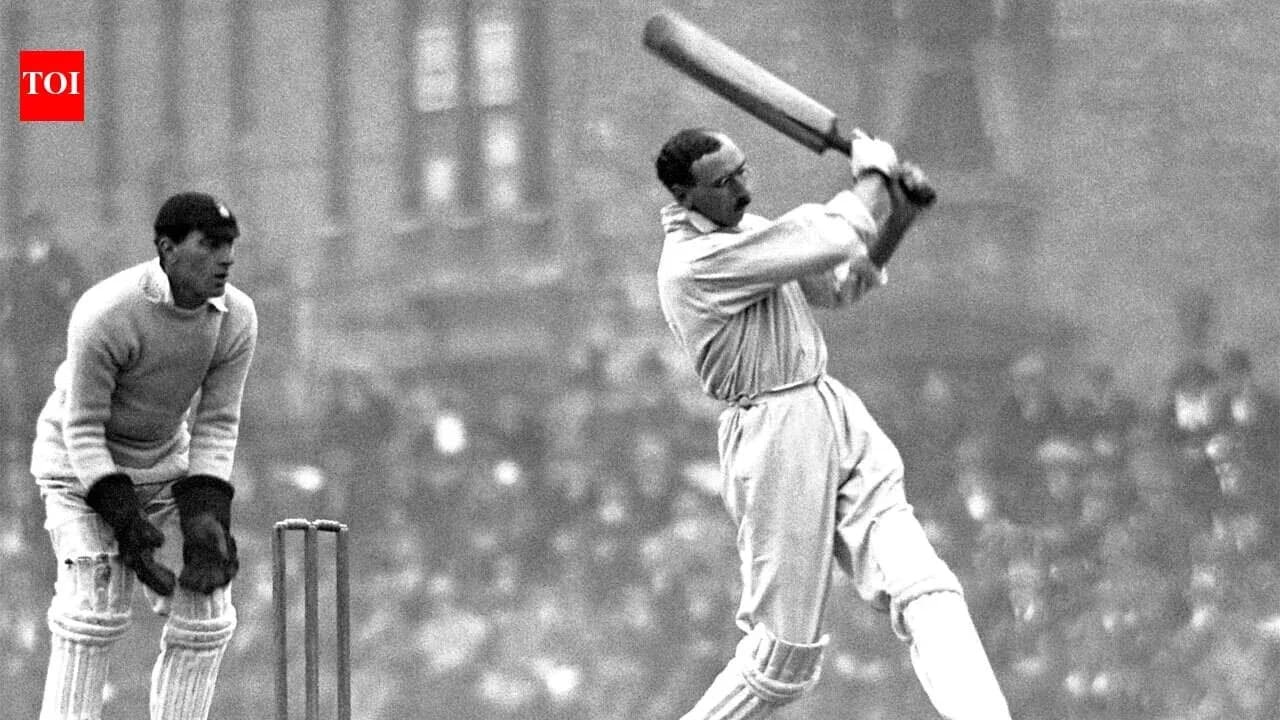
The clock has ticked on for more than a century, yet nobody has beaten Percy Fender’s race against time.
On August 26, 1920, four days after his 28th birthday, the Surrey all-rounder walked out at Northampton and detonated one of the most ferocious innings the first-class game has ever seen. In 35 minutes at the crease, he turned a solid County Championship match against Northamptonshire into a landmark that still stands as the fastest authentic first-class century by time.
Not by balls faced. By the old measure: pure, relentless minutes.
A Championship Match Turns Into Theatre
The day did not begin with chaos. Northamptonshire had done the hard work first, posting 306, anchored by 128 from Fanny Walden. Fender had already played his part with the ball, taking three wickets, the familiar figure in the Surrey attack doing his job.
Surrey’s reply wobbled. At 160 for four, with Andy Sandham gone for 92, the innings teetered between respectability and waste. Then Andy Ducat and Alan Peach seized control. They added 288 in just 135 minutes, Ducat marching to 149 in an alliance that dragged Surrey not just out of trouble but into dominance.
When Ducat finally departed, the stage cleared. Fender walked in.
What followed belonged to another tempo entirely.
He did not settle. He launched. From the outset, he drove through the line, slashed square, pulled with violence. Northamptonshire’s bowlers, who had watched Ducat and Peach grind them down, suddenly faced a man intent on shredding them.
Fender’s fifty arrived in 19 minutes. Nineteen. The field scattered, but it barely mattered. He kept swinging, kept finding the rope, kept turning a strong position into a rout.
Gilbert Jessop had set the previous benchmark for speed: a century in 40 minutes for Gloucestershire against Yorkshire at Harrogate in 1897, an innings that became part of cricket folklore. Fender ripped five minutes off that mark. In a sport that often measures change in inches and degrees, he carved out a gulf.
He reached his hundred in 35 minutes.
Boundaries, Not Singles
He did not stop there. Records often freeze a moment, but Fender’s onslaught kept rolling.
He finished unbeaten on 113, compiled in just 42 minutes. The numbers are stark: 16 fours, five sixes. Ninety-four of his 113 runs came in boundaries. More than 83 per cent of his total was carved in fours and sixes, a scoring pattern that would look outrageous even on a modern T20 scorecard.
At the other end, Peach kept churning away, quietly assembling a monumental double-century. When he reached 203 not out, Surrey declared. The sixth-wicket partnership between Peach and Fender had thundered to 171 runs in only 42 minutes, an almost cartoonish scoring rate for the era.
Yet the essence of Fender’s record lies not in strike-rate, nor in balls faced. The stopwatch is the judge. This is a record rooted in elapsed time at the crease, an older, purist way of measuring how quickly a batter can dismantle an attack.
That distinction matters.
When Records Don’t Quite Count
For 63 years, nobody got near Fender’s 35-minute standard in any credible sense. Then, in 1983, Steve O’Shaughnessy of Lancashire appeared to have matched him.
On paper, the story looked similar. O’Shaughnessy hammered a century in 35 minutes against Leicestershire. His name joined Fender’s in the record columns. But the reality on the field told a different tale.
The match had been mangled by bad weather. Time was short. Both sides needed to contrive a finish. After Leicestershire declared, O’Shaughnessy and Graeme Fowler walked out to face an “attack” that featured David Gower and James Whitaker, both part-time bowlers, both with other priorities in mind.
What followed was described as farcical. Gower and Whitaker sent down full tosses and long hops. The boundary ropes were close enough to tempt even the cautious. Fowler took full advantage, blasting 100 with 10 sixes. O’Shaughnessy joined the fun and raced to three figures in the same 35-minute window that defined Fender’s feat.
The scoreboard loved it. The record books did not.
This was cricket as negotiation, not contest. Declarations needed to be engineered, overs needed to be burned, a result needed to be manufactured. The bowling was deliberately friendly, the conditions artificially tilted towards run-making. The runs counted in the match. The “record” did not.
The Era of Manufactured Mayhem
O’Shaughnessy was only the beginning. Once captains realised how to game the system, the numbers became even more extreme.
Glen Chapple thrashed a century in 21 minutes for Lancashire against Glamorgan in 1993. Mark Pettini reached three figures in 24 minutes for Essex against Leicestershire in 2006. Michael Goodwin and Tom Moody produced hundreds in 25 and 26 minutes respectively.
On raw timing alone, they obliterated Fender.
But the context was the same: contrived declarations, part-timers lobbing hittable deliveries, captains trying to claw back time after rain or slow over rates. County cricket in the three-day era often relied on such deals to force a result. Bowlers became sacrificial, fields scattered, and what should have been a contest turned into a hitting drill.
Officially, the runs are there in the scorecards. Unofficially, the record-keepers draw a line. They treat these blitzes as staged, unsuited to comparison with an innings carved out against a full attack in a genuine competitive situation.
That is why Fender’s 1920 assault still stands as the benchmark. His 35 minutes were not negotiated. They were imposed.
Fastest – But By What Measure?
There is another layer to the debate.
Change the metric from minutes to balls faced and the landscape shifts. By that standard, the fastest first-class century belongs to David Hookes, who tore 102 from just 34 balls for South Australia against Victoria in 1982. In Test cricket, the quickest hundred by deliveries is Brendon McCullum’s 54-ball blitz for New Zealand against Australia in Christchurch in 2016.
Those innings live in a different category: modern aggression, fielding restrictions, heavier bats, and a game that has learned to live at a higher tempo.
Yet by elapsed time, under authentic first-class conditions, Fender remains untouched. No legitimate innings has bettered his 35-minute charge at Northampton. Not Hookes, not McCullum, not the county slog-fests of the late 20th century.
More than 100 years on, the sport has changed its formats, its rhythms, even its vocabulary. But on a quiet line in the record books, Percy Fender still owns the clock.